
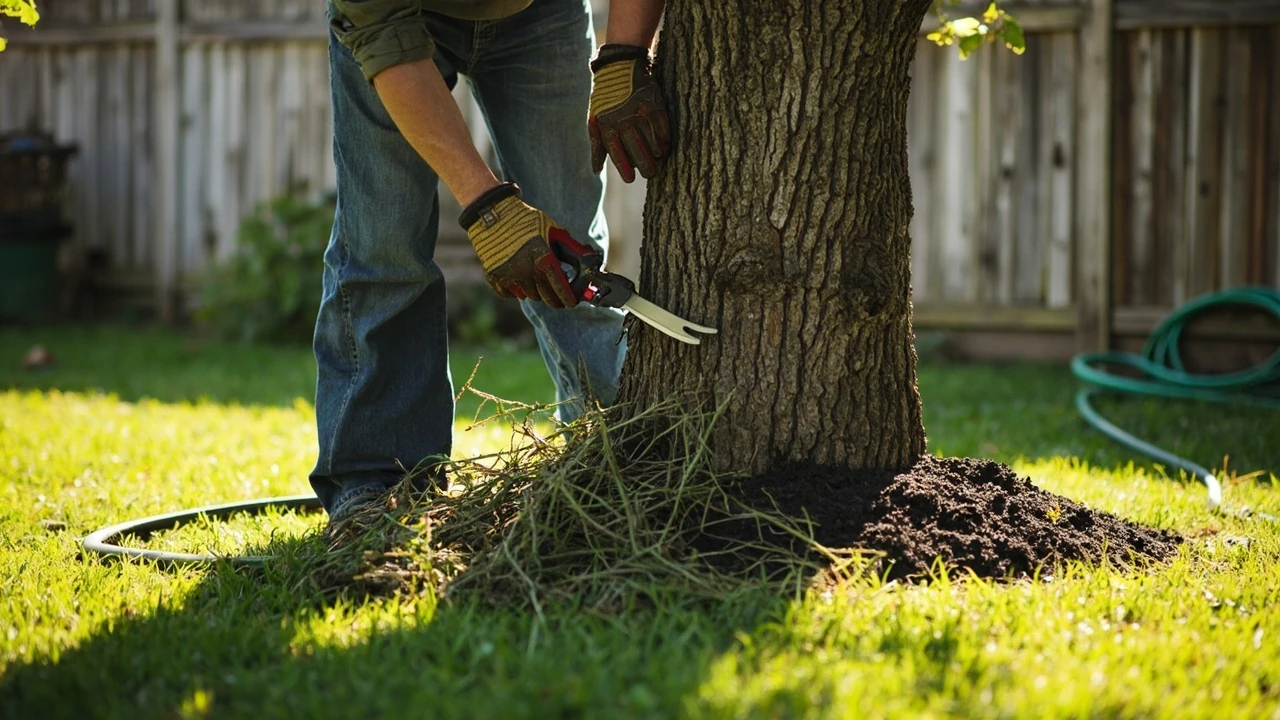
Tree maintenance for homeowners: what actually matters and when
A mature shade tree can add character, shade, and resale value to a home, but the same tree can drop a limb onto a roof, push a sidewalk up, or hollow out until a storm snaps it in half. Most of those outcomes are not bad luck. They are the predictable result of years without any tree maintenance at all, followed by a single weather event that exposes the weakness. The good news is that routine care does not have to be complicated or expensive, and most of it can be done with a pair of pruners, a garden hose, and a willingness to look at the tree once a season.
This guide walks through what tree maintenance really means for a homeowner, which tasks you can do yourself, which ones belong to a certified arborist, and how to plan the work across the year so the tree stays healthy and the people and property around it stay safe.
What tree maintenance actually includes
Tree maintenance is an umbrella term for the small, recurring tasks that keep a tree structurally sound, biologically healthy, and appropriately sized for the space it lives in. It is not the same as tree removal, and it is not the same as landscaping. Landscaping is about how the yard looks. Tree maintenance is about the long-term condition of a single living organism that happens to be rooted in your yard.
In practical terms, tree maintenance covers five recurring activities:
- Inspection. Walking around the tree a few times a year and looking for dead limbs, cracks, fungal growth, leaning, root exposure, and changes from one season to the next.
- Pruning and trimming. Removing dead, damaged, diseased, or crossing branches to reduce the risk of failure and open the canopy to light and air.
- Watering. Supplementing rainfall during drought, especially for young or recently planted trees whose roots have not yet reached deeper moisture.
- Mulching. Maintaining a 2- to 4-inch layer of organic mulch over the root zone, kept clear of the trunk, to conserve moisture and protect roots.
- Fertilizing. Adding nutrients to the soil when a soil test or visible symptoms suggest a real deficiency, rather than on a fixed schedule.
Some sources fold in pest and disease monitoring, structural support such as cabling and bracing, and protection during nearby construction. Those are real parts of tree maintenance too, but they tend to be situational rather than routine, so they get their own sections later in this guide.
Why routine tree maintenance is worth the effort
Homeowners often treat tree maintenance as something to do only when a branch falls or a neighbor complains. The case for doing it on a schedule is not abstract. It comes down to three things that actually affect your house and your budget.
Safety
A neglected tree is the single most common cause of large-limb failures on residential property. Dead branches, included bark, internal decay, and root plate movement do not announce themselves. A regular visual check, paired with timely pruning of the obvious problems, is the cheapest way to keep a 60-foot tree from ending up in a bedroom.
Property protection
Trees that overhang a roof shed leaves into gutters, drop limbs onto shingles, and rub against siding in the wind. Roots that lift a sidewalk or push into a foundation drain can quietly cost thousands of dollars in repairs. Routine tree maintenance keeps the canopy where you want it and the roots where they belong.
Tree health and lifespan
A tree that is pruned at the right time, watered through drought, and mulched properly will outlast an ignored tree of the same species by decades. Pruning in particular reduces the chance of disease by removing infected wood before pathogens spread and by opening the canopy so foliage dries quickly after rain.
The five core tasks, explained one at a time
Each task below is something a homeowner can either do or supervise. The goal is to understand what good practice looks like, not to memorize a horticultural manual.
Inspection
Inspection is the foundation. Without a baseline, you cannot tell whether a change is new or has been there for years. Twice a year, in late spring after leaf-out and in late fall after leaf drop, walk the tree from a short distance and look at it as a whole, then step in and look at the trunk, branch unions, and root flare.
Useful things to look for include dead branches with no leaves during the growing season, cracks or seams in the trunk, mushroom or conk growth on the bark, cavities, sudden lean, exposed roots, and soil mounded up around the trunk. Take phone photos from the same spots each year so you have a visual record.
Pruning and trimming
Pruning is the removal of specific branches for a reason: deadwood removal, structural training of a young tree, clearance over a roof or sidewalk, or thinning to reduce wind resistance. Trimming is often used loosely to mean the same thing, though some people reserve it for shaping hedges. For tree maintenance, treat the two as one task.
Two practical rules matter most. First, never remove more than about a quarter of a living canopy in a single season. Trees need their leaves to feed their roots, and heavy pruning in one pass can starve the tree. Second, cut just outside the branch collar, the slightly swollen area where a branch meets the trunk or a larger limb. Flush cuts and stubs both heal poorly and invite decay.
Most routine pruning on small to medium trees is well within the reach of a careful homeowner with sharp bypass pruners, a pole pruner, and a pruning saw. Anything that requires a chainsaw, a ladder in the canopy, or a rope is a job for a professional.
Watering
A mature tree with a deep, established root system can usually survive on rainfall alone, except in a serious drought. A young tree, defined roughly as anything planted within the last three to five years, cannot. Its roots are still in the original root ball or just beyond it, which dries out faster than the surrounding soil.
For a young tree, a slow, deep soak once a week during the growing season is more useful than a light daily sprinkle. A soaker hose laid in a ring over the root zone, run for an hour or two, gets water down where the roots actually are. Mature trees only need supplemental water during prolonged drought, and even then the goal is to wet the soil to a depth of about a foot rather than to flood the surface.
Mulching
Mulch is one of the cheapest and most effective parts of tree maintenance. A 2- to 4-inch layer of shredded hardwood or pine bark over the root zone insulates the soil, slows evaporation, suppresses grass that would compete for water, and breaks down slowly into organic matter that feeds the tree.
The common mistake is the volcano mulch look, where mulch is piled high against the trunk. That traps moisture against the bark, encourages rot, and can hide root flare problems. Keep mulch a few inches away from the trunk and extend it out to roughly the dripline, or as far as is practical for a small yard.
Once a year, in early spring, rake back the old mulch, check the root flare, and lay down a fresh layer within the same depth range.
Fertilizing
Fertilizer is the part of tree maintenance that homeowners most often get wrong, usually by applying too much of the wrong product on a fixed schedule. A healthy tree in reasonable soil rarely needs supplemental fertilizer. When it does, the trigger should be a soil test or visible symptoms such as pale leaves, stunted growth, or chlorosis, not the calendar.
If a soil test shows a real deficiency, a slow-release product applied in late fall or early spring, spread over the root zone and watered in, is the standard approach. Slow-release nitrogen in particular is less likely to burn roots than a quick-release lawn fertilizer.
When to do each task: a seasonal tree maintenance calendar
For a thorough look at the property-side considerations around tree care, including how construction, insurance, and long-term planning fit together, the homeowner overview of routine tree care from Nationwide is a useful starting point. It is written for a general audience, so the specific recommendations are conservative, but the framing of tree maintenance as a safety and property issue rather than just a cosmetic one is consistent with what most arborists will tell you on a site visit.
Trees respond to seasons, and so should your maintenance. The table below is a general guide for temperate climates in the United States. Adjust by two to four weeks if you live in the deep South or the upper Midwest.
| Season | Priority tasks | Why this timing |
|---|---|---|
| Late winter (dormant) | Structural pruning of deciduous trees, removal of deadwood, inspection of winter damage | No leaves means you can see the structure, and the tree is not actively growing so cuts stress it less |
| Early spring | Refresh mulch, soil test if growth was poor last year, plant new trees | Soil is workable, roots wake up before leaves, and new trees get a full season to establish |
| Late spring | First inspection walk, monitor for pests and disease, begin supplemental watering for young trees | Leaves are out so you can see canopy gaps, and dry season often starts in June |
| Summer | Water deeply during dry spells, watch for storm damage, light pruning only of suckers and water sprouts | Heat stress is the main risk; heavy pruning now can attract pests and sunscald |
| Early fall | Second inspection walk, plant new trees, light cleanup of deadwood | Cooler weather reduces transplant shock, and you can see stress before leaves drop |
| Late fall | Final mulch check, protect young trees from rodent and mechanical damage, plan dormant pruning | Trees are going dormant; cleanup now prevents winter problems |
The key idea is that most heavy work happens in late winter, when the tree is asleep and the structure is visible. Everything else is mostly inspection, watering, and small adjustments.
Pruning basics: cuts, timing, and what to leave alone
Pruning is the part of tree maintenance that most affects both safety and appearance, so it is worth a closer look. There are four common reasons to prune a tree, and each one has a slightly different approach.
Deadwood removal
Dead branches are the most common pruning target on a mature tree. They are also the safest place to start, because removing deadwood cannot hurt a living tree. Dead branches are brittle, snap easily in wind, and can be hard to spot once leaves drop, so many homeowners wait for late winter when dead branches stand out against the sky.
Structural pruning of young trees
Young trees benefit from formative pruning, the kind that establishes a strong central leader, well-spaced scaffold branches, and good attachment angles. This is the only pruning where it makes sense to remove living wood on purpose, because the goal is to set the structure for the next fifty years. Once a tree is mature, structural pruning is mostly a correction for problems that should have been addressed earlier.
Thinning for light and air
Selective thinning, removing a small number of inner branches to open the canopy, can reduce disease pressure by helping foliage dry faster and improving light penetration. It is also useful on trees close to a house, where reducing wind resistance in the canopy lowers the risk of a whole-tree failure in a storm.
Crown raising for clearance
Crown raising, removing the lowest branches to provide clearance over a sidewalk, driveway, or roof, is a common residential need. It is also a place where it is easy to over-prune. A good rule is to leave at least two thirds of the total tree height as live crown. Removing more than that can starve the roots and trigger a flush of weak, weakly attached water sprouts.
| Pruning type | Best timing | Typical limit | Common mistake to avoid |
|---|---|---|---|
| Deadwood removal | Any time the branch is identifiable | No upper limit, remove what is dead | Leaving deadwood that overhangs a roof or walkway |
| Structural pruning on young trees | Late dormant season | No more than 25 percent of live canopy in one year | Topping the tree to control size |
| Thinning for light and air | Late dormant season | 10 to 15 percent of live canopy in one pass | Removing too much interior wood and leaving a thin shell of leaves at the tips |
| Crown raising for clearance | Late dormant season | Keep at least two thirds of height as live crown | Lifting too high and creating a weak, top-heavy tree |
Watering, mulching, and fertilizing compared
These three tasks are often lumped together as “tree feeding,” but they do very different things. Mixing them up is one of the more common mistakes in routine tree maintenance.
| Task | What it actually does | How often to do it | Easy mistake to avoid |
|---|---|---|---|
| Watering | Replaces soil moisture lost to evaporation and transpiration | Weekly deep soak for young trees in dry weather; only during drought for mature trees | Daily shallow sprinkling that wets only the surface |
| Mulching | Insulates roots, conserves soil moisture, suppresses competing grass, adds organic matter as it breaks down | Refresh once a year, 2 to 4 inches deep, kept off the trunk | Piling mulch against the trunk in a volcano shape |
| Fertilizing | Adds nutrients, mainly nitrogen, phosphorus, and potassium, that the soil is missing | Only when a soil test or symptoms show a deficiency | Applying on a calendar without knowing what the soil actually needs |
For most residential trees in reasonable soil, mulching and watering will do more for tree health than any fertilizer you can buy.
Recognizing when a tree needs an arborist, not a homeowner
Some tree maintenance tasks are genuinely dangerous or technically demanding, and the right move is to call a certified arborist. The list below covers situations where DIY work is a bad idea, regardless of how handy you are.
- Large deadwood in the canopy. Anything bigger than your thumb that is more than head height off the ground generally needs a professional with a pole saw, climbing gear, or a bucket truck.
- Limbs touching or close to utility lines. This is a job for the utility or a qualified line-clearance arborist, never a homeowner with a pole pruner.
- Significant lean or recent root plate movement. If a tree has shifted visibly after a storm, the failure risk is high, and the right next step is a professional assessment rather than a hurried pruning job.
- Major cavities, fungal conks, or extensive decay. A certified arborist can do a more thorough evaluation, including sounding and, in some cases, resistograph testing, and recommend cabling, bracing, or removal.
- Trees close to a structure that need size reduction. Reduction cuts require experience to avoid leaving the tree worse than before.
A good rule of thumb: if the work involves both feet leaving the ground, a chainsaw, or a rope, it is no longer a maintenance task. It is a tree care job, and it belongs to someone with training, insurance, and the right equipment.
Construction, soil compaction, and root protection
One of the most overlooked parts of tree maintenance is what happens around the tree, not on it. Homeowners often plan a new patio, driveway, or addition without thinking about the mature trees nearby, and the damage shows up years later as a slow decline that is hard to connect to the building project.
Two specific risks come up again and again. First, soil compaction from heavy equipment or even from routinely parking a car in the same spot under a tree reduces the air space in the soil and limits root growth. Second, grade changes, even a few inches of added soil over the root zone, can smother feeder roots and lead to a gradual dieback in the canopy.
If you are planning work near a tree you want to keep, mark off a critical root zone, roughly the area under the dripline, and keep vehicles, stored materials, and trenching out of it where possible. A short conversation with the contractor about which areas to avoid is far cheaper than replacing a mature tree ten years later.
Common tree maintenance mistakes and how to avoid them
Most of the tree problems a homeowner ends up paying to fix started as a small, well-intentioned mistake that was repeated for years. The list below is not exhaustive, but it covers the patterns that come up over and over.
- Topping the tree. Cutting the crown back to a flat plane at a set height produces a flush of weakly attached water sprouts, sunscald on exposed limbs, and a tree that is more dangerous in a storm than it was before. Reduction cuts that preserve the natural form are the correct alternative.
- Leaving branch stubs. A cut made too far from the branch collar leaves a stub that the tree cannot seal over, which becomes an entry point for decay and insects.
- Mulch volcanoes. Piling mulch against the trunk keeps the bark wet, encourages rot, and can hide root flare issues that would otherwise be obvious.
- Over-fertilizing. Pushing a tree with nitrogen to make it grow faster often produces weak, succulent growth that is more attractive to pests and more vulnerable to breakage.
- Ignoring young trees. The first three to five years are when a tree is most vulnerable to drought, mechanical damage, and poor pruning decisions. Skipping tree maintenance during that window is the most common reason newly planted trees fail.
- Removing a tree that could have been saved. Some decline is reversible. A certified arborist can sometimes rescue a tree that a homeowner has already written off, which is worth at least one consultation before scheduling a removal.
Pest and disease monitoring for homeowners
You do not need to be an entomologist or a plant pathologist to do useful monitoring. The goal is to catch obvious changes early and call a professional when something does not look right. A short list of things worth looking for in a routine inspection walk:
- Sudden yellowing, browning, or wilting of leaves during the growing season, especially when the rest of the tree looks fine.
- Unusual leaf spots, powdery coatings, or curling that was not there the previous year.
- Sap oozing from the trunk or branches, with or without sawdust-like frass.
- Mushrooms, conks, or bracket fungi on the trunk or large limbs, which often indicate internal decay.
- Sudden dieback of a single large branch, which can mean a problem with that specific limb or with the root system on one side of the tree.
Because pest and disease pressures vary a lot by region, your state forestry agency or a local cooperative extension office is usually the best place to confirm what is normal and what is not. Take clear photos and a sample if you can do so safely.
When tree removal is the right answer
Sometimes the correct end of a tree maintenance plan is removal. A tree that is structurally compromised, severely diseased, in active decline, or sitting in a position where its failure would damage a home or a person is no longer an asset. It is a liability, and removing it on your schedule is far better than losing it in a storm on the weather’s schedule.
Signs that point toward removal rather than more maintenance include a large cavity that takes up more than a third of the trunk’s diameter, extensive fungal conks on the trunk or main stem, a sudden or progressive lean, root plate heaving, and major dieback that has continued for more than one growing season despite reasonable care. Any of those warrant an in-person evaluation by a certified arborist.
Putting it into practice: a simple annual tree maintenance plan
If all of the above feels like a lot, the plan below reduces it to a short checklist that a homeowner can actually follow. Run it once a year, ideally in late winter for deciduous trees and during the dormant season for evergreens, and adjust based on what you find.
- Walk the tree from all sides, at a distance and then up close. Note any dead branches, cracks, cavities, conks, lean, or root exposure.
- Remove deadwood you can reach safely from the ground with hand tools.
- Prune any branches that rub the roof, hang over a walkway, or block a driver or pedestrian sightline, up to a safe working height.
- Refresh mulch to a depth of 2 to 4 inches, keeping it a few inches away from the trunk.
- Check stakes and ties on young trees. Remove stakes after one or two growing seasons if the tree is stable.
- Water young trees weekly during dry weather; only water mature trees during a real drought.
- Schedule a professional inspection every three to five years for mature trees, and immediately if you notice a sudden change.
Trees that get this level of attention rarely develop the kind of structural problems that lead to emergency calls after a storm, and they tend to live longer, look better, and add more to the property than trees that are left alone until something goes wrong.
Frequently asked questions
How often should tree maintenance be done?
For most residential trees, a light inspection twice a year and a single round of routine pruning in late winter is enough. Young trees benefit from more frequent attention, especially watering during the first three to five years, and mature trees benefit from a professional inspection every three to five years even if nothing is obviously wrong.
What is the best time of year to prune most trees?
Late winter, while the tree is dormant, is generally the best window for structural pruning of deciduous trees. The absence of leaves makes the branch structure easier to see, and cuts stress the tree less than they would during active growth. Spring-flowering trees are an exception and are usually pruned right after they finish blooming so you do not remove the current year’s flower buds.
Can I prune a tree myself or do I need an arborist?
Ground-level work with hand pruners, a pole pruner, and a pruning saw is well within the reach of a careful homeowner, as long as the cuts are made just outside the branch collar and no more than about a quarter of the live canopy is removed in one season. Anything that requires climbing, a chainsaw, working near utility lines, or removing large limbs is a job for a certified arborist with insurance and the right equipment.
How much water does a tree actually need?
Young trees need roughly an inch of water per week during the growing season, delivered as a slow, deep soak rather than daily light sprinkling. Mature trees with established root systems can usually rely on rainfall alone, except during a real drought, when the goal is to wet the soil to a depth of about a foot every week or two until conditions improve.
Is mulch really necessary, and what kind should I use?
Mulch is one of the most useful parts of routine tree maintenance because it conserves soil moisture, moderates soil temperature, and suppresses grass that would compete with the tree for water. Shredded hardwood or pine bark at a depth of 2 to 4 inches, kept a few inches away from the trunk, works well for most species. Avoid piling mulch against the bark and avoid using fresh wood chips in thick layers, which can temporarily tie up nitrogen as they break down.
How do I know when a tree has to be removed instead of pruned?
Removal is usually the right call when the tree has a large cavity that takes up a significant share of the trunk, multiple fungal conks on the trunk or main stem, a sudden or progressive lean, root plate movement, or major dieback that has continued for more than one growing season despite reasonable care. A certified arborist can do an in-person evaluation and tell you whether the tree is worth saving.
Do trees near a house need more maintenance than trees out in the yard?
Yes. Trees close to a structure need more frequent attention because the consequences of a failure are higher. That usually means keeping the canopy thinned for wind resistance, raising the crown for clearance over roofs and walkways, watching for root growth near foundations and drains, and inspecting the tree more often for the kind of structural defects that matter most when a target is below.
What is the difference between pruning and trimming?
In residential tree care the two words are often used interchangeably. Pruning usually refers to selective removal of specific branches for a clear reason, such as deadwood removal, structural correction, or clearance. Trimming is sometimes used more loosely for shaping or for cutting hedges. For a shade or ornamental tree, the underlying technique is the same: clean cuts just outside the branch collar, with a clear purpose for each cut.
Can routine tree maintenance really prevent storm damage?
No maintenance program can make a tree stormproof, but a well-maintained tree is significantly less likely to drop a large limb or fail at the trunk in a typical storm. Thinning the canopy to reduce wind resistance, removing deadwood before it has a chance to fall, and catching structural defects early are the three things that matter most, and all three are routine parts of an annual tree maintenance plan.
Is it worth paying for a professional tree maintenance plan?
For a yard with one or two mature trees close to a house, a written maintenance plan from a certified arborist is usually worth the cost. It gives you a baseline, a prioritized list of work, and a record that is useful if you ever sell the house or file an insurance claim. For a yard with mostly young or small trees, an annual walk-through with a local arborist is usually enough.
Leave a Reply