
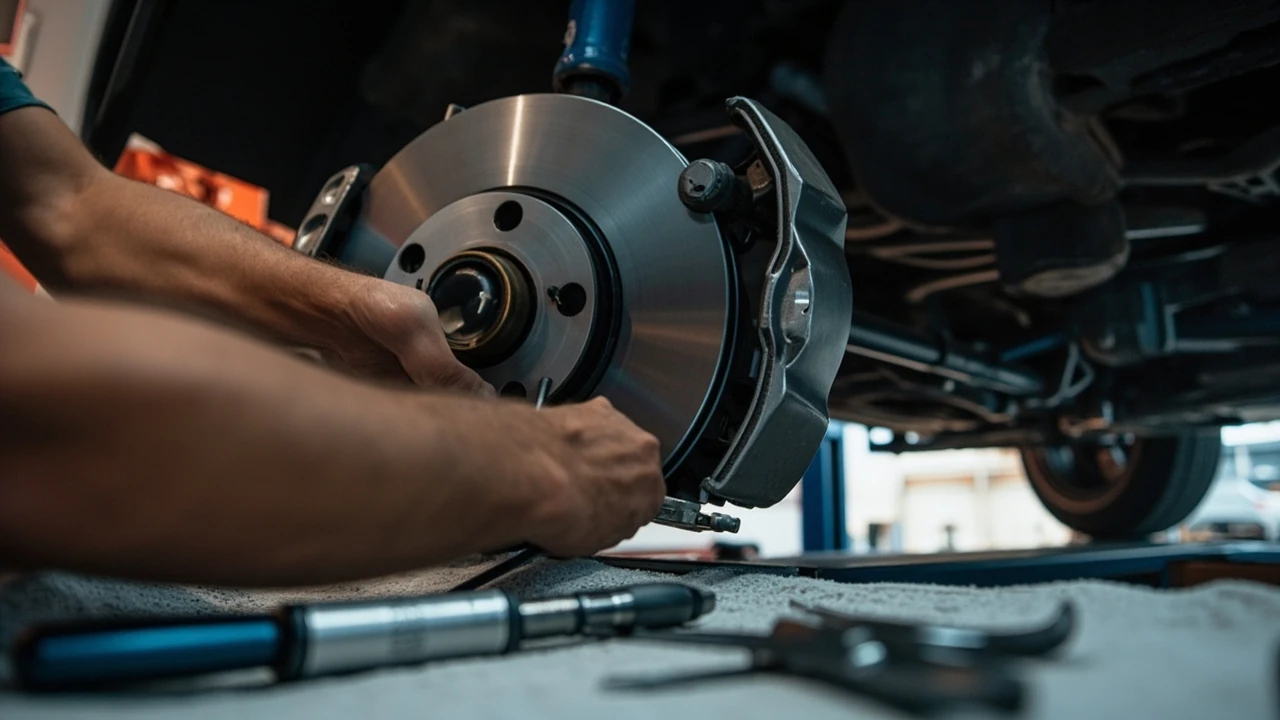
Brake services: what a proper shop actually does during a brake job
You press the pedal, the car slows, and most drivers never think about what happens between that foot pressure and a stopped vehicle. Then a warning light appears, a squeal starts at low speed, or the pedal sinks toward the floor, and the same drivers suddenly want a clear answer about what brake services should include, what they cost, and whether the shop is recommending the right work. This guide is built for that moment: the one where you have a real vehicle problem and need to understand the job before you sign a work order.
Brake services is a broad term that covers inspections, fluid service, pad and shoe replacement, rotor and drum machining or replacement, caliper and hose work, and the electronic diagnostics tied to anti-lock and stability systems. The goal here is not to teach you to overhaul a brake system in your driveway. The goal is to give you enough working knowledge to read a shop’s estimate, judge whether the recommendations make sense for your vehicle, and ask the right follow-up questions when something does not add up.
Why brake services matter more than most drivers realize
A modern passenger car or light truck uses a hydraulic brake system that converts pedal force into clamp force, which then uses friction to convert kinetic energy into heat. That last step is doing enormous work. A typical family vehicle traveling at 60 mph carries enough kinetic energy to boil a small pot of water every time it makes a panic stop. The components that handle that energy wear out on a predictable schedule, and they wear faster when the vehicle is driven in stop-and-go traffic, carries heavy loads, or lives in a region with steep grades.
Skipping or delaying brake services does not just create noise. Worn pads can score rotors, contaminated fluid can damage ABS modulators, a seized caliper can overheat and ignite, and a soft pedal can lengthen stopping distance at exactly the moment a driver needs the shortest stop possible. According to the Insurance Institute for Highway Safety, braking capability and stability under braking are two of the central factors in the agency’s evaluations of crashworthiness and crash avoidance, which is why the condition of the brake system is treated as a primary safety system rather than routine maintenance.
What a thorough brake inspection actually covers
A real inspection is more than a quick look through the wheel. On most vehicles, a technician will remove the wheel, measure pad and shoe friction material thickness, check rotor or drum surface condition, measure rotor thickness and runout, inspect caliper slide pins and pistons, examine flex hoses and hard lines, and read live data from the ABS module. The technician is also listening for uneven wear patterns that point to a stuck caliper, a worn bushing, or a dragging emergency brake.
You should expect a written report that lists friction material thickness in millimeters, rotor thickness and minimum specification, brake fluid condition, and any visible leaks. If a shop hands you a quote without those numbers, ask for them. Measurements are the difference between a real inspection and a sales pitch.
Common brake services a typical driver will actually need
Most drivers encounter the same handful of services over the life of a vehicle. The table below summarizes the work, the typical trigger, and the components that should be replaced together when possible.
| Service | Typical trigger | Components normally addressed |
|---|---|---|
| Brake pad replacement (front or rear) | Friction material at 2 to 3 mm, squeal, or warning light | Pads, shims, slide hardware, sensor wires |
| Rotor replacement or machining | Scoring, thickness below minimum, thickness variation, or warp symptoms | Rotors, retaining hardware, and a careful pad swap to bed in new surfaces |
| Brake fluid flush | Manufacturer interval, usually every 2 to 3 years, or any moisture test failure | Old fluid, sometimes a bleed of the ABS modulator |
| Caliper replacement | Stuck piston, leaking seal, uneven pad wear | Caliper, pads, and often the flexible hose |
| Brake hose replacement | Cracked, swollen, or leaking flexible hose | Hose, fresh fluid, and a re-bleed |
| Drum brake service | Rear drum systems on trucks and older sedans | Shoes, wheel cylinder, springs, and drum surface |
| ABS diagnostics and repair | ABS warning light, traction control light, or scan tool codes | Wheel speed sensor, tone ring, wiring, or ABS module |
How a professional brake pad replacement is actually done
Pad replacement is the most common brake service and the one most often done poorly. A correct job starts with the vehicle on a lift, wheels removed, and the caliper supported so the flexible hose is not under tension. The technician compresses the caliper piston with a tool made for the specific caliper design, because many modern calipers require the piston to be screwed in rather than simply pressed. Slide pins are cleaned and lightly greased with high-temperature silicone or synthetic caliper grease, never general purpose grease. New pads are installed with fresh shims and hardware, the rotor is measured for thickness variation, and the caliper is reassembled with the correct torque.
After the wheels go back on, the technician should perform a brake pedal feel check, a slow test stop from about 5 mph, and a road test at moderate speed with several firm stops to bed the pads against the rotor surface. Skipping the bedding process leads to uneven transfer film on the rotor, which is a common cause of brake judder within the first few hundred miles after a brake service.
How brake fluid ages and why a fluid flush is not optional
Brake fluid is hygroscopic, which means it absorbs water from the atmosphere every time the system is open or the fluid level changes. Most specifications for glycol-ether brake fluid assume moisture content of less than one percent, but a vehicle that is three to four years past its last fluid service can carry fluid with three to four percent water, which lowers the boiling point by more than 100 degrees Celsius. That matters because brakes work by generating heat, and water in the fluid can vaporize under hard use, producing compressible vapor that makes the pedal feel soft or spongy at exactly the wrong time.
A proper fluid flush uses fresh fluid from a sealed container, bleeds the system in the manufacturer’s specified order, and verifies that the old fluid is actually being pushed out. On vehicles with stability control and ABS, the technician may need to use a scan tool to cycle the ABS modulator and replace the fluid inside the unit, since trapped old fluid inside the modulator will mix with the new fluid and shorten its service life.
Rotors, drums, and the replacement-or-machine question
Rotor thickness is the single number a driver or shop should track over the life of a brake system. Every rotor is stamped with a minimum thickness specification, often abbreviated as MIN THK on the casting. The technician measures each rotor at several points and compares the result to the minimum, and also checks thickness variation between high and low spots. A rotor that is below minimum is unsafe regardless of how it looks, because thinner metal cannot absorb and dissipate heat as designed.
When a rotor is within spec but has surface rust, light scoring, or minor thickness variation, the technician can sometimes resurface it on a brake lathe. There are tradeoffs. Machining removes material and shortens the remaining service life of the rotor, and many late-model vehicles with vented composite rotors are now designed for replacement rather than machining. On most modern vehicles, replacing the rotors at every other pad change is the more predictable option, particularly because new rotors come with a known thickness and a known runout from the factory.
Warning signs that should send you to a shop quickly
Some brake symptoms are urgent, while others can wait for a scheduled appointment. The list below sorts common signs by urgency and explains what tends to cause each one.
- Squeal or grinding at low speed: usually worn pads, sometimes a stuck debris shield. Grinding means metal on metal and rotor damage is already happening.
- Pulsation in the pedal during braking: thickness variation in the rotor, a hot spot from dragging pads, or a bent hub flange.
- Pulling to one side under braking: a caliper that is sticking on the side that is not pulling, an unevenly adjusted rear drum brake, or a collapsed brake hose.
- Soft or sinking pedal: air in the system, a master cylinder that is bypassing internally, or a serious external leak.
- ABS or stability control warning light: a wheel speed sensor, a tone ring, a wiring fault, or a stored diagnostic trouble code that requires a scan tool.
- Burning smell after a long descent: overheated pads or a dragging caliper, and a real risk of boil-off if the vehicle continues to be driven.
- Brake fluid visible under the vehicle: a leak from a line, a caliper seal, or the master cylinder, and a reason to stop driving as soon as it is safe.
How to evaluate a brake service estimate
A clean estimate tells you four things: which parts are being installed, which parts are being reused, the labor time and rate, and any shop supplies or fees. You should be able to look at a printed or emailed estimate and see the pad part number, the rotor part number if rotors are included, and a clear note about whether old rotors are being machined or replaced. If a shop is recommending pads only on a vehicle with rotors that are at minimum thickness, ask which spec they are measuring against. Many of the disagreements between drivers and shops come down to a measurement that never happened, or a measurement that did happen but was not written down.
The other detail worth checking is the warranty. Most reputable shops warrant brake services for at least 12 months or 12,000 miles, and pad and rotor warranties often run longer when premium parts are installed. A short or verbal warranty is not automatically a problem, but it should at least be paired with clear documentation of the parts used so the driver knows what is and is not covered.
What a fair price actually looks like
Brake service pricing varies widely by region, vehicle, and parts quality, and any specific number quoted here would be misleading. Instead of chasing a single dollar figure, it helps to compare apples to apples: the same brand of pad, the same rotor option, and the same warranty terms. National chains often post their pad-and-rotor pricing online, and that published price is a useful reference point even if your vehicle is not on the menu. Independent shops sometimes come in lower on labor and higher on parts, or the reverse, which is why the line-item detail on the estimate is more useful than the total at the bottom.
Be cautious of any quote that bundles a fluid flush, a fuel system service, and a cabin air filter into a brake job without explaining why each item is needed. Bundling is a common sales tactic, and while none of those services are bad in isolation, they should not be presented as required to complete a brake repair.
Independent shop, dealership, or national chain
Each option has real strengths, and the best choice depends on the vehicle, the work required, and your tolerance for surprises. The table below summarizes how the three options typically compare on a standard pad and rotor job.
| Factor | Independent shop | Dealership | National chain |
|---|---|---|---|
| Parts options | Usually two or three grades, from economy to OE-equivalent | Original equipment parts from the manufacturer | Predominantly private-label or economy parts, with upgrades available |
| Labor rate | Often the lowest of the three | Usually the highest of the three | Mid-range, with frequent promotional pricing |
| Warranty | 12 months or 12,000 miles is common, sometimes longer | Tends to match the manufacturer parts warranty | Often a national warranty honored across locations |
| Diagnostic capability | Strong on common repairs, varies on complex electronics | Strongest for brand-specific systems and recalls | Strong for common repairs, mixed for complex electronics |
| Best fit | Older vehicles, owners who want a long relationship with one shop | Newer vehicles under warranty, complex stability and ADAS systems | Drivers who value predictable pricing and quick turnaround |
The role of the anti-lock brake system in modern brake services
The anti-lock brake system, or ABS, is no longer an optional feature on passenger vehicles, and its presence changes how brake services are performed. The system uses wheel speed sensors, a hydraulic modulator, and a controller to prevent wheel lockup during hard braking. When the ABS light is on, the system has detected a fault, and the base brake system will still work, but the anti-lock function is disabled. A scan tool is required to read the stored code, and the diagnosis should be specific rather than guesswork based on a common failure pattern.
Wheel speed sensors live in a hostile environment of brake dust, road salt, and heat, and they are one of the most common ABS components to fail. Replacing a sensor is a routine service, but the wiring between the sensor and the ABS module is a frequent and often overlooked source of intermittent faults. Any shop performing ABS-related brake services should inspect the harness, not just the sensor, and should clear the codes only after the fault is confirmed repaired.
How driving style changes the brake service interval
There is no single service interval that applies to every driver. The same vehicle can go 70,000 miles on a set of front pads in gentle suburban use, or 25,000 miles in stop-and-go city driving. A few habits measurably extend pad and rotor life, and they are worth knowing if you want to keep brake services from eating into your maintenance budget.
- Anticipate stops by lifting off the throttle early, so the vehicle slows on engine and drivetrain drag rather than on the brake pedal.
- Use a moderate, steady pedal pressure for normal stops rather than late and hard stops whenever traffic allows.
- On long descents, drop to a lower gear and use engine braking to take load off the brake system.
- Avoid riding the brake pedal with light constant pressure, which generates continuous heat without giving the system a chance to cool.
- Wash the wheels regularly in regions that use road salt, since salt accelerates corrosion on caliper brackets, slide pins, and rotor hats.
What to ask before you hand over the keys
Most disagreements after a brake service come down to a conversation that did not happen before the work began. The list below is a practical set of questions that any reputable shop should be able to answer without hesitation.
- What is the measured thickness of the pads, and what is the minimum thickness in the service information for this vehicle?
- What is the measured thickness of each rotor, and how does it compare to the stamped minimum?
- Is the brake fluid being tested for moisture content, and what test method is being used?
- If the caliper is being replaced, is the replacement new, remanufactured, or used, and what is the warranty on the part?
- Are the new pads and rotors from the same brand, and are they appropriate for the way the vehicle is used?
- Will the old parts be available for you to inspect before they leave the shop?
- What does the warranty cover, what does it exclude, and how is a warranty claim handled?
Common scams and overselling to watch for
Brake services are a frequent target for unnecessary upsells, in part because the work is easy to recommend and hard for a driver to verify. A few patterns are worth recognizing so that you can push back politely when something does not add up.
- Showing a worn pad and claiming the rotor must also be replaced, when the rotor is within spec and can be reused with new pads.
- Recommending a fluid flush at every oil change, which is more frequent than any major manufacturer specifies.
- Replacing brake hoses that show no signs of cracking, swelling, or external fluid, simply because the vehicle has high mileage.
- Selling a premium rotor upgrade without explaining the difference between a standard OE replacement, a slotted rotor, and a drilled rotor.
- Charging shop supplies or disposal fees that are not disclosed in writing before the work begins.
None of these scenarios mean the shop is dishonest, and there are real cases where each of these recommendations is correct. The point is to verify the work, not to assume the worst. A shop that refuses to show you the worn parts, refuses to write the measurements on the estimate, or pressures you into same-day decisions on a vehicle that is safe to drive is a shop you should walk away from.
What the actual repair process looks like step by step
If you have never watched a brake service performed, the process is more involved than most drivers expect. A typical pad and rotor job on a front axle takes about an hour to an hour and a half of clock time, and follows a predictable sequence.
- The vehicle is lifted, the wheels are removed, and the technician performs a written inspection with measurements.
- The caliper bolts are removed, and the caliper is supported so the brake hose is not under tension.
- The old pads are removed, the rotor is inspected and measured, and a decision is made on machining or replacement.
- New rotors are installed if needed, the caliper bracket is cleaned, and slide hardware is replaced.
- New pads are installed with fresh shims, and the caliper piston is compressed using the correct tool.
- The caliper is reinstalled, torqued to specification, and the wheels go back on with proper torque.
- The vehicle is lowered, the brake pedal is pumped, and the system is checked for leaks.
- A road test and a bedding cycle are performed to seat the pads against the new rotor surface.
How long quality brake work should last
Expectation matters as much as the work itself. A set of economy pads on a commuter sedan can deliver 25,000 to 35,000 miles in mixed driving, while a set of premium pads on a lighter vehicle with mostly highway use can exceed 60,000 miles. Rotors typically last through two sets of pads, sometimes three, when the vehicle is not subjected to repeated heavy braking.
For drivers who want a more predictable outcome, choosing a higher quality pad with a low-dust compound and a quality rotor tends to produce better pedal feel, less noise, and longer service life, even if the upfront cost is higher. The relationship between parts quality and service life is not perfectly linear, but it is real, and a shop that explains the tradeoffs in plain terms is usually a shop that will do the work well.
When a brake service turns into a bigger repair
It is fairly common for a routine brake service to reveal a secondary problem. A stuck caliper found during a pad replacement may need its own replacement. A leaking wheel cylinder on a rear drum system can turn a simple shoe job into a brake system overhaul. A tire that is wearing on one shoulder because of a dragging caliper may already be damaged and need to be replaced as well.
Good shops explain these findings in real time and ask for authorization before continuing. If a shop calls during the day to say the original work is done but they have discovered a caliper issue that needs additional parts and labor, that is a sign of a professional operation. If the shop simply performs the extra work and adds it to the bill without a phone call, that is a sign you should ask hard questions when you pick up the vehicle.
Special considerations for trucks, SUVs, and towing vehicles
Larger vehicles place different demands on a brake system. A half-ton pickup towing a trailer needs pads and rotors rated for higher heat capacity, and many of these vehicles use larger calipers with more pistons that require specific piston compression tools. The bed-in process is also more important on heavier vehicles, since the additional mass of the vehicle and the trailer put more energy into the rotors during normal stops.
If you tow regularly, it is worth asking the shop about heavy-duty pad compounds, slotted or vented rotor upgrades, and whether the trailer brake controller is functioning correctly. Trailer brakes are part of the overall brake system and should be inspected at the same time, particularly because a trailer with weak or unbalanced brakes will push the tow vehicle’s brakes harder and shorten their life.
The quiet role of the parking brake in a full brake service
The parking brake is often forgotten during a routine brake service, but it is part of the same hydraulic system on most vehicles. On rear disc setups, the parking brake is usually integrated into the caliper, and the mechanism is adjusted or replaced during caliper service. On rear drum systems, the parking brake uses a separate set of shoes that expand inside the drum, and those shoes need to be inspected and adjusted as part of any drum brake service.
A parking brake that does not hold on a hill, that requires the pedal to be pumped several times to engage, or that releases only partway is a sign that the rear brake system needs attention. Ignoring the parking brake for too long can lead to a rear drum or caliper that has to be replaced entirely, because the internal mechanisms seize in the partially engaged position.
What a driver can check between shop visits
You do not need to be a technician to keep an eye on your brake system. A few simple checks, performed on a level surface with the vehicle cool, will catch most developing problems before they become expensive.
- Look through the wheel spokes at the pad and rotor. Visible pad material on the edge of the rotor should be at least a few millimeters thick, and the rotor surface should be smooth rather than deeply grooved.
- Listen for any change in brake noise, particularly a new squeal, scrape, or clunk that appears during normal stops.
- Pay attention to brake pedal feel. A pedal that is noticeably softer, firmer, or sits closer to the floor than it used to is worth investigating.
- Watch for any change in vehicle behavior under braking, including pulling, vibration, or a delayed response.
- Check the brake fluid level in the master cylinder reservoir against the markings on the body, and top off only with the fluid type specified in the owner’s manual.
Putting it all together: how to approach your next brake service
The best brake service is the one that matches the actual condition of your vehicle, performed by a shop that documents its work and stands behind it. Start with a written inspection that lists measurements rather than impressions, ask which parts are being replaced and which are being reused, and verify that the work matches the symptoms you came in for. If you are not sure about a recommendation, ask for the part numbers and the service information that supports the decision, and give yourself permission to call back the next day if you need a moment to think it over.
Brake services are a regular cost of driving, but they do not have to be a mystery. With a working knowledge of what the system includes, what the warning signs mean, and what a fair estimate looks like, you can walk into a shop and walk out with work that actually needed to be done, performed at a price that reflects the parts and labor involved.
For drivers thinking about the broader picture of vehicle maintenance, it helps to understand how brake services fit alongside other safety and comfort systems. A homeowner weighing the value of professional services across the property will recognize the same dynamic in articles like this guide to getting a house ready to sell, where the goal is to identify which services are truly necessary and which are nice to have. The same logic that applies to a pre-listing inspection applies to a brake inspection: a written list of measured conditions is more useful than a verbal promise.
Drivers who want to understand the cost side of major home systems can also compare the structure of the estimate to articles on systems like how much a water softener costs, where parts, labor, and warranty terms are spelled out rather than bundled. Reading those estimates with the same critical eye you would apply to a brake service quote is a useful habit, and it tends to produce better outcomes across the board.
Frequently asked questions
How often should I have brake services performed?
Most vehicles benefit from a brake inspection at least once a year, and many manufacturers specify a brake fluid flush every two to three years. Pad and rotor replacement depends on driving style, vehicle, and parts, so the right interval is the one driven by measurement rather than a fixed mileage.
What is included in a basic brake service?
A basic brake service typically includes an inspection, pad replacement, and a check of the calipers, hoses, and fluid. A more complete brake service adds rotor replacement or machining, a fluid flush, and an electronic scan of the ABS system.
Do I need to replace all four brakes at the same time?
Not necessarily. Many vehicles wear the front brakes faster than the rear because of weight transfer under braking, so it is common to replace the front pads and rotors while leaving the rear system alone. The right answer depends on measured wear on each axle.
How long do brake pads and rotors usually last?
Pad life ranges from about 25,000 miles in hard use to 60,000 miles or more in gentle driving. Rotors typically last through one to three sets of pads, depending on driving style, parts quality, and whether the rotors are machined or replaced when pads are changed.
Is it safe to drive with the brake warning light on?
A red brake warning light typically means the parking brake is engaged or the fluid level is low, and the vehicle should not be driven until the cause is identified. An amber ABS light means the anti-lock function is disabled, but the base brakes still work, so the vehicle can be driven carefully to a shop.
Can I do any brake services at home?
A confident owner with the right tools can change pads, bleed fluid, and replace hoses on many vehicles. The work is not complicated, but it does require correct torque values, proper piston compression, and a clean workspace. ABS and stability control diagnostics are usually best left to a shop with a scan tool and brand-specific training.
Why does my brake pedal feel soft after a brake service?
A soft pedal after a brake service is most often caused by air in the hydraulic system from an incomplete bleed, or by a caliper piston that was not fully compressed. Returning the vehicle to the shop for a re-bleed and a pedal feel check is the standard next step.
What is the difference between ceramic and semi-metallic brake pads?
Ceramic pads tend to produce less dust, run quieter, and wear rotors more slowly, but they can be more expensive and may not perform as well under extreme heat. Semi-metallic pads handle high heat better and are often less expensive, but they produce more noise and rotor wear. The best choice depends on the vehicle and how it is driven.
Are drilled or slotted rotors worth the extra cost?
Drilled and slotted rotors are designed for repeated hard braking, which is more common on track-driven vehicles than on daily drivers. For most commuters, a high quality OE-style rotor delivers better service life and quieter operation than an aftermarket drilled or slotted rotor, which can also be more prone to cracking under daily use.
What should I do if my vehicle pulls to one side when I brake?
Pulling under braking usually points to a caliper that is sticking on one side, a collapsed brake hose that is restricting flow, or uneven pad wear. The vehicle should be inspected before the next long drive, because continued use can overheat the affected side and cause a brake fire or complete loss of braking on that corner.
Leave a Reply