
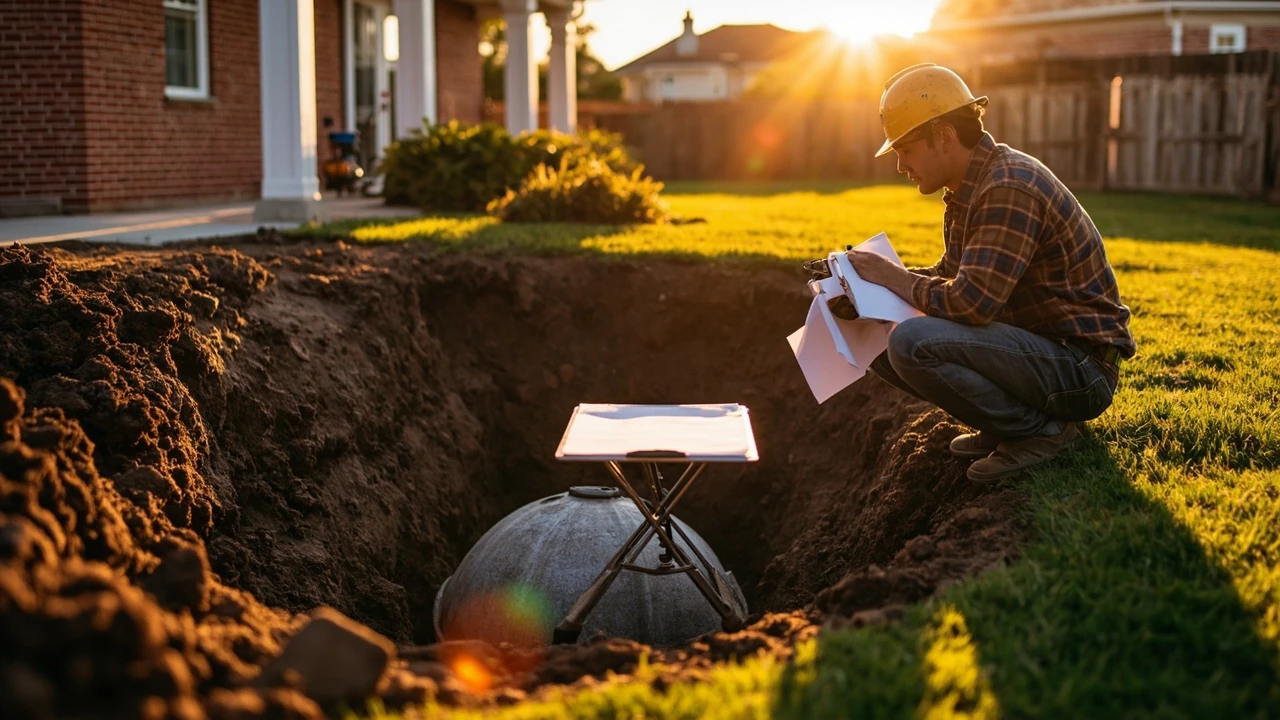
Septic tank cost: a realistic look at what homeowners pay
A four-bedroom house on two acres of clay soil, no municipal sewer at the curb, and a perc test that came back on the low end of acceptable. That is the situation many homeowners face when a septic system fails inspection, a property changes hands, or a new build needs its first system installed. The first number the installer quotes is rarely the number the project ends on, because the tank itself is only one slice of a much larger job that includes the soil, the drain field, the permit, and the labor to put it all in the ground.
This guide walks through septic tank cost line by line, so a homeowner can read a written estimate and understand what each item covers. It also covers the related costs that are easy to forget, from the perc test to the final landscaping. The numbers here are typical ranges reported across multiple U.S. regions in 2025 and early 2026, adjusted where the data shows clear movement. Local pricing varies, and a site-specific quote from a licensed installer is the only reliable number for an actual project.
What a septic system actually includes
A septic system is not just the tank you can see on an installer’s brochure. The tank is the most visible part, but the system also needs pipe from the house, a distribution box or manifold, a drain field or alternative disposal area, and the soil beneath that field. Permits, site work, and the perc test that determines whether the soil can accept effluent at all are all part of the same project budget.
Understanding the parts makes a written estimate easier to evaluate. A low tank price with a separate charge for every accessory item is common, and it is not necessarily a bad sign, as long as the totals are fair and the parts are listed clearly.
- Tank: the watertight chamber, usually concrete, fiberglass, or plastic, where solids settle and start to break down.
- Inlet and outlet piping: connects the house plumbing to the tank and the tank to the drain field.
- Distribution hardware: a distribution box, manifold, or pressure dosing chamber that spreads effluent across the field.
- Drain field: trenches or a bed filled with gravel and perforated pipe, or an engineered alternative such as a mound or aerobic system.
- Soil: the natural filter that does most of the actual treatment, and the single biggest variable in the whole project.
Most of the price variation that surprises homeowners comes from the last two items. Tank choice moves the number by hundreds of dollars; soil and field type move it by thousands.
Average septic tank cost at a glance
The table below shows typical all-in installed prices a U.S. homeowner is likely to see for a complete conventional system, including the tank, pipe, gravel, and a simple gravity drain field on a site with reasonable soil. Prices vary by region, tank size, and site access, and they are intended for planning, not for bidding.
| System type | Typical tank size | Installed cost range | Common use |
|---|---|---|---|
| Concrete gravity system | 1,000 to 1,500 gallons | $7,000 to $15,000 | New builds and full replacements on good soil |
| Plastic or fiberglass gravity system | 1,000 to 1,500 gallons | $6,500 to $13,000 | Sites with tight access or weight limits on the driveway |
| Concrete with pump chamber | 1,000 to 1,500 gallons | $9,000 to $18,000 | Flat sites or sites where the field must sit uphill of the tank |
| Mound system | 1,000 to 1,500 gallons | $15,000 to $30,000 | Shallow soil, high water table, or poor percolation |
| Aerobic treatment unit (ATU) | 500 to 1,000 gallons equivalent | $12,000 to $25,000 | Small lots, poor soil, or required by local rules |
| Engineered drip dispersal | 1,000 to 1,500 gallons | $18,000 to $35,000 | Tight sites, sensitive areas, or replacement of failed fields |
The ranges above are based on national cost data published by home-services and remodeling reference sources through 2025, which generally converge on similar per-project totals. For a closer look at how labor and material costs move on other home improvement projects, the site’s HVAC system guide uses the same kind of cost breakdown that helps a homeowner sanity-check a written bid.
What drives the price up or down
Two quotes for the same address can be thousands of dollars apart. The difference almost always comes down to a small set of variables that the installer evaluates during the site visit and perc test.
Soil and perc test results
Soil is the single biggest factor. A sandy loam that percolates quickly supports a simple gravity field with shallow trenches. A heavy clay with a slow perc rate needs a larger or engineered field, sometimes a mound or a pressure-dosed system, and that adds materials, excavation, and engineering time. The For additional context, basic operation of a septic tank depends on the drain field being able to absorb the clarified effluent, so when the soil cannot, the system has to be redesigned around the limitation.
Tank material and size
Concrete is the default in most U.S. regions because it is heavy, durable, and resists flotation. Fiberglass and polyethylene are lighter, easier to haul into tight backyards, and do not corrode, but they can shift in high water tables if not anchored properly. Larger tanks cost more, and the right size is set by the number of bedrooms and the expected daily flow, not by guesswork.
- 1,000-gallon tank: typical for a three-bedroom home with normal water use.
- 1,250-gallon tank: common for four-bedroom homes or properties with a large jacuzzi or irrigation return.
- 1,500-gallon tank: used for larger homes, homes with garbage disposals, or sites where the health department requires extra capacity.
Site access and excavation
If the installer can drive a truck and a backhoe straight to the tank location, excavation is a single line item. If the only path is through a finished backyard, around a pool, or under a fence, the labor goes up. Rocky soil, tree roots, and a high water table each add time and risk to the dig, and contractors usually price that risk into the bid rather than absorb it.
Local rules and permits
Health departments set their own design standards, setback distances, and inspection schedules. Some jurisdictions allow the homeowner to do parts of the work; others require a licensed installer for the entire system. Permit fees are usually a few hundred to roughly a thousand dollars depending on the county, and engineered plans add more when the site does not qualify for a standard gravity design.
Septic tank cost by component
A useful way to read an estimate is to look at each component separately. The breakdown below is the share of the total project cost that each major element typically represents on a conventional concrete gravity system in average soil. Mound and engineered systems shift these shares significantly toward excavation, fill material, and engineering.
| Component | Share of total cost | What the line covers |
|---|---|---|
| Tank and delivery | 25 to 35 percent | Tank itself, delivery, setting, and water testing for leaks |
| Excavation and backfill | 15 to 25 percent | Digging the tank hole and the field, stockpiling soil, backfilling once inspected |
| Drain field materials | 15 to 25 percent | Gravel or chamber products, perforated pipe, geotextile fabric, distribution box |
| Piping and connections | 5 to 10 percent | Inlet and outlet pipe, fittings, risers, and connections to the house plumbing |
| Perc test, permits, and engineering | 5 to 10 percent | Soil testing, application fees, engineered plans when required |
| Labor and contractor overhead | 15 to 25 percent | Site supervision, equipment, insurance, and warranty setup |
Reading an estimate this way makes it easier to compare two bids. A bid that is significantly lower on the tank line and higher on the excavation line might still be a fair number if the access is genuinely difficult, but it can also be a sign that a contractor is shifting visible items to less obvious ones.
Replacement vs. new installation
Replacing an existing system is usually cheaper than installing a first system on a raw lot, because the site is already known, the soil has been evaluated, and the route from the house to the tank is usually established. The tank itself is almost always the part being replaced; an old concrete tank that has lost its waterproofing or settled out of level has to come out, and the new tank goes in the same hole, often with a riser added so future pumping is easier.
- Tank swap only: common when the field is in good shape, the soil still passes, and the old tank has failed.
- Tank plus partial field: needed when the field is aging but the better portion can be left in service.
- Full system replacement: required when the field has failed, the soil is saturated, or the home has been expanded beyond the original design flow.
A complete replacement that also involves a new field typically costs roughly the same as a new installation, because the field is the most expensive single line on the project. Homeowners planning other exterior work at the same time, like fence installation or a new driveway, can sometimes save by sequencing trades so the same equipment is on site.
Repair costs versus replacement
Not every problem needs a new tank. A cracked baffle, a broken inlet, or a clogged distribution line can sometimes be repaired for a few hundred to a couple of thousand dollars. The decision to repair rather than replace usually comes down to the age of the tank, the condition of the field, and whether the system is still meeting current code for the size of the home.
The table below compares typical repair costs to replacement costs for the most common issues. Numbers assume a conventional gravity system with a concrete tank in average condition; prices will be higher in regions with strict codes or expensive excavation.
| Problem | Typical repair cost | Repair or replace |
|---|---|---|
| Cracked or missing baffle | $300 to $900 | Repair if the tank is otherwise sound and the field is healthy |
| Broken inlet or outlet pipe | $500 to $1,500 | Repair if the leak has not saturated the soil around the tank |
| Clogged distribution box | $400 to $1,200 | Repair and re-level, then inspect the field for damage |
| Failed drain field | $5,000 to $20,000+ | Replacement is usually the only durable option |
| Tank age over 30 years with leaks | $7,000 to $15,000+ | Replacement is almost always cheaper than repeated repairs |
The repair-versus-replace decision also depends on the home’s near-term plans. A homeowner planning to sell within a year usually chooses the cheaper option that will pass inspection. A homeowner planning to stay for a decade or more usually invests in a replacement that meets current sizing rules and avoids another round of excavation in five years.
Pumping and ongoing maintenance costs
A new tank is not a one-time expense. It needs to be pumped on a schedule, the baffles need a quick check, and the drain field needs to be protected from the things that kill fields early. The cost of routine care is small compared to the cost of a premature field failure.
- Pumping: typically $300 to $600 for a 1,000 to 1,500 gallon tank, depending on region and access.
- Inspection: $100 to $300 when scheduled separately from a pump-out.
- Riser installation: $300 to $800 if the tank is buried deep and access was not built in originally.
- Effluent filter cleaning: $50 to $200 during a routine pump-out.
The pumping interval depends on tank size, household size, and what goes down the drain. A family of four with a 1,000-gallon tank and a garbage disposal usually pumps every three to five years. A two-person household on a 1,500-gallon tank can sometimes go seven to ten years. The cost of pumping is small enough that it almost never makes sense to skip it, because a tank that overflows into the field is the most common cause of an expensive field replacement.
How to read a written estimate
Once the bids come in, the cheapest one is not always the best one and the most expensive is not always the safest one. A good estimate lists each item, the quantity, the unit cost, and the total, and it includes everything from the perc test to the final grade. A vague estimate that lumps everything into a single number is harder to compare and easier to grow with change orders during the project.
The checklist below is a practical way to compare two or three bids side by side. Anything that is not addressed in the estimate should be asked about directly, in writing, before signing.
- Is the perc test included, or is it billed separately if the soil fails?
- Who pulls the permit, and is the fee in the total?
- Is the tank size and model listed by name and capacity?
- Are risers and lids included, or are they optional add-ons?
- What is the field size in square feet or linear feet, and does it match the engineered plan?
- Is rock excavation priced as a separate unit, in case the dig hits ledge?
- What is the warranty on the tank, the field, and the labor?
- Is the final grade, seeding, and clean-up included?
Homeowners working through other project estimates at the same time, like planning a pre-sale punch list, will find that this same line-by-line approach removes most of the guesswork from a contractor bid.
Ways to keep septic tank cost under control
Septic systems are not a place to bargain-hunt on the tank itself, because a failed tank takes the field with it. There are still several legitimate ways to control total cost without cutting corners on the parts that matter.
- Schedule the work in the off-season: late fall and early spring are slower for many installers, and some offer modest discounts to keep crews busy.
- Combine projects: if a new driveway, fence, or landscaping job is already planned, sharing excavation time can reduce equipment mobilization.
- Keep the system simple: stay with a standard gravity design when the soil allows, since pumps, mounds, and aerobic units add equipment and maintenance.
- Protect what is there: avoid driving over the field, planting water-loving trees near it, and routing downspouts away from the tank.
- Plan for access: adding risers at installation costs a few hundred dollars and saves the same amount the first time the tank is pumped.
The single most expensive mistake is treating the drain field as a yard. Parking on it, building a shed on it, or paving over it cuts the field’s life from decades to a few years, and a field replacement usually costs more than the original system.
What a homeowner can do themselves, and what requires a pro
Some jurisdictions allow the homeowner to do parts of the work, such as clearing the site, digging the trenches in stable soil, or doing the final landscaping after the system is approved. The tank setting, the pipe connections, the electrical work for a pump or aerobic system, and the final inspections almost always require a licensed installer. The perc test, the engineered plan, and the permit sign-off are professional-only steps regardless of how much of the physical work the homeowner wants to take on.
A practical rule is to do the things that do not affect system performance and to leave the parts that do to a licensed contractor. Site clearing, fence coordination, and final grading are good candidates for self-work. Tank placement, pipe slope, and field construction are not, because a small slope error or a missed compaction step can shorten the life of an otherwise good system.
When the soil rules out a conventional system
Some sites do not pass a standard perc test. Shallow bedrock, a high water table, tight clay, or a small lot can all push the design away from a simple gravity field. In those cases, the cost of the system rises, but so does the importance of getting the design right, because the field is the part of the system that does the actual environmental work.
Engineered alternatives are more expensive up front, but they often have lower long-term risk because they are designed for the specific site rather than forced into a standard layout. The Environmental Protection Agency’s overview of decentralized wastewater treatment describes how soil, site, and system design interact, and is a useful reference when an installer recommends an alternative to a standard gravity field.
Frequently asked questions
How much does a new septic tank cost for a typical three-bedroom home?
For a three-bedroom home on average soil with a standard 1,000-gallon concrete tank and a simple gravity drain field, most homeowners in 2026 are looking at a total installed cost in the $7,000 to $15,000 range. Sites with poor soil, long runs to the field, or a need for a pump or mound will be higher.
What is the cheapest septic tank option that still meets code?
On a site that supports a standard gravity design, a plastic or fiberglass tank is usually the lowest-cost option that still meets code, with installed totals in the $6,500 to $13,000 range for a complete system. Cheaper is not always better, because lower-quality tanks and thin-wall risers can shorten the life of the system and add to long-term cost.
How long does a septic tank last before it has to be replaced?
A well-installed concrete, fiberglass, or plastic tank can last 30 to 50 years or more with routine pumping and care. The drain field usually has a shorter life, often 20 to 30 years, because the soil around it changes over time even when the tank itself is fine.
Does homeowners insurance cover septic tank replacement?
Standard homeowners policies usually cover damage from a sudden, specific cause such as a fallen tree or a vehicle driving over the tank, but they generally do not cover failure from age, wear, or normal maintenance issues. A few insurers offer an optional sewer and water line endorsement that can be added for an extra premium.
How often should a septic tank be pumped?
For most households, every three to five years is a safe interval, with larger tanks and smaller households able to go longer. The local health department or a service technician can recommend a specific interval based on tank size, household size, and water use.
Can I install a septic system myself?
In some jurisdictions, a homeowner can do parts of the work, such as site clearing or trench digging, but the tank setting, pipe work, perc test, and final inspection almost always need a licensed installer. Local code should be checked before any work begins, because unpermitted systems can cause problems at sale time and may be illegal to occupy.
What raises the cost of a septic system the most?
Soil conditions are usually the single biggest driver. A site that needs a mound, an engineered drip field, or an aerobic treatment unit can easily add $5,000 to $20,000 to a project compared with a simple gravity field on good soil. Long pipe runs, difficult access, and rock excavation also add significant cost.
Is a bigger tank always better?
Not necessarily. The tank should be sized to the home’s expected daily flow, which is set by the number of bedrooms and the local code. A tank that is larger than required costs more to buy and install without giving the system any real benefit, and it can sometimes make the field work harder by holding effluent longer than the bacteria need.
What should I do before getting a quote?
Pull the property records to confirm lot size, any existing system location, and prior perc tests if available. Get a list of licensed installers from the local health department, ask each one for a written site visit, and compare the resulting bids line by line using the checklist earlier in this guide.
How does a septic system affect a home sale?
In most regions, a septic system has to pass an inspection at closing, and a failed system is a common reason for a deal to fall apart or a price to be reduced. A documented history of pumping and maintenance, an as-built drawing of the system, and a recent inspection report make the sale smoother and protect the seller from later claims.
Leave a Reply