
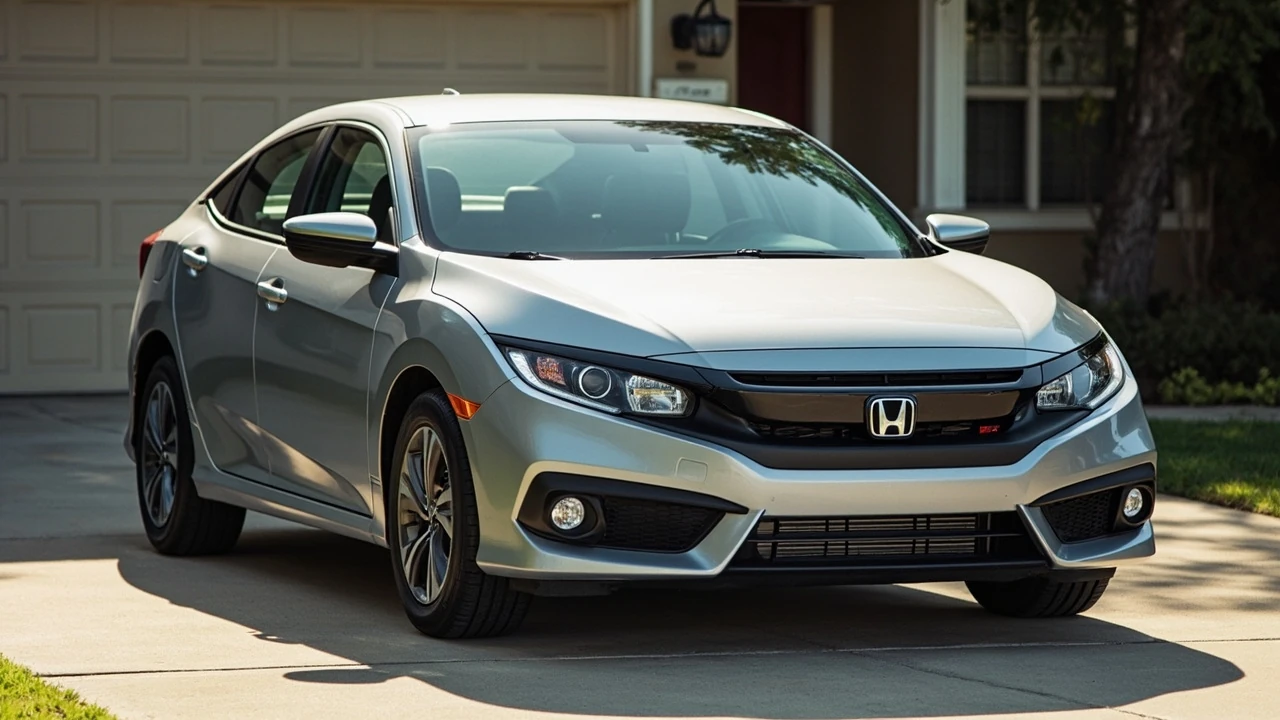
Honda civic tires
The spare under the cargo floor of a 2018 Civic EX is a T135/80D15 temporary donut, while the car on the drive outside is wearing 215/50R17 all-season tires mounted on 7-inch alloy wheels. That kind of mismatch is common, and it confuses owners who are trying to order a replacement set without overpaying or buying the wrong size. The good news is that Honda Civic fitment is one of the more consistent things in the compact-car world: once you know the generation, the trim, and the wheel size, the right tire size is usually a short lookup away.
This guide focuses on the practical side of Honda Civic tires: how to read the size on your current sidewall, what each generation was originally shipped with, how to keep speedometer accuracy and ABS behavior correct, and how to match the tire to the way you actually drive. It is written for owners of recent Civics (roughly 2016 through the current model) as well as owners of older generations who still see plenty of road time.
Why fitment matters more than brand
Most tire problems blamed on the brand or the model are actually fitment problems. A tire that is the wrong diameter can throw off the speedometer, confuse the anti-lock brake system, and in some cases trigger a traction-control warning. A tire that is too narrow for the wheel can wear unevenly and feel twitchy in crosswinds, while a tire that is too wide can rub the fender liner on full steering lock. Before comparing tread patterns or prices, it is worth getting the size right.
Honda has been conservative with Civic fitment because the platform is used globally and the same engineering targets (low rolling resistance, predictable wet braking, long tread life) apply in every market. That consistency is helpful for owners because it means a 2017 Civic LX on steel wheels and a 2023 Civic Si on 18-inch wheels are not so far apart that the basics change; only the numbers do.
How to read a Honda Civic tire size
Every tire on a Civic has a code molded into the sidewall. A typical code looks like 215/50R17 91H, and each part of that string tells you something specific.
- 215 – Section width in millimeters, measured from sidewall to sidewall.
- 50 – Aspect ratio: the sidewall height is 50 percent of the 215 mm width.
- R – Radial construction. Almost every modern tire is radial.
- 17 – Wheel diameter in inches that the tire is designed to fit.
- 91 – Load index. For 91, the maximum load per tire is about 615 kg (1,356 lb).
- H – Speed rating. H is rated to 210 km/h (130 mph); V is 240 km/h (149 mph); W is 270 km/h (168 mph).
The overall diameter of the tire can be estimated from these numbers. Take the width, multiply it by the aspect ratio to get the sidewall height, double it, convert to inches, and add the wheel diameter. A 215/50R17, for example, has roughly a 25.7-inch overall diameter. That figure matters because Honda calibrates the speedometer and the ABS to a specific rolling diameter. Going more than about 3 percent larger or smaller will usually start to produce noticeable speedometer error and may cause the ABS or traction control to misbehave.
Where to find the OEM size
Three places tell you what Honda originally fitted:
- The driver’s door jamb sticker. This is the most reliable source and lists both tire size and the recommended cold inflation pressure for the front and rear.
- The owner’s manual, usually in the maintenance or specifications section.
- The sidewall of the tire currently on the car, provided it has not been changed to a non-OEM size.
On most recent Civics, the door jamb sticker shows two sizes: one for the standard wheel and one for the optional wheel. The 2016–2021 Civic, for instance, was commonly delivered with either 215/55R16 or 215/50R17, and the 2022+ Civic moved to 215/50R17 or 235/40R18 depending on trim.
Stock Honda Civic tire sizes by generation
The Civic has been through eleven generations, and the wheel and tire package has changed with each one. The table below covers the generations most owners are still driving today. Sizes are the OEM fitments; actual cars on the used market often have aftermarket wheels and tires installed by a previous owner.
| Generation | Model years | Common OEM sizes | Wheel options |
|---|---|---|---|
| 10th generation | 2016–2021 | 215/55R16, 215/50R17, 235/40R18 | 16, 17, 18 in |
| 11th generation | 2022–present | 215/50R17, 235/40R18 | 17, 18 in |
| 9th generation | 2012–2015 | 205/55R16, 215/45R17, 225/40R18 | 16, 17, 18 in |
| 8th generation | 2006–2011 | 205/55R16, 215/45R17, 225/45R18 | 16, 17, 18 in |
| 7th generation | 2001–2005 | 195/60R15, 205/55R16, 215/45R17 | 15, 16, 17 in |
| 6th generation | 1996–2000 | 175/65R14, 185/65R15, 195/60R15, 205/45R16 | 14, 15, 16 in |
Within each generation, trims usually line up with a specific wheel size. LX and EX trims tend to run the smaller wheels (16 or 17 inch) with taller sidewalls, which gives a softer ride. Sport, Touring, and Si trims step up to 18-inch wheels with shorter, stiffer sidewalls and a slightly wider footprint. Performance variants like the Civic Si and the high-output version of the Type R use even larger wheels and lower-profile tires, and the Type R in particular has its own wheel-and-tire package that is not interchangeable with the standard Civic. According to the public history of the Honda Civic Type R lineage, performance variants have used a unique Type R setup since the EK9 generation, so if you are replacing tires on a Type R, always confirm the size rather than assuming it matches a standard Civic of the same year.
Choosing the right tire type for how you drive
Honda Civic tires come in three broad categories, and the right choice depends more on climate and driving style than on the badge on the sidewall.
All-season tires
All-season tires are the default fitment on most Civics sold in North America. They use a tread compound that stays flexible across a wide temperature range and a tread pattern that balances wet grip, dry grip, and noise. For most owners who commute in mixed weather, a quality all-season tire is the right answer. Look for a treadwear rating above 500 if you want long life, and pay attention to the UTQG temperature and traction grades, which give a rough sense of wet and dry performance.
Summer tires
Summer tires use a softer compound that grips better in warm conditions but hardens below about 7 °C (45 °F). They are common on Civic Si and Type R models, where the focus is dry handling. If you live somewhere with cold winters, summer tires are not safe year-round; the compound loses traction and the tread pattern is not designed to evacuate snow. Owners who run summer tires usually own a second set of winter tires on a separate wheel set.
Winter tires
Winter tires use a compound that stays flexible in freezing temperatures and a tread pattern with many small cuts (sipes) that bite into snow and ice. They are noticeably better than all-season tires below about 7 °C, both for stopping and for cornering. The trade-off is faster wear in warm weather and a softer feel on dry pavement. A common setup is a 16- or 17-inch steel wheel with a narrower winter tire, which gives more sidewall for potholes and saves the nicer alloy wheels from road salt.
Speed rating, load index, and why they matter
Honda specifies a minimum speed rating for each Civic trim. The standard trims usually require an H rating (130 mph), while the Si and Type R require a V or higher. It is fine to fit a tire with a higher speed rating than the original, but never lower. The speed rating is tied to the tire’s heat-dissipation capability, and a tire rated below what the car can reach will not be able to handle sustained high-speed driving without internal damage.
Load index works the same way. The door jamb sticker and the owner’s manual list a minimum load index, and a tire below that rating is technically not safe. In practice, the OEM sizes used on the Civic already meet or exceed the requirement, so a direct replacement in the OEM size will be fine. The only time load index becomes a problem is when an owner downsizes to a smaller-diameter wheel with a thinner tire, where the load rating can drop below the requirement.
| Common Civic size | Typical load index | Approx. max load per tire | Typical speed rating |
|---|---|---|---|
| 215/55R16 | 93 | 650 kg (1,433 lb) | H |
| 215/50R17 | 91–95 | 615–690 kg (1,356–1,521 lb) | H or V |
| 235/40R18 | 91–95 | 615–690 kg (1,356–1,521 lb) | W or Y |
| 205/55R16 | 91 | 615 kg (1,356 lb) | H |
Inflation pressure, TPMS, and the door jamb sticker
The pressure printed on the tire sidewall is the maximum pressure, not the recommended pressure. The correct pressure for your Civic is on the driver’s door jamb sticker, listed separately for the front and rear tires. Underinflation is one of the leading causes of premature tire wear, especially on the rear axle, where a Civic can lose a noticeable amount of camber-induced edge wear if the pressure is low. Overinflation makes the ride harsh and can cause the tire to wear in the center.
All Civics from 2008 onward in the United States use a Tire Pressure Monitoring System (TPMS) that warns the driver when pressure drops significantly. After a tire change, the TPMS needs to relearn the new sensor IDs, which usually happens automatically after a few miles of driving above 25 mph. If the warning light stays on, a tire shop can trigger the relearn with a scan tool.
When a slightly different size makes sense
There are a few cases where going one size up or down from the OEM size is reasonable, as long as the overall diameter stays close to original.
- Plus-one upgrade: going from a 16-inch wheel to a 17-inch wheel with a lower-profile tire to improve cornering response. This is the most common change and is well within the range that the speedometer and ABS will tolerate.
- Downsize for winter: going from an 18-inch wheel to a 16- or 17-inch wheel with a taller sidewall for winter driving. The taller sidewall protects the wheel from potholes, and the narrower tire cuts through snow better.
- Width change: going one width up or down (for example, from 215 to 225 or 205) when the OEM size is no longer available. This is fine as long as the wheel width is appropriate for the new tire.
The general rule is to keep the overall diameter within about 3 percent of OEM. Beyond that, the speedometer error becomes noticeable, the ABS calibration drifts, and in extreme cases the tire can contact the fender liner on full steering lock.
Tire rotation, balancing, and alignment
Honda recommends tire rotation every 7,500 to 10,000 miles, usually in a forward-cross pattern for front-wheel-drive cars. Regular rotation extends tread life because front tires wear faster on a Civic (the front axle does the steering, most of the braking, and all of the driving). Skipping rotation is one of the most expensive small mistakes a Civic owner can make: tires that should last 50,000 miles can be worn out at 30,000 miles.
Balancing should be done every time a tire is mounted or dismounted, and again if you feel a vibration at highway speed. Alignment is separate: a four-wheel alignment checks camber, caster, and toe, and it should be done if you notice uneven wear, after hitting a curb, or after any suspension work. A Civic that is out of alignment by a small amount can eat through a set of tires in a few thousand miles.
How long do Honda Civic tires last?
A quality all-season tire in the OEM size on a Civic typically lasts 40,000 to 60,000 miles, depending on the compound, the climate, the driver’s habits, and whether the car is aligned and inflated correctly. Summer tires wear faster, often in the 20,000 to 30,000 mile range, because the compound is softer. Winter tires are somewhere in between, but owners usually switch them out before they wear out to keep them from getting hard in warm weather.
A simple way to check whether a tire is still usable is the tread depth test. New tires start at about 10/32 inch of tread. Most manufacturers recommend replacement at 4/32 inch for all-season tires and 2/32 inch as the legal minimum in many states. Winter tires should be replaced at 5/32 inch because the sipe depth is what gives them snow grip, and that depth drops quickly with wear.
Common mistakes when buying Honda Civic tires
There are a few repeat issues that show up in tire shops and online forums.
- Buying by price alone. A very cheap tire in the correct size is not a bargain if it wears out in 25,000 miles or hydroplanes in a moderate rain. Look at independent reviews and UTQG numbers before choosing.
- Mixing brands or models on the same axle. The Civic is a front-wheel-drive car, and mixing tires on the front axle can upset the balance of the stability control system. Replace tires in pairs at minimum, and in sets of four when possible.
- Ignoring the wheel width. A 215-width tire needs a wheel that is roughly 6 to 7.5 inches wide. Putting it on a 5.5-inch wheel is unsafe, and putting it on an 8.5-inch wheel can change the shape of the contact patch.
- Skipping the road-force balance. Modern balancer machines can measure radial and lateral force variation. A tire that is round but not uniform can cause a vibration that no amount of balancing will fix.
- Forgetting the spare. The temporary spare on a Civic is a T-class tire with a different diameter. It is not meant to be driven above 50 mph, and it is not meant to be used on all four corners. If your Civic has a temporary spare, check its pressure twice a year.
Seasonal considerations and storage
Owners who run two sets of tires usually store the off-season set in a garage, a basement, or a tire hotel at a shop. Stored tires should be cleaned, dried, and either stacked or hung on tire racks. They should be kept out of direct sunlight, away from ozone-producing equipment (electric motors, welders), and away from solvents and fuels. Properly stored tires hold their performance characteristics for years, so a set of winter tires stored over the summer is not meaningfully worse than a set that has been on the car continuously.
If you only own one set, the trade-off is real. In regions with mild winters, a quality all-season tire with the three-peak mountain snowflake symbol is a reasonable compromise. In regions with serious snow, a dedicated winter tire is safer, and the convenience of a year-round all-season does not make up for the loss of grip on ice.
Cost expectations and what affects price
Honda Civic tires are not particularly expensive compared with other compact cars. A set of four quality all-season tires in the 215/50R17 size typically lands in the $500 to $800 range before mounting, balancing, and any road-hazard fees. Performance all-season and summer tires run higher, often $800 to $1,200 for a set. Winter tires in the same size usually fall in the middle, around $600 to $1,000.
Several factors push the price up: larger wheel diameter, lower-profile sidewall, higher speed rating, and brand reputation. Two tires with the same size code can vary by a factor of two or more in price simply because of those four variables. The size code is the starting point, not the final answer.
Reading the DOT date code
Every tire has a Department of Transportation date code on the sidewall that tells you when it was manufactured. The last four digits are a week and a year: 1522, for example, means the 15th week of 2022. Tires sold in the United States are generally considered fresh if they are less than a few years old, but they do degrade slowly with age even if they are not used. Most tire manufacturers recommend replacement after six to ten years regardless of tread depth because the rubber hardens and the structural compounds break down.
This matters when buying discount tires online. A deeply discounted set may be older stock, and a tire that has been sitting in a warehouse for three years is not the same as one that was manufactured last month. Always check the date code before mounting.
Working with a tire shop versus buying online
Buying tires online and having them shipped to a local installer is usually cheaper than buying directly from a shop, and many online retailers partner with local installers for the mounting and balancing. The trade-off is that the installer cannot pick the tire for you, and any warranty claim has to go through the online retailer. Buying from a local shop is more expensive but offers direct support, free rotation in some cases, and the ability to ask the technician which tires they see lasting longest on Civics specifically.
Either path is reasonable. The most important thing is that the tire, the wheel, and the car are all matched correctly, and that the mounting is done with a torque wrench to the wheel manufacturer’s specification. Impact guns are fine for most of the process, but the final torque on the lug nuts should be controlled.
A practical checklist before you buy
- Confirm the OEM size from the door jamb sticker or the owner’s manual.
- Decide on the tire type: all-season, summer, or winter.
- Match the speed rating and the load index to the OEM specification or higher.
- Keep the overall diameter within about 3 percent of OEM if you change sizes.
- Check the wheel width to make sure the new tire fits the wheel.
- Look at independent reviews and UTQG numbers, not just price.
- Verify the DOT date code on any discounted tire.
- Plan for mounting, balancing, TPMS relearn, and a four-wheel alignment if needed.
For a useful cross-reference on home maintenance decisions, see the home HVAC system guide on Better Build Contractors. If you are also preparing a property for sale, the getting house ready to sell checklist covers the practical steps that go beyond the car.
Frequently asked questions
What size tires does a Honda Civic use?
Most recent Honda Civics use 215/55R16, 215/50R17, or 235/40R18, depending on the generation and the trim. The exact size is on the driver’s door jamb sticker and in the owner’s manual. Older Civics used 195/60R15, 205/55R16, and 205/50R16, among others.
Can I put a different size tire on my Civic?
Yes, as long as the new size is compatible with the wheel and the overall diameter stays within about 3 percent of the OEM size. Going one size up or down is common and well supported. Going two or more sizes in either direction can affect the speedometer, the ABS, and the traction control system.
How often should I rotate Honda Civic tires?
Every 7,500 to 10,000 miles is a good interval for a Civic. Front tires wear faster than rear tires on a front-wheel-drive car, and regular rotation keeps the wear even across all four corners and extends the life of the set.
Do all-season tires work in snow?
All-season tires with the three-peak mountain snowflake symbol handle light snow and slush reasonably well. For serious winter driving on packed snow or ice, a dedicated winter tire is significantly safer. The compound and the sipe design are different, and the difference shows up in braking distance and cornering grip.
What is the correct tire pressure for a Honda Civic?
The recommended pressure is on the driver’s door jamb sticker, usually around 32 psi (220 kPa) for the front and rear. The pressure printed on the sidewall is the maximum, not the recommended pressure. Check pressure when the tires are cold, before driving more than a mile.
How long do Honda Civic tires last?
Typically 40,000 to 60,000 miles for a quality all-season tire, less for a summer tire, and more for a long-life all-season. Climate, driving style, inflation, alignment, and rotation all affect the actual mileage. A tire that is more than six years old should be replaced regardless of tread depth.
Should I replace all four tires at the same time?
On a front-wheel-drive Civic, replacing all four at the same time is best because the stability control and the ABS expect matched tires. If cost is a concern, replacing the two front tires together is acceptable, but avoid mixing brands or models on the same axle.
What is the difference between H, V, and W speed ratings?
H is rated to 210 km/h (130 mph), V to 240 km/h (149 mph), and W to 270 km/h (168 mph). A higher speed rating is fine on a Civic that does not need it, but a lower rating is not safe. Most standard Civics ship with H-rated tires; the Si and Type R often have V or higher.
Do I need to recalibrate the TPMS after new tires?
Usually no. The TPMS sensors stay on the wheels, and the system relearns automatically after a short drive. If the warning light stays on, a tire shop can trigger the relearn with a scan tool. If you have new sensors, the shop will need to program them into the system.
Are run-flat tires available for a Civic?
Some manufacturers offer run-flat tires in Civic sizes, but they are not the OEM fitment on most trims. Run-flat tires have a stiffer sidewall that supports the car after a puncture, and they can be more expensive and harder to repair than conventional tires. They are an option, not a requirement.
Leave a Reply