
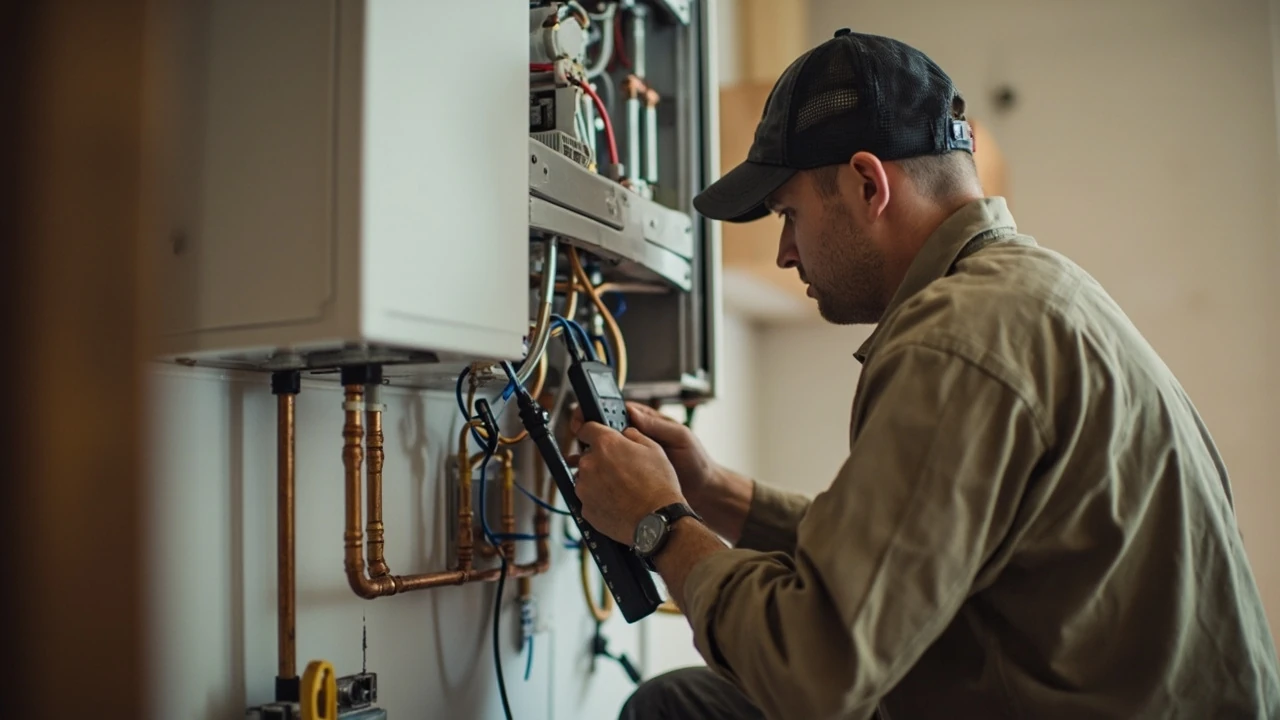
Tankless water heater repair: how to diagnose what is actually wrong
A homeowner steps into the shower, waits a full minute for the water to warm up, and is met with a blast of cold water. The tankless unit on the wall is running, the exhaust fan spins up, and the small status light blinks a code that no one in the household can interpret. This is the moment most people start searching for tankless water heater repair, because the unit itself is silent about what it needs and the symptoms look identical across very different failures.
Tankless models, also called on-demand or instantaneous water heaters, heat water only when a hot tap opens. That operating logic removes the storage tank but introduces a different set of failure points: flow sensors, flame rods, heat exchangers, venturis, and electronic control boards all have to cooperate for a successful ignition. When any single component drifts out of spec, the unit either refuses to fire, fires and shuts down, or runs long enough to deliver a few minutes of hot water before tripping out.
This guide focuses on the practical side of tankless water heater repair: the symptoms a homeowner or technician can verify, the most common root causes behind each symptom, the checks that are safe to do without a license, and the situations that justify calling a professional. The aim is to help you walk up to the unit with a working hypothesis instead of a guess.
How a tankless water heater works during a normal call for heat
Before diving into tankless water heater repair, it helps to understand the sequence a healthy unit runs through each time a hot tap opens. Most residential gas and propane models follow roughly the same logic, with electric models substituting heating elements for a burner.
- A hot tap opens and the flow sensor detects a minimum flow rate, typically around 0.4 to 0.5 gallons per minute depending on the manufacturer.
- The control board checks inlet water temperature, then calculates the required burner modulation or element power to reach the setpoint.
- The induced draft fan ramps up and the pressure switch confirms a stable flue draft before ignition is allowed.
- The gas valve opens, the igniter fires, and the flame rod confirms a stable flame within a few seconds.
- Water circulates through the copper or stainless heat exchanger, absorbing heat on its way to the fixture.
- When the tap closes, the flow sensor drops below the threshold, the burner shuts down, and the fan runs a short purge cycle.
Each of these stages has a sensor or switch that can fail. A useful tankless water heater repair diagnosis is essentially a process of elimination across this sequence, working from the cheapest checks to the most expensive components.
Symptoms that drive most tankless water heater repair calls
Most service tickets fall into a small set of repeatable complaints. Grouping problems by symptom, rather than by component, is usually the fastest way to narrow down the work.
| Symptom | What the homeowner sees | Likely family of causes |
|---|---|---|
| No hot water at all | Unit never ignites, cold water at every fixture | Power, gas supply, frozen or kinked plumbing, flow sensor, control board |
| Hot water then cold | Warm for one to three minutes, then temperature drops | Scale buildup, undersized unit, cross-connected plumbing, recirc pump issue |
| Water too hot or fluctuating | Temperature swings between lukewarm and scalding | Mixing valve, temperature sensor drift, flow fluctuation at the fixture |
| Error code on display | Numeric or blinking code, no hot water | Manufacturer-specific fault, often ignition, flame, or vent related |
| Unit ignites and shuts off | Brief burn, then lockout within seconds | Flame rod, flue blockage, condensate drain, gas pressure |
| Leaking water | Drip from the bottom of the cabinet or connections | Heat exchanger pinhole, loose fittings, condensate line, relief valve |
| Unusual noises | Popping, hissing, or rumbling during operation | Mineral scale, air in the lines, burner fouling, restricted flow |
None of these symptoms point to a single part. A blinking code that says “ignition failure” can come from a clogged flame rod, a stuck gas valve, a dirty burner, a blocked vent, or a failed igniter. The job of a careful tankless water heater repair is to confirm the actual cause before replacing parts.
Safety checks before any tankless water heater repair
Even though tankless units are smaller and more accessible than storage tanks, they still combine high-voltage electricity, combustible gas, very hot exhaust, and scalding water in one cabinet. Two safety checks belong at the top of every repair visit, including a visit you make yourself.
- Turn off the gas supply at the manual shutoff valve, typically a yellow or red handle within a few feet of the unit, before opening the front cover. For electric tankless units, shut off the dedicated breaker at the panel before removing any cover.
- Close the cold water isolation valves if your installation has them, or shut off the main if it does not. Open a hot tap downstairs to depressurize the line before you disconnect anything.
Gas and electrical work is regulated in most jurisdictions. Tasks like cleaning a flame rod, descaling a heat exchanger with a pump and bucket, or replacing a venturi are often within the scope of a competent homeowner, but anything involving the gas valve, the burner orifice, internal wiring, or a sealed heat exchanger usually falls under a licensed professional. A reputable tankless water heater repair company will state clearly which tasks they are willing to perform on a unit still under warranty, because manufacturer warranties frequently exclude owner-performed disassembly.
Diagnosing power, gas, and water supply first
Before blaming any internal component, a technician will confirm that the three inputs to the unit are present and within spec. Tankless water heater repair visits that end with a one-minute fix usually start here.
Power supply and control board status
Tankless units need continuous power for the control board, the igniter, and the display. If the display is completely blank, work outward from the unit before assuming a board failure.
- Verify the breaker is on. Tankless units often share a circuit with other appliances, and a partial trip can leave the board energized without enough current to run the igniter.
- Check the outlet or junction box behind the unit. Look for a tripped GFCI on the receptacle, a loose wire nut, or signs of heat discoloration on the terminals.
- Listen for a relay click when a hot tap opens. A silent board often points to a failed control board, but it can also mean a failed flow sensor that never tells the board to start.
Gas supply for gas-fired units
Gas pressure problems are an underrated cause of intermittent tankless water heater repair calls. The burner needs a stable pressure within the manufacturer’s range to ignite cleanly and modulate properly.
- Confirm the manual gas shutoff is fully open. A valve that is only three-quarters open can pass enough gas for the furnace but not enough for a high-fire tankless call.
- Check other gas appliances. If the furnace and range work but the tankless struggles during simultaneous demand, the gas line may be undersized for the home’s total load.
- For propane units, verify the tank is not in vapor lock during cold weather. A first-stage regulator that is frosting over is a classic sign of under-capacity.
Water supply and isolation valves
Tankless water heater repair often traces back to plumbing changes the homeowner forgot about. A new whole-home filter, a pressure-reducing valve that is set too low, or a closed recirculation line can all suppress flow below the unit’s ignition threshold.
- Confirm the cold inlet and hot outlet valves are both open. Closed or partially closed valves are surprisingly common after other service work.
- Measure static and dynamic water pressure with a simple gauge on an outdoor hose bib. Readings well below the unit’s spec sheet minimum can prevent ignition.
- Look for kinked or trapped flexible connectors behind the unit. Flex lines that are tight against the wall can pinch slightly when the cabinet warms during operation.
Common tankless water heater repair scenarios and how to test them
The next layer of tankless water heater repair looks at the parts that wear out, foul, or fail in a predictable pattern. The table below matches recurring symptoms to the parts most often responsible, plus a basic verification step for each.
| Part | Function | Failure symptom | Verification approach |
|---|---|---|---|
| Flow sensor | Detects tap opening, signals the board to fire | No ignition even with strong flow; random shutoffs | Compare flow rate at the tap to the unit’s spec minimum; test sensor resistance if service manual allows |
| Flame rod | Confirms a stable flame for the board | Ignites then locks out within seconds; flame error codes | Inspect for carbon buildup, clean with a fine emery cloth, avoid aggressive sanding |
| Igniter | Creates the spark or hot surface for ignition | No burner activity, click without flame, repeated ignition attempts | Look for spark at the burner during a call for heat; check continuity where the manual allows |
| Venturi | Draws air into the gas mixture for combustion | Sooting, incomplete combustion, flame failure codes | Remove and inspect for debris or insect nests; confirm gasket integrity on reassembly |
| Heat exchanger | Transfers burner heat to the water | Popping noises, lukewarm output, pinhole leaks, persistent scale | Descale with a pump and food-grade circulating solution; inspect for visible weeping after cleaning |
| Condensate trap and drain | Captures acidic condensate from high-efficiency units | Lockouts in cool weather, water in the cabinet, slow drain | Pour water into the trap to confirm free flow; clear any blockage with a flexible brush |
| Temperature sensor | Reports outlet water temperature to the board | Surging temperatures, overheating codes, no modulation | Compare displayed outlet temperature to a calibrated thermometer at a fixture |
| Control board | Orchestrates the sequence and safety checks | Random error codes, no response to inputs, partial display | Swap with a known-good unit only after the manufacturer approves and the warranty status is reviewed |
Notice that many of these failures overlap. A flame rod covered in scale and a partially blocked vent can produce the same lockout code. That is why a thoughtful tankless water heater repair workflow checks both, rather than replacing the first suspect part and hoping the problem disappears.
Scaling and the role of water quality in tankless water heater repair
Hard water is the single largest contributor to preventable tankless water heater repair calls in regions where the local supply carries high mineral content. The same scaling that slowly chokes a traditional storage tank accumulates much faster in a tankless heat exchanger, because the water moves through narrow passages and the surface temperature is high.
When calcium and magnesium precipitate out of the heated water, they form a chalky layer on the inside of the heat exchanger and on the flame rod. The layer insulates the water from the burner, so the unit has to fire longer and harder to reach the setpoint. Eventually the layer becomes thick enough that the water cannot absorb heat fast enough, and the outlet temperature starts to drift below what the tap demands.
Preventive maintenance that reduces tankless water heater repair frequency
Manufacturers publish descaling intervals, often annual for hard water and every two to three years for soft water. The procedure is similar across most brands and is a legitimate homeowner task if the unit is out of warranty or the manufacturer permits it.
- Isolate the unit with the inlet and outlet service valves, or shut off water upstream if isolation valves are not installed.
- Connect a submersible pump and a bucket of food-grade white vinegar or a manufacturer-approved descaling solution to the service ports.
- Circulate the solution through the heat exchanger for forty-five to ninety minutes without letting the pump run dry.
- Flush with clean water until the discharge runs clear, restore isolation valves, and run a hot tap to confirm normal operation.
Beyond descaling, a small whole-home prefilter or a water softener dramatically reduces the rate of scale buildup. If you already maintain a softener, the article on how much a water softener costs in 2026 outlines the operating costs and sizing considerations that affect long-term performance. In hard-water regions, a softener is often cheaper over the life of the tankless unit than a few descaling visits per year.
Vent, exhaust, and condensate problems
High-efficiency gas tankless units pull air in and vent exhaust out through sealed pipes, usually PVC or special stainless. Anything that disturbs the pressure balance inside those pipes can cause a tankless water heater repair visit that looks like an ignition problem but is really a venting problem.
- Bird or rodent nests in the outside termination are common after a quiet winter. A blocked exhaust causes the pressure switch to fail open and the burner to refuse to fire.
- Long horizontal vent runs with too many elbows can accumulate condensate that does not drain back to the trap. The pooled water disrupts the pressure switch reading.
- Missing or disconnected condensate drain lines allow acidic water to back up into the secondary heat exchanger, which can corrode the drain pan and trip sensors.
Direct-vent units that draw combustion air through a concentric pipe are especially sensitive to debris in the intake. A visual inspection of both the intake and exhaust terminations from outside the home is a quick first step in any tankless water heater repair where the unit fails to ignite on a calm day.
Sensor and electronic faults in modern tankless units
Newer tankless models lean heavily on sensors and firmware. The benefit is precise temperature control, the cost is that any sensor that drifts out of calibration can shut the unit down. A technician running a tankless water heater repair diagnosis will often start by reading the error code history, then cross-referencing it with the live sensor readings the service menu can display.
Common sensor-related issues include:
- Outlet thermistors that read a few degrees low, causing the board to over-fire and trigger an overheating code.
- Inlet thermistors that read high after a long hot run, leading the unit to short-cycle the burner.
- Flow sensors that report flow when the taps are closed, usually because of a small piece of scale lodged in the impeller.
For most homeowners, sensor replacement is not a do-it-yourself task. It requires opening the unit, identifying the correct part number for the firmware revision, and in many cases running a manual calibration step from the service menu. A bad board swap on a modern unit can introduce a mismatch between the board firmware and the existing sensors, which is why a careful tankless water heater repair professional will confirm the part numbers before ordering.
When a tankless unit is beyond reasonable repair
Not every problem is worth fixing. Two situations push a unit out of the repair category.
- The heat exchanger has developed a pinhole leak, especially in a unit that is past the ten-year mark. Replacement heat exchangers are often close to the cost of a new unit, and a failed exchanger can void the cabinet warranty if not handled through the manufacturer.
- The unit has been out of service through a hard freeze with water in the heat exchanger. The damage from expanding ice usually splits more than one internal passage, and the resulting leaks can reappear months after the first repair.
If you are weighing repair against replacement, the same life-cycle logic that applies to choosing a new HVAC system applies here: compare the repair cost to a meaningful percentage of replacement, then look at the age, the service history, and the efficiency of the current unit. A heater that has needed two or more tankless water heater repair visits in the past two years is usually a better candidate for replacement than for a third fix.
Working with a tankless water heater repair professional
A good service visit starts before the technician arrives. A few minutes of preparation can save diagnostic time and reduce the chance of a return trip.
- Write down the brand, model number, and serial number, usually on a label on the side of the cabinet or inside the front cover.
- Note the error code, if any, and the conditions under which it appears. “Code 12 every morning when the dishwasher runs” is far more useful than “it does not work sometimes.”
- Check whether the unit is still under manufacturer warranty. Tankless heat exchangers often carry longer coverage than parts, and a covered repair should go through the manufacturer to avoid voiding the remaining term.
- Ask whether the technician will run a combustion analysis on a gas unit or an amperage check on an electric unit. A service visit that ends with parts replacement but no measured baseline can hide a new problem.
Expect a thorough tankless water heater repair visit to include a visual inspection, an error code review, a flow test, a combustion or electrical test, and a written estimate before any parts are installed. A technician who quotes a flat fee over the phone without seeing the unit is guessing, and a guess on a tankless unit usually turns into a second visit.
A practical decision framework for the next repair
For most homeowners, the choice is not “repair versus replace” in the abstract. It is a question about this specific unit, this specific season, and this specific household usage. A short framework helps.
| Question | Lean toward repair when | Lean toward replacement when |
|---|---|---|
| Age of the unit | Under eight years with regular maintenance | Over twelve years, especially with prior repairs |
| Cost of repair | Less than a quarter of the replacement cost | Approaching half of replacement, or includes a heat exchanger |
| Symptom pattern | One clear, isolated failure with a defined fix | Multiple overlapping issues or a leak that returns |
| Hot water demand | Household usage has not changed | Family size, fixtures, or appliances have grown |
| Warranty status | Heat exchanger or parts still covered | Out of warranty with no extended coverage available |
The hardest case is a mid-life unit with a single stubborn issue. In that situation, a second opinion from a different tankless water heater repair company is often worth the service call fee, because the first technician’s estimate is not the only data point.
Reducing the odds of the next tankless water heater repair
Most tankless water heater repair work is preventable. A small set of habits, repeated consistently, is the difference between a unit that runs quietly for fifteen years and one that sees a technician every other season.
- Schedule a descaling flush on a fixed interval based on your water hardness, not on the unit’s age.
- Install a simple sediment prefilter on the cold inlet if your supply carries visible particles.
- Keep the area around the vent termination clear of vegetation, snow, and stored items.
- Test the pressure relief valve on any associated storage or buffer tank once a year, and confirm the condensate line flows freely.
- Record every service visit, including the error codes and the parts replaced. A short log changes a future tankless water heater repair from a fresh investigation into a pattern recognition exercise.
For broader context on how a tankless unit fits into a home’s mechanical systems, the article on choosing the right HVAC system walks through related decisions about efficiency, sizing, and long-term operating cost.
Frequently asked questions
How long does a typical tankless water heater repair take?
A first-visit diagnosis usually runs between forty-five minutes and two hours, depending on accessibility and how clearly the symptom reproduces. If the fix is a clean-and-test, like a flame rod cleaning or a condensate trap clear-out, the visit can wrap up the same day. If the diagnosis points to a control board or a heat exchanger, the technician may need to order a part, and a return visit typically follows within a few business days.
Can a homeowner safely do tankless water heater repair without a license?
Homeowners can perform certain maintenance tasks, such as descaling the heat exchanger with a pump and bucket, cleaning a flame rod, or clearing a condensate trap, in many jurisdictions. Work that involves opening the gas train, adjusting the burner orifice, replacing internal wiring, or changing a sealed heat exchanger usually requires a licensed professional and may also be required by the manufacturer to keep the warranty valid. When in doubt, check the installation manual and your local code before opening the cabinet.
Why does my tankless water heater run for a minute and then go cold?
The most common cause is scale buildup on the heat exchanger, which insulates the water from the burner and prevents the unit from reaching the setpoint at the rated flow. The unit fires, partially heats the water, then drops below the target temperature and either shuts down or behaves erratically. A descaling flush, followed by a water hardness evaluation, is the typical fix. Undersizing the unit for the home’s simultaneous demand is a secondary cause that requires either a usage change or a unit replacement.
What does it mean when my tankless unit shows an error code?
Error codes are manufacturer-specific, but they fall into a few common families: ignition failure, flame loss, vent pressure, overheat, freeze, and sensor faults. The most useful step is to write down the exact code, the conditions when it appeared, and whether the unit recovered on its own. That information lets a tankless water heater repair technician skip several rounds of guesswork and start on the relevant subsystem.
How often should a tankless water heater be descaled?
Most manufacturers recommend an annual descaling in regions with hard water, and every two to three years in areas with soft water. Households on a well with high mineral content sometimes need more frequent service. The interval is also a function of usage: a home that runs three or four hot taps simultaneously every evening will accumulate scale faster than a single-occupant home that runs one shower in the morning.
Is it worth repairing a tankless water heater that is more than ten years old?
It depends on the failed part. Replacing a flow sensor, igniter, or fan on a ten-year-old unit is often reasonable, especially if the heat exchanger is in good condition. Replacing a heat exchanger or a control board on the same unit is usually a poor investment, because the labor approaches the cost of a new, more efficient unit. A clear log of past repairs makes this decision much easier.
Can hard water alone cause a tankless unit to fail?
Hard water is the leading preventable cause of premature tankless water heater repair work. It accelerates scale on the heat exchanger, fouls the flame rod, and shortens the life of sensors that sit in the water path. A whole-home softener or a dedicated prefilter, paired with regular descaling, will dramatically reduce both the frequency and the cost of repairs in hard-water regions.
What is the difference between a tankless water heater repair and a maintenance visit?
A maintenance visit is preventive: descaling, inspection, sensor checks, combustion analysis, and any small adjustments that keep the unit within spec. A repair visit is corrective: it starts with a specific symptom or error code, isolates the failed component, and restores function. Many tankless water heater repair companies bundle both into an annual service plan, which usually lowers the per-visit cost and catches small issues before they become lockouts on a cold morning.
Leave a Reply