
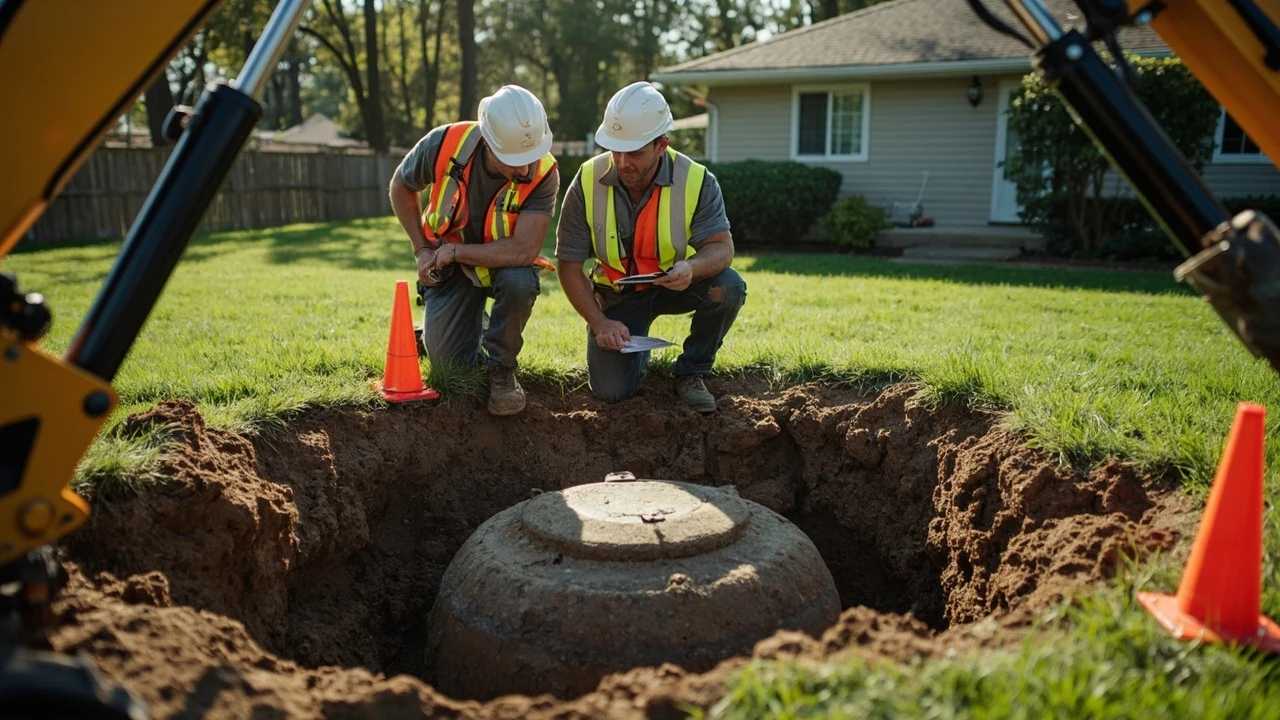
Septic tank replacement: when it is needed and what to expect
A septic tank that has served a home for twenty-five or thirty years rarely fails all at once. The first signs are usually subtle: a gurgle in the drain when the washing machine empties, a patch of grass that stays greener than the rest of the lawn after a dry week, a faint odor near the tank lid on a warm morning. By the time sewage backs up into a shower, the tank has often been overdue for attention for a long time. Septic tank replacement is the project homeowners face when pumping and repairs can no longer keep the system within safe operating limits, and the work itself raises a practical chain of questions: when is replacement actually the right call, what does the process involve, how long does the yard stay torn up, and what does a realistic budget look like before the first backhoe arrives.
This guide walks through those questions in the order most homeowners actually ask them. It covers the warning signs that point toward replacement rather than repair, the choices between like-for-like tanks and modern alternatives, the steps a contractor follows on site, the cost drivers that move a quote up or down, and the maintenance habits that protect a new tank for the next three decades. Where costs and timelines vary by region, the article flags the variables to ask about rather than quoting a single national number that would be misleading.
How to tell the system needs replacement rather than repair
A septic system gives owners a long series of small warnings before it stops working. Reading those warnings correctly is the difference between a planned project and an emergency. Three categories of evidence matter: the tank itself, the drain field, and the household behavior surrounding both.
Tank-level red flags
Concrete and steel tanks deteriorate in different ways, but the practical symptoms overlap.
- The tank needs pumping more often than every two to three years, even with normal household use.
- The tank lid is cracked, sunken, or visibly tilted, and groundwater or soil is seeping around the riser.
- Effluent inside the tank no longer separates cleanly, with solids floating into the outlet baffle or moving toward the drain field.
- The tank walls are bowed inward on a steel unit or crumbling along the seams on an older concrete unit.
- There is a persistent sewage odor at the lid or in the utility room where the plumbing exits the house.
Drain field red flags
When the drain field stops accepting water, the problem often traces back to a tank that is no longer doing its job, so replacement of the tank alone may not be enough. Warning signs include:
- Patches of lawn that stay wet or squishy even when the weather has been dry.
- Bright green grass growing in a narrow strip directly over the field, especially in dry spells.
- Sewage odors outdoors, usually downwind of the field in the early morning.
- Backups inside the home that occur only when multiple fixtures run at once, such as showers plus a dishwasher cycle.
- Slow drains across the house rather than a single clogged fixture, which usually points to the absorption side of the system rather than a local blockage.
Behavioral and structural cues
Some replacement decisions are driven by changes in the home rather than the tank’s age. A property being converted from a seasonal cabin to a full-time residence, a finished basement adding a bathroom, or a kitchen remodel that adds a garbage disposal can push an old, undersized tank past its design load. Likewise, a tank that sits under a new driveway, addition, or garage is often cheaper to relocate and replace than to work around. Local health departments usually require a permit before a tank is abandoned, moved, or replaced, and a site visit is the right place to confirm whether a repair permit is even available for the unit in question.
Repair, replacement, or a new system: the decision matrix
Not every problem requires a full replacement. A useful first step is to separate problems into those that live in the tank, those that live in the drain field, and those that come from how the system is being used.
| Problem | Likely fix | Reason |
|---|---|---|
| Single cracked lid or riser | Repair | The tank body is sound; only the access point needs replacement. |
| Failed outlet baffle | Repair or partial replacement | A new baffle can restore separation if the tank structure is intact. |
| Concrete walls crumbling, steel walls corroded | Full replacement | Structural loss cannot be reversed with patching. |
| Tank undersized for current household load | Replacement with a larger tank | Adding bedrooms or plumbing fixtures changes the design flow. |
| Drain field saturated and ponding | Field repair or full system replacement | Often combined with tank replacement to address the root cause. |
| Sand mound or alternative system required by soil | New engineered system | Local code may mandate an upgrade beyond a conventional tank and field. |
A contractor who diagnoses the system should be willing to walk the homeowner through each of these buckets in plain language. If the recommendation is immediate replacement without explaining what specifically failed, it is reasonable to ask for a second opinion, or at minimum a written scope that lists the failed components.
Choosing a replacement tank: material, size, and configuration
Once replacement is the agreed path, the practical decisions narrow to material, capacity, and whether the new tank will sit in the same hole as the old one.
Material options
Three materials dominate the residential replacement market in most of the United States. Each has trade-offs that matter over a thirty-year service life.
- Concrete: the most common choice for new and replacement installations, valued for weight, durability, and buoyancy resistance in high water tables. Quality depends heavily on the local precaster and the reinforcement schedule.
- Fiberglass: lighter to transport and resistant to corrosion, which makes it attractive in acidic soil. The lighter weight can be a drawback in areas with a high water table unless the tank is anchored.
- Polyethylene or HDPE: a plastic option that is also lightweight and corrosion-resistant, typically used for smaller capacities. Like fiberglass, it may need ballast or anchoring in saturated soils.
Sizing the new tank
For additional context, Tank size is driven by the number of bedrooms in the home, the estimated daily flow, and local code. A common rule of thumb used by many jurisdictions is roughly 250 to 300 gallons per bedroom for the first bedrooms, with additional capacity for fixtures such as a jetted tub or a basement bathroom. Local health departments publish the specific tables that apply in their county, and a permit reviewer will check the design against those tables before issuing approval.
| Home profile | Typical tank capacity | Notes |
|---|---|---|
| 1 to 2 bedroom cottage | 750 to 1,000 gallons | Often the minimum allowed for new construction. |
| 3 bedroom home | 1,000 to 1,250 gallons | Most common size for a single-family replacement. |
| 4 bedroom home | 1,250 to 1,500 gallons | Check local code for garbage disposal multipliers. |
| 5+ bedroom or accessory dwelling | 1,500+ gallons | May require a two-compartment or two-tank design. |
How the replacement work actually unfolds on site
A clear sequence helps set expectations and gives the homeowner a fair way to judge progress. While local practice varies, most residential septic tank replacement projects follow a similar order.
- Site evaluation and permit: a soil test or review of the existing perc test, location of the tank and field, and any easements or setbacks. The local health department issues a permit before excavation.
- Pumping and inspection: the existing tank is pumped out, and the contractor confirms the failure mode that drove the project.
- Excavation: the tank is uncovered, with care taken around the inlet and outlet pipes and any utilities that were marked in advance.
- Removal or abandonment: the old tank is lifted out, or, if it is concrete and structurally sound, it is sometimes crushed in place and filled with sand or gravel as an abandoned tank. Local rules determine which option is allowed.
- Setting the new tank: the bed is leveled, the tank is set on a sand or gravel base, and the inlet and outlet elevations are matched to the existing plumbing.
- Plumbing and risers: new piping is connected, risers are brought to grade for future access, and any distribution box or filter is installed.
- Backfill and compaction: the hole is backfilled in lifts, usually with the excavated material if it is clean, and the surface is restored.
- Final inspection and approval: the health department signs off, the contractor leaves the site, and the system is ready for use.
A typical single-tank replacement with good access takes one to three working days on site, with the permit and inspection schedule extending the overall timeline to one to three weeks. Difficult access, weather, the need to also replace part of the drain field, or a high water table can stretch the schedule further.
What septic tank replacement actually costs
Costs vary widely by region, soil, access, and whether the drain field is also being replaced. The two main drivers are the tank itself and the labor to install it, but several other line items frequently show up on a written estimate.
| Cost component | What it covers | Why it changes |
|---|---|---|
| Tank and risers | Material, delivery, and access hardware | Concrete is usually the most expensive material option. |
| Excavation and backfill | Equipment, operator, and labor | Depth, soil type, and access for the backhoe. |
| Pumping and disposal | Emptying the old tank and septage hauling | Distance to the receiving treatment facility. |
| Piping and baffles | Inlet, outlet, and distribution components | Whether the existing plumbing can be reused. |
| Permits and inspections | Local health department fees | Set by county or state. |
| Site restoration | Topsoil, seed, and any hardscape repair | Whether the tank sits under a lawn, driveway, or patio. |
Homeowners researching the project will see a wide range of figures in news articles and guides, because national averages mask local conditions. For example, a homeowners’ guide on septic tank replacement cost and ways to save notes that the work can run into thousands of dollars, and that several design and timing choices can meaningfully change the final bill. Reading that kind of overview alongside two or three local written estimates is the most reliable way to set a realistic budget for a specific property.
Cost variables that move a quote up or down
Beyond the headline number, several specific choices and conditions have an outsized effect on price.
- Access for equipment: a long, narrow side yard or a fenced backyard can require hand digging or smaller equipment, which adds labor time.
- Depth of the existing tank: a tank buried below the frost line or below a basement slab takes longer to expose.
- Soil conditions: rocky or clay-heavy soil slows excavation and may require additional bedding material.
- Water table: a high water table requires dewatering during installation and may rule out lightweight tanks without anchoring.
- Existing plumbing: if the home’s drain line has settled or shifted, the contractor may need to rework the line between the house and the new tank.
- Drain field condition: a field that has also failed can nearly double the project scope.
Permits, codes, and inspections
Septic systems are regulated at the state and county level rather than by a single federal standard, and the permitting authority is usually the local health department or a designated environmental agency. A few practical points apply almost everywhere.
- A permit is required before the old tank is removed or abandoned and before a new tank is installed.
- Setback rules determine how close the tank and field can sit to wells, property lines, water bodies, and structures. New setbacks are sometimes stricter than the setbacks on the original system.
- A final inspection is required before the excavation is closed up, and the inspector may ask to see the tank, the plumbing connections, and the risers before backfill.
- Records of the new system, including its location, capacity, and design, should be kept with the property records for future owners.
Homeowners who plan to sell within a few years of the work should ask for an as-built drawing or a copy of the permit. A documented replacement is a stronger selling point than a verbal history.
Common mistakes to avoid during a replacement project
Most problems with a replacement project trace back to a small set of decisions that are easy to get wrong under time pressure.
- Choosing the cheapest quote without comparing scope: a low bid may exclude pumping, restoration, or the permit, which then appear as change orders.
- Skipping the soil or site evaluation: replacing a tank without confirming that the soil and field can still accept effluent can lead to a new tank paired with a failing field.
- Ignoring household water habits: a new tank will fail early if the home continues to send heavy lint, grease, or non-degradable wipes into the system.
- Driving or parking over the new tank: even concrete tanks have load limits, and a riser that sits in a driveway will eventually be crushed by a delivery truck.
- Failing to map the system: a tank that is buried and forgotten becomes difficult to pump and impossible to replace cleanly the next time.
Living with a new tank: maintenance for the next thirty years
A well-installed tank is a quiet piece of infrastructure. The habits that protect it are straightforward and easy to keep on a household calendar.
- Pump the tank on a schedule matched to household size, typically every two to three years for a family of four, rather than waiting for a problem.
- Keep a record of each pump, including the date, the company, and the condition of the tank at the time.
- Avoid sending grease, coffee grounds, flushable wipes, and excessive bleach or chemical drain cleaners into the system.
- Spread laundry across the week instead of running many loads in a single day, which gives the tank time to settle between discharges.
- Divert roof gutters and surface water away from the drain field, since saturation is the leading cause of field failure.
- Keep the riser lid accessible and visible, and avoid planting deep-rooted trees or building structures over the tank or field.
How to choose the right contractor for the job
Septic tank replacement is a specialized trade that overlaps with general excavation but is regulated separately in most jurisdictions. A short checklist helps separate a good fit from a risky one.
- Confirm that the company is licensed or registered to install septic systems in the relevant county, and ask to see the registration number.
- Ask for a written scope that lists the tank size and material, the depth of excavation, the pumping plan, the backfill plan, and what is included in site restoration.
- Request references from at least two recent replacement projects of similar size, and ask whether those projects came in on budget and on schedule.
- Check that the contractor pulls the permit in their name rather than asking the homeowner to pull it, since the permit holder is accountable for the work.
- Confirm who is responsible for calling the inspection and for any rework if the inspector flags an issue.
Frequently asked questions
How long does a septic tank typically last before it needs replacement?
A well-maintained concrete tank commonly lasts thirty to forty years, while steel tanks often corrode within twenty to thirty years depending on soil acidity and groundwater conditions. Fiberglass and HDPE tanks can last longer in non-corrosive soils, but their service life is also sensitive to installation quality and the water table.
Can a septic tank be repaired instead of replaced?
Yes, when the issue is limited to a baffle, a lid, a riser, or the plumbing connections, repair is usually the right call. Replacement becomes the better option when the tank walls are failing, the tank is undersized, or the drain field has also been damaged by solids migrating out of the tank.
How do I know if my drain field needs replacement at the same time?
Slow drains across the house, wet spots over the field, and persistent odors after heavy use are the main signals. A contractor can run a dye test or a simple distribution box inspection to confirm whether the field is still accepting effluent at the design rate.
How long does the replacement work take on site?
Most single-tank replacements are completed in one to three working days of active construction, with additional time for permitting and inspections before and after. Difficult access, deep burial, or simultaneous field work can extend the on-site portion of the project.
What size tank do I need for a three-bedroom home?
Many jurisdictions specify 1,000 to 1,250 gallons for a three-bedroom home, but the actual requirement depends on local code, the presence of a garbage disposal, and any additional plumbing fixtures. The permit reviewer will confirm the correct size before approval.
Do I need a permit to replace a septic tank?
Yes. A permit from the local health department or environmental agency is required before the old tank is removed or abandoned and before a new tank is installed. The permit process usually includes a site visit and a final inspection.
Can I build a driveway or addition over a new septic tank?
It is best to avoid placing any structure or paved surface over a tank or its drain field. Risers can be brought to grade for access, but a tank is not designed to carry the load of vehicles, and access to the lid must remain available for pumping and inspection.
What can I do to make a new tank last longer?
Pump on a regular schedule, avoid sending grease and non-degradable items into the system, spread water use across the week, and keep roof runoff and surface water away from the drain field. A simple written record of each pump helps the next service call go smoothly.
Will homeowner’s insurance cover septic tank replacement?
Standard homeowner’s policies usually cover damage from sudden, specific causes such as a fallen tree or a vehicle impact, but not from age, wear, or gradual failure. Coverage for a failed tank is uncommon unless a named peril is involved, so it is worth checking the policy language before relying on it.
Is a plastic or fiberglass tank as good as concrete?
Plastic and fiberglass tanks are resistant to corrosion and are easier to transport, but they are lighter and may require anchoring in areas with a high water table. Concrete remains the most common residential choice for its weight, structural strength, and long track record.
Leave a Reply