
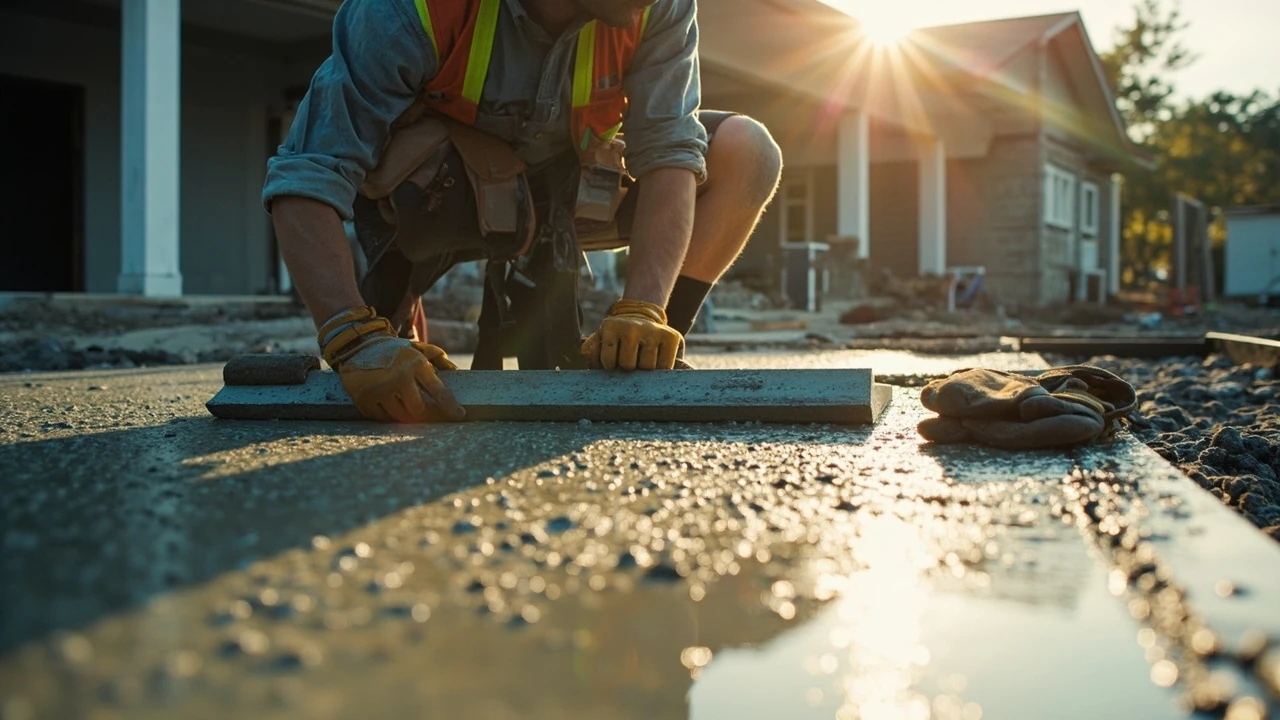
Concrete contractor: what they actually do on a residential or light commercial job
A concrete contractor is the tradesperson or small firm that takes a project from the bare ground to a finished slab, wall, or foundation that you can drive or build on. On a typical day they might layout forms at six in the morning, have a ready-mix truck on site by eight, finish the surface by noon, and spend the afternoon sawing control joints. The work is physical, weather-dependent, and unforgiving of shortcuts, because concrete does not wait for anyone once water hits the cement.
Because the trade is so local and so hands-on, a good concrete contractor is often the difference between a driveway that lasts thirty winters and one that spalls in three. The rest of this guide walks through what the work really involves, what it usually costs, how to read a written estimate, and how to tell a serious professional from someone who showed up with a mixer and a helper.
Where a concrete contractor fits in the broader project
General contractors coordinate many trades. A concrete contractor focuses on one specific scope: anything that uses Portland cement-based material as a finished product. In practice that covers a wide range of work, and a single contractor may specialize in only a few of them.
- Flatwork such as driveways, sidewalks, patios, garage floors, basement slabs, and shop floors
- Structural work including poured foundations, footings, retaining walls, and grade beams
- Decorative concrete such as stamped patios, exposed aggregate, colored slabs, and polished interior floors
- Repair and replacement work like mudjacking, slabjacking, partial slab replacement, and crack sealing
- Specialty services including concrete pumping, saw cutting, and shotcrete for pools or retaining structures
Knowing which category your project falls into matters because many contractors only do one or two of these well. A flatwork specialist may not be the right call for a foundation wall, and a decorative specialist may not want a plain utility slab.
The main services you can hire a concrete contractor for
When homeowners search for a concrete contractor, they are usually trying to solve one of a few practical problems. The list below covers the requests that show up most often in local markets, including the small cities in southeast Kansas where the trade is dominated by small owner-operated crews rather than regional chains.
- New driveways, replacements, and tear-out of cracked or heaved slabs
- Patios, porches, and outdoor living slabs that tie into existing landscaping
- Garage and shop floors, including thicker pours that handle heavier vehicles
- Sidewalks, curb cuts, and ADA ramps for residential or small commercial lots
- Basement and crawl space foundations for new construction and additions
- Retaining walls, footings for decks, and piers for porches or outbuildings
- Decorative finishes like broom-finished patios with picture-frame borders, stamped surfaces, and exposed aggregate
- Repair services including crack routing and sealing, slabjacking, and resurfacing of worn but structurally sound slabs
If you are weighing several of these at once, it is worth asking the contractor directly whether they self-perform the work or subcontract parts of it. A firm that self-performs its own forming, pouring, and finishing tends to control quality better than one that hands off stages to a revolving list of day crews.
How a concrete contractor scopes and prices a job
Pricing varies a lot by region, but the structure of an estimate is fairly consistent. Most contractors price concrete work in three layers: prep, pour, and finish. Each layer has its own line items, and reading the estimate line by line tells you a lot about how the contractor thinks about the job.
| Estimate layer | Typical line items | What it tells you |
|---|---|---|
| Site prep | Excavation, subgrade compaction, base rock, geotextile fabric, form setting | Whether the contractor plans to build a stable base or pour over marginal soil |
| Materials | Concrete by the cubic yard, rebar or wire mesh, expansion joint material, curing compound | Strength of mix, reinforcement plan, and whether proper joint material is included |
| Pour and finish | Labor for placing, screeding, floating, edging, jointing, and texturing | How much hand work you are paying for and what finish quality to expect |
| Add-ons | Removal of existing slab, pumping, sealing, decorative color, sealer, dumpster fees | Anything that can quietly inflate the bottom line if it is not discussed up front |
Two estimates for the same square footage can differ by twenty to forty percent and still both be honest, because the prep and reinforcement details are usually where the gap lives. A lower bid that skips base rock, uses a weaker mix, or omits reinforcement is not a bargain, it is a different slab.
What most concrete contractors actually charge
Because the focus here is on a general, evergreen picture, treat any specific number as a midpoint rather than a quote. Pricing changes with fuel costs, cement prices, labor availability, and weather, and it can shift noticeably even within a single year.
| Project type | Typical scope | Ballpark installed price (USD) | Main price drivers |
|---|---|---|---|
| Standard residential driveway | Tear-out, base, 4-inch pour with wire mesh, broom finish | Low four figures to mid five figures | Square footage, access for trucks, removal of old slab, region |
| Patio or porch slab | Site prep, forms, mesh-reinforced pour, basic finish | Low to mid four figures | Size, shape complexity, finish type, distance from truck |
| Garage or shop floor | Thicker 5 to 6 inch slab, heavier reinforcement, vapor barrier | Mid four figures to mid five figures | Thickness, reinforcement, vapor barrier, floor flatness tolerance |
| Basement or crawl space foundation | Excavation, footings, walls, waterproofing, backfill | Mid to high five figures and up | Wall height, soil conditions, waterproofing scope, code requirements |
| Decorative stamped or colored concrete | Integral color, release agent, stamping, sealer | Higher than plain flatwork of the same size | Pattern complexity, color count, custom borders, sealer quality |
For a concrete contractor in smaller local markets, including southeast Kansas and the surrounding region, a useful sanity check is to look at how typical homeowner projects cluster around the national average. Public cost summaries for Independence, KS put the minimum reported concrete project for homeowners at about $2,548, the average at roughly $3,663, and the maximum at about $4,545, which is consistent with mid-sized residential flatwork rather than full foundations. If a bid is well under those numbers for a similar project, it usually means something important is missing from the scope.
How to compare two concrete contractor estimates
Side-by-side comparisons only work if the line items line up. A common mistake is to look at the total and pick the lower number without checking what was actually priced. A more useful approach is to normalize both bids so you are comparing the same work.
- Check the slab thickness in inches. A 4 inch residential slab and a 5 inch slab look similar on paper but behave very differently under a loaded truck.
- Confirm concrete strength, usually expressed in psi. 3,000 psi is a common residential mix, 3,500 to 4,000 psi is typical for driveways that see heavier vehicles.
- Look at the reinforcement plan. Wire mesh on chairs, rebar on grade, and synthetic fibers are not interchangeable, and each has a different cost and performance profile.
- Compare base prep. A proper compacted base of crushed rock is more expensive to install but prevents the settlement and cracking that ruin cheaper slabs.
- Ask about joints. Control joints should be tooled or sawed at planned spacing, not left to random cracking.
- Look at finish details. Broom finish, edge profile, picture-frame border, and sealer all add labor and should appear in the estimate.
When you are working from a written scope, a useful mental model is that the cheapest bid usually matches the middle bid on materials and finishes, but quietly cuts prep and reinforcement. Those are exactly the parts of the job that determine whether the slab is still flat and crack-free ten years later.
How a concrete contractor plans a pour day
Pour day is the part of the job the homeowner sees, but most of the planning happens before the truck shows up. A careful contractor will think through the schedule, the crew, and the weather in detail, because reversing course mid-pour is extremely expensive.
- Confirm the weather window. Concrete wants air temperatures roughly between 40 and 90 degrees Fahrenheit during placement and the first day of curing, and the surface should not be allowed to freeze within the first 24 hours.
- Order concrete by the cubic yard with a small overage, usually 5 to 10 percent, to cover over-excavation, waste, and slab thickness variation.
- Check access. The chute on a ready-mix truck only reaches so far, so a long wheelbarrow run, a pump truck, or a buggy may be required and should be scheduled in advance.
- Stage tools and labor. Screeds, floats, edgers, jointers, finishing trowels, curing compound, and a water source for cleanup all need to be on site before the truck arrives.
- Plan the finish sequence. Broom finishes and stamped finishes have short working windows, so the crew has to be sized for the square footage and the temperature.
- Cure on schedule. Curing compound, wet burlap, or a curing blanket should be applied as soon as the surface can take it without marring.
If a contractor cannot clearly walk you through these steps, that is a fair signal that the pour day itself may not be as well organized as it should be.
Materials a concrete contractor chooses between
Most homeowners do not realize how many material decisions happen on a typical flatwork project. The table below summarizes the most common choices a residential or light commercial concrete contractor makes on a normal job.
| Material | Common options | When it is usually chosen |
|---|---|---|
| Concrete mix strength | 3,000 psi, 3,500 psi, 4,000 psi | 3,000 psi for patios, 3,500 psi for most driveways, 4,000 psi where heavier loads or freeze-thaw exposure are expected |
| Reinforcement | Wire mesh, rebar, synthetic fibers, no reinforcement | Mesh or rebar for structural slabs, fibers as a secondary control for plastic shrinkage cracking |
| Base material | Compacted crushed rock, recycled concrete, native soil | Crushed rock for driveways and garage floors, native soil only in low-risk areas with stable subgrade |
| Joint material | Tooled control joints, sawed joints, expansion joint filler | Tooled or sawed control joints in slabs, expansion joint filler where slab meets a fixed structure |
| Finish | Broom, trowel, stamped, exposed aggregate, polished | Broom for traction outdoors, trowel for interior floors, stamped or exposed aggregate for decorative patios |
| Sealer or cure | Curing compound, penetrating sealer, film-forming sealer | Curing compound on most flatwork, penetrating sealer for decorative concrete that needs to breathe |
These choices are interconnected. Higher strength mixes need more careful curing, and a decorative finish may need a sealer that is incompatible with the curing compound used at placement. A concrete contractor who works through these tradeoffs in advance tends to produce a more durable result than one who picks each option in isolation.
Questions to ask a concrete contractor before signing
The best way to filter contractors is to ask questions whose answers reveal how they plan and execute. The list below is a useful starting point. A good concrete contractor will answer these directly. A weak one will hedge, deflect, or rely on a single high number for reassurance.
- What slab thickness and concrete strength are you proposing for this project, and why?
- How will you prep the base, and what depth and type of base material do you plan to use?
- What reinforcement are you including, and how will it be supported off the ground?
- How will you handle control joints, and at what spacing?
- Who is on the crew on pour day, and how many finishers will be on the slab?
- What happens if the weather does not cooperate on the scheduled pour date?
- What is included in the price and what is treated as a change order?
- Do you carry general liability insurance and workers compensation, and can you provide a certificate?
- What warranty do you offer on the work, and what does it cover and exclude?
- Can you provide two or three recent local references for similar projects?
The warranty question is particularly informative. A confident contractor will explain what the warranty covers (for example, workmanship) and what it does not (for example, hairline shrinkage cracks that are normal in concrete), and will put that in writing.
How to verify a concrete contractor before you hire
Most concrete problems are not caused by bad luck. They are caused by a contractor who cut corners, did not show up, or was not really a contractor at all. A little verification up front prevents most of those outcomes.
- Confirm the legal business name and that it matches the name on the estimate and insurance certificate.
- Check that the contractor is registered or licensed in your state or locality, where registration is required.
- Ask for a copy of the insurance certificate directly from the insurer if possible, not just a photocopy.
- Drive by one or two recent jobs, ideally ones that are at least one or two winters old, so you can see how the work has held up.
- Call references and ask specifically about communication, schedule, and how the contractor handled any issues.
- Read the contract carefully, including payment schedule, change order process, and cancellation terms.
If the contractor asks for a large upfront deposit, that is a yellow flag. In most residential markets, a reasonable deposit is enough to cover materials, and the balance is tied to completion milestones. Be cautious about paying the full amount before the slab is placed and finished.
Common mistakes homeowners make when hiring a concrete contractor
Even careful homeowners repeat the same handful of mistakes. Knowing them in advance makes it easier to avoid them.
- Picking the lowest bid without checking what was removed from the scope
- Accepting verbal promises about thickness, reinforcement, or finish instead of written line items
- Letting the pour happen in clearly bad weather because the schedule has already slipped
- Skipping the base prep to save money, then wondering why the slab settled
- Failing to confirm access for the concrete truck, then paying extra for wheelbarrow work or a pump
- Walking on a new slab too early or driving on it before it has cured
- Choosing a decorative finish on a slab that is too thin or poorly reinforced for the traffic it will see
Most of these are avoidable with a clear written scope and a contractor who is willing to talk through the decisions in plain language. When in doubt, slow the project down. Concrete is one of the few trades where a week of patience can prevent a problem that lasts for decades.
How long a concrete contractor’s work should last
Service life depends on the slab, the exposure, and the maintenance, but there are useful general expectations.
| Project type | Realistic service life with reasonable maintenance | Main factors that shorten it |
|---|---|---|
| Residential driveway | 25 to 40 years | Heavy vehicles, deicing salt, poor base prep, thin pour |
| Patio or porch slab | 30 years and up | Freeze-thaw cycles, poor drainage, lack of sealing |
| Garage or shop floor | 30 years and up | Salt exposure, point loads from jacks, no vapor barrier |
| Basement or foundation wall | 50 years and up | Hydrostatic pressure, poor waterproofing, expansive soils |
| Decorative stamped or colored concrete | 20 to 30 years before resealing or recoloring | UV exposure, abrasive wear, missed resealing cycles |
These ranges are not guarantees, and a slab can fail early if any single part of the system is wrong, but they are useful benchmarks. If a contractor’s expected life is far below these ranges for a similar project, it is worth asking why.
How a concrete contractor handles repairs and resurfacing
Not every concrete problem calls for a full tear-out. A good concrete contractor will be honest about whether a slab can be saved and what a repair will and will not do.
- Hairline shrinkage cracks are common and usually do not affect performance. Routing and sealing them keeps water out and prevents the crack from spalling.
- Settlement or sunken slabs can often be lifted with foam injection or mudjacking, which is faster and cheaper than replacement.
- Surface wear, including light scaling and discoloration, can sometimes be addressed with a resurfacer or a decorative overlay, provided the underlying slab is sound.
- Structural cracking, heaving, or widespread spalling usually means the slab itself is compromised, and full replacement is the longer-lasting answer.
A contractor who proposes a repair should be able to explain what the repair is expected to achieve and how long it should last. If a repair is being sold as a permanent fix for a structural problem, that is a sign to get a second opinion.
How seasonal weather shapes a concrete contractor’s schedule
Concrete is a temperature-sensitive material, and most contractors plan their year around it. In colder climates the season effectively shuts down for frozen ground and sub-freezing pours. In hotter regions, summer pours may be scheduled early in the morning to avoid the worst of the heat, and admixtures may be used to slow the set.
- Spring and fall are usually the busiest seasons, with mild temperatures and stable weather.
- Summer pours can still be successful, but require careful attention to evaporation, early joint sawing, and curing.
- Winter work in cold climates is possible with blankets, heated enclosures, and special mix designs, but adds cost and complexity.
- Rains during placement are a real risk. Heavy rain can damage the surface, add water to the mix, and wash out cement from the top layer.
Homeowners who are flexible on timing sometimes get better pricing by scheduling outside the peak spring and fall windows, and a contractor will usually be upfront about what dates they have open.
What to expect on the day the concrete contractor arrives
Once the date is locked in, the day itself usually follows a familiar rhythm. Knowing the sequence helps you stay out of the way of the crew and spot any issues early.
- The crew arrives early to set forms, check dimensions, and confirm the location of the truck chute or pump.
- The concrete truck arrives and concrete is placed into the forms, often with help from the crew moving it with shovels, come-alongs, or a vibrator.
- The crew screeds the surface flat, then floats it to bring paste to the top and close the surface.
- Edges are tooled, control joints are tooled or sawed, and the final texture is applied.
- Control joints and edges are finished last, then curing compound is applied or wet curing begins.
- Forms are usually stripped the next day, and the slab is left to cure for at least several days before any heavy loads.
A good crew works quickly and quietly. A chaotic pour day, where workers seem unsure, tools are missing, or the truck is waiting, is a sign that the planning was not as thorough as it should have been.
How concrete contracting is organized in smaller regional markets
Outside the largest metros, concrete work is usually done by small owner-operated firms, often with one to three crews, and sometimes by individuals working under a larger general contractor. The independence of these firms is one of the reasons that local reputation and references matter so much. There is usually no large corporate brand standing behind the work, and the people on the slab are often the people who gave the estimate.
In a city like Independence, Kansas, for example, the local directory of concrete contractors lists several independent firms and individuals, including companies that focus on concrete, contractors that handle concrete alongside dirtwork and building construction, and specialty firms in adjacent trades like masonry, excavation, and bathroom remodeling. The list of concrete specialists in Independence, KS includes names such as DNA Contracting, Dixon Construction LLC, and Sanders Masonry and Construction, while other local firms like RJK Concrete and Construction Services and Hucke Construction cover concrete as part of a broader residential and agricultural portfolio. The point is not to endorse any one firm, but to illustrate how varied the local market is, and why it pays to verify exactly what each company actually does before signing.
Broader directory lists of this kind are useful as a starting point, but they are not a substitute for a site visit, references, and a written scope.
Frequently asked questions
What does a concrete contractor actually do?
A concrete contractor handles projects that use Portland cement-based material, including site prep, forming, placing, finishing, curing, and often removal of old concrete. Some focus on flatwork like driveways and patios, others on foundations, and others on decorative work.
How much does it cost to hire a concrete contractor?
For most residential flatwork, total cost usually lands in the low four figures for a small patio and the mid five figures for a full driveway replacement, depending on size, access, region, and finish. National and regional cost summaries can be used as a sanity check against any individual bid, but the written scope tells you far more than the bottom-line number.
How do I choose a concrete contractor?
Check that the company is registered or licensed where required, ask for proof of insurance, drive by recent jobs, talk to references, and compare written estimates line by line. A clear, specific scope is more important than a low total price.
How long does it take to pour and finish a typical residential job?
For a standard driveway or patio, the pour itself usually takes a few hours once the truck is on site, with the crew returning over the next day or two to strip forms, saw joints, and apply curing compound. Larger or more complex projects can take several days of active work.
When can I drive or walk on new concrete?
Light foot traffic is usually fine after 24 to 48 hours, but vehicles should stay off a new driveway for at least seven days and ideally longer, depending on mix, temperature, and slab thickness. The contractor should give a specific schedule for your pour.
What is the difference between concrete and cement?
Cement is an ingredient in concrete. Concrete is the finished mix of cement, water, sand, and aggregate. When people say cement driveway or cement patio, they almost always mean concrete, and a concrete contractor works with concrete, not raw cement.
Do I need a permit for a concrete project?
It depends on the scope and the local building department. Many municipalities require permits for new driveways that affect the curb cut, for foundations, and for some retaining walls, but not for simple patio replacements. Your concrete contractor should know the local rules.
What kind of warranty should I expect?
Reputable contractors typically offer a workmanship warranty, often one to several years, that covers things like excessive cracking or surface defects caused by the work itself. Material defects and damage from abuse, settlement, or weather are usually excluded. The exact terms should be in writing.
Can a cracked slab be repaired instead of replaced?
Sometimes. Hairline cracks can be routed and sealed, and sunken slabs can be lifted with foam or mudjacking. Widespread structural cracking, heaving, or deep spalling usually means replacement is the better long-term answer.
What is the best time of year to pour concrete?
Spring and fall offer the most stable conditions in most climates. Summer pours are workable with attention to heat and curing, and winter pours are possible with special measures but cost more. The exact best window depends on your region.
Leave a Reply