
Dethatching service: what it does and when your lawn needs one
When your lawn starts to feel spongy underfoot, repels water instead of drinking it, and keeps turning yellow no matter how often you fertilize, the problem is usually hiding just below the grass blades. A professional dethatching service is built to remove that hidden layer and give the soil a direct line to water, air, and nutrients again. For most homeowners, it is the single most underrated step in a yearly lawn care plan.
This guide walks through how a dethatching service actually works, the signs that point to a real thatch problem, what a realistic visit looks like on site, and how to judge whether a quote is fair. The goal is to help you decide, with calm evidence, whether to book a service or simply adjust your own routine.
What thatch is and why it matters
Thatch is the layer of dead and living organic material that builds up between the green grass blades and the soil surface. It is made of stems, roots, crowns, and clippings that decompose more slowly than they accumulate. A thin layer, under about half an inch, is normal and even helpful. It cushions foot traffic and insulates the soil against temperature swings.
Problems start when the layer gets thicker than the lawn can break down. When thatch exceeds roughly three quarters of an inch, water and fertilizer sit on top of the mat instead of reaching the roots. Disease and insect pressure rise, and the lawn becomes more sensitive to heat and drought. In most cases, a homeowner notices the symptoms before they ever look for the cause: dry spots that never recover, weak color after feeding, and that persistent spongy feel.
How a professional dethatching service works
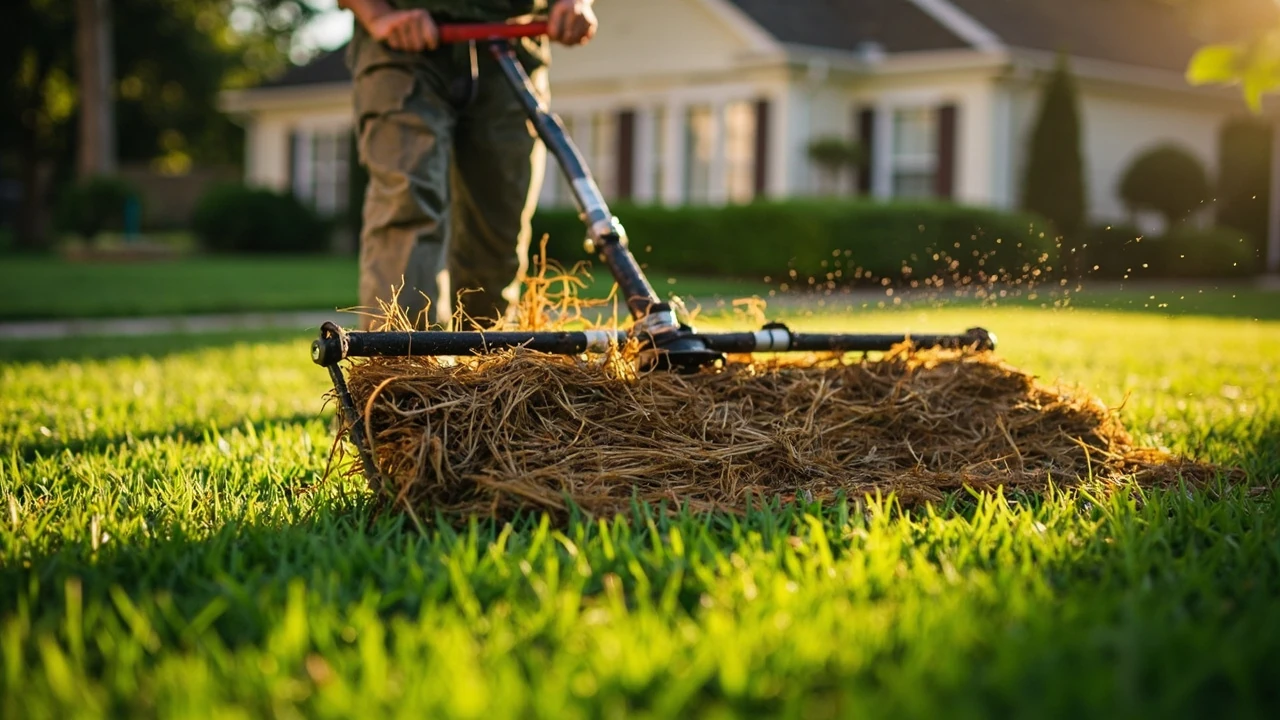
A dethatching service is not the same as a typical mow-and-go visit. The crew is using specialized equipment, usually a power rake or vertical mower, with blades or tines set to a calibrated depth. Those blades slice vertically through the thatch layer, pulling it up to the surface where it can be bagged or raked away. Done correctly, the process thins the mat without tearing out the living grass.
A well-run service follows a predictable sequence. Knowing that sequence helps you compare quotes and spot contractors who plan to cut corners.
- Inspection and measurement. The crew checks thatch depth with a soil probe or by cutting a small wedge out of the turf, then confirms grass type and overall lawn condition.
- Mowing and prep. The lawn is mowed shorter than normal, usually to about one and a half inches, so the machine can reach the thatch without catching on tall blades.
- Mechanical dethatching. A power rake or vertical mower makes one or two passes, depending on how thick the layer is, with depth adjusted for the grass species.
- Cleanup and removal. The pulled-up debris is bagged, raked, or vacuumed so it does not smother the lawn as it sits on top.
- Recovery plan. The crew recommends watering, overseeding, and a light feeding schedule to help the lawn recover in the following two to three weeks.
Clear signs you need a dethatching service
Not every tired lawn needs dethatching. Some problems look similar but have different causes, such as compacted soil, grub damage, or simply a dull mower blade. The signs below are the most reliable indicators that a thatch layer is the real issue.
- The lawn feels spongy or bouncy when you walk on it.
- Water pools or runs off instead of soaking in within a few minutes.
- Grass thins out in patches even with regular fertilizer and watering.
- You can see a thick brown or tan mat when you part the grass with your fingers.
- Disease and fungal problems keep coming back, especially in the same spots.
- You notice more insect activity, particularly chinch bugs and sod webworms, than in neighboring lawns.
If two or more of these apply, a dethatching service is usually a better first step than another round of fertilizer, which will simply feed the thatch layer instead of the soil.
When to skip dethatching and look elsewhere
Dethatching is not free, and it does stress the lawn for a short period. It only makes sense when thatch is the actual problem. In a few common situations, another service gives a better return.
- Compacted soil. If the lawn feels hard and water beads on the surface, the issue is compaction, not thatch. Aeration is the right tool there.
- New sod or new seed. Dethatching too early can rip out young plants. Most new lawns need at least one full growing season before mechanical dethatching.
- Drought-stressed lawns. Mid-summer dethatching in a heat wave can kill weak grass. Wait for the cool season to recover.
- Very thin grass. If more than a third of the lawn is bare, the problem is more about reseeding or resodding than removing thatch.
Best timing for a dethatching service by grass type
Timing is the most common reason a dethatching service underperforms. The lawn needs active growth to recover from the stress of the machine, so the visit has to land during the right window for the grass species in your yard.
| Grass type | Common varieties | Best dethatching window | Recovery expectation |
|---|---|---|---|
| Cool-season grass | Kentucky bluegrass, perennial ryegrass, tall fescue | Early fall, with early spring as a backup | Two to three weeks of active growth |
| Warm-season grass | Bermuda, zoysia, St. Augustine, centipede | Late spring to early summer, after full green-up | Two to four weeks in active growth |
| Transitional zones | Mix of cool and warm varieties | Early fall for cool grasses, late spring for warm patches | Varies by species in each zone |
For cool-season lawns, early fall is ideal because the grass is coming out of summer stress and has the entire fall and early winter to recover. For warm-season lawns, the window opens after the grass has fully greened up and closed by midsummer to avoid peak heat.
DIY dethatching versus hiring a service
Renting a dethatcher and doing the work yourself can save money, but only if the conditions line up. The comparison below is the one most contractors use internally to set their pricing, and it also helps you decide which route fits your situation.
| Factor | DIY dethatching | Professional dethatching service |
|---|---|---|
| Equipment cost | Rental fee plus transport and pickup | Included in service price |
| Labor | Several hours of physical work over a large yard | Handled by trained crew |
| Calibration risk | Higher; depth settings are easy to misjudge | Lower; techs set depth by grass species and thatch thickness |
| Cleanup | Raking, bagging, and disposal are on the homeowner | Bagging and haul-away often included |
| Recovery plan | You plan watering and overseeding on your own | Crew leaves with a written recovery schedule |
| Best fit | Small yards, healthy lawns, experienced homeowners | Larger lots, thick thatch, or first-time dethatching |
A useful rule of thumb: if the lawn is under 2,000 square feet and the thatch is moderate, a careful homeowner can handle it. Past that point, the time, the rental logistics, and the calibration risk usually favor a service.
What a fair dethatching service quote includes
Quotes vary widely because contractors bundle different steps, and because regional labor costs differ. The line items below are the ones a legitimate quote should call out, even if the language is simplified. If a quote skips these, ask why.
- Lawn size measured in square feet, not vague “lot size” descriptions.
- One or two passes specified, with a note on extra passes for very thick thatch.
- Depth setting by grass type, written into the work order.
- Bagging, raking, and haul-away of debris.
- Cleanup of hard surfaces, including driveways and walks, after the work.
- Optional overseeding and starter fertilizer, priced separately.
- A clear recovery plan, including watering frequency for the first two weeks.
How to prepare your yard before the crew arrives
The day before a scheduled dethatching service is worth preparing. Small steps cut the time on site and reduce the risk of damage to hidden objects.
- Mow the lawn slightly lower than normal and bag the clippings.
- Mark sprinkler heads, shallow irrigation lines, and any buried cable runs you know about.
- Remove toys, hoses, and pet waste from the lawn.
- Water lightly the night before if the soil is bone dry. Very dry soil tears more easily under the machine.
- Plan to keep pets and children off the lawn until the debris is removed.
What to do after a dethatching service
The two to three weeks after the visit are when the lawn either rebounds strongly or struggles. Most failures come down to two things: water and seed. A simple aftercare routine protects the investment.
- Water lightly once or twice a day for the first week to keep the soil surface moist, then taper to deeper, less frequent watering.
- Overseed bare or thin patches within a few days so new grass can fill in before weeds move in.
- Hold off on broadleaf weed control for at least three to four weeks so new seedlings can establish.
- Avoid heavy foot traffic across the lawn for the first week.
- Resume normal mowing once the new growth reaches about three inches, and never remove more than a third of the blade at a time.
How often you really need a dethatching service
Frequency is the most over-promised part of the lawn care industry. A well-balanced lawn with normal use, proper mowing height, and yearly aeration rarely needs dethatching more than once every one to three years. Lawns with aggressive growth, heavy fertilizer use, or certain grass varieties like Kentucky bluegrass can build thatch faster and may need it every year or two. The honest test is to measure thatch depth each spring with a soil probe rather than follow a fixed schedule.
Dethatching and lawn aeration: how they work together
It is common to see dethatching and core aeration sold as a package, and for good reason. They fix two different problems that often show up together. Dethatching removes the surface mat. Aeration relieves compaction deeper in the soil and gives roots room to spread. Done in the same visit, usually with dethatching first and aeration second, the lawn recovers faster than if either service is done alone.
| Service | What it removes or relieves | Best time | Effect on thatch |
|---|---|---|---|
| Dethatching | Surface mat of stems, crowns, and clippings | Active growth window for the grass | Direct reduction |
| Core aeration | Soil compaction and thatch mixed into soil | Same active growth window | Indirect, by speeding breakdown |
| Topdressing | Thin spots and uneven areas | After dethatching or aeration | Supports microbial breakdown |
Common mistakes to avoid with a dethatching service
Most unhappy experiences trace back to a small number of avoidable errors. A short list of the most common ones keeps the visit on track.
- Dethatching at the wrong time of year, especially during summer heat or winter dormancy.
- Setting the machine too deep, which rips out living grass along with the thatch.
- Skipping the post-service watering plan and letting the lawn dry out.
- Applying heavy fertilizer immediately after, which burns exposed roots.
- Treating thatch as a one-time fix instead of checking depth each year.
Cost expectations for a dethatching service
Pricing varies by region, lawn size, and how much cleanup is included, but a few patterns hold across most markets. The ranges below are realistic planning estimates for typical suburban lots. Always confirm with a written quote rather than a per-minute phone estimate.
| Lawn size | Typical dethatching service range | What’s usually included |
|---|---|---|
| Under 2,000 sq ft | Lower per-square-foot rate, often a minimum service fee | One pass, bagging, light cleanup |
| 2,000 to 5,000 sq ft | Mid-range per-square-foot pricing | One or two passes, bagging, haul-away |
| 5,000 to 10,000 sq ft | Lower per-square-foot rate due to scale | Two passes, full cleanup, optional overseeding |
| Over 10,000 sq ft | Custom quote by the visit or per acre | Multi-crew visit, mechanical cleanup, recovery plan |
Add-ons such as overseeding, starter fertilizer, or topdressing are usually priced separately. A clear quote lists each one so you can decide what you actually need this year.
How to choose the right dethatching service in your area
Most contractors have access to similar equipment, so the difference comes down to judgment and follow-through. A short list of questions separates the crews that know what they are doing from the ones just chasing the next job.
- How will you set the blade depth, and what depth do you use for my grass type?
- How many passes do you plan, and what changes that on site?
- Is bagging and haul-away included, and what happens to the debris?
- Do you recommend overseeding, and is that priced into the quote?
- What does your recovery plan look like for the first two weeks?
- Are you licensed and insured for this kind of work, and can you share a sample written quote?
Crews that answer these directly, in plain language, are the ones worth scheduling. The ones that quote by the minute or refuse to put the depth setting in writing tend to be the same ones that leave ruts and torn turf behind.
Frequently asked questions
How do I know if my lawn actually needs a dethatching service?
Cut a small wedge out of the turf with a trowel and measure the brown mat between the green grass and the soil. If it is more than about three quarters of an inch thick, a dethatching service is justified. Spongy feel, water runoff, and recurring disease are also strong signals.
When is the worst time to book a dethatching service?
Mid-summer heat and deep winter are the worst times for most lawns. Cool-season grasses should be dethatched in early fall. Warm-season grasses do best in late spring or early summer, after they have fully greened up.
How long does a dethatching service take on a typical yard?
Most crews finish a 5,000 square foot lawn in two to four hours, including setup, passes, and cleanup. Very thick thatch or two passes can extend that window, but the actual dethatching pass itself is usually the shortest part of the visit.
Can I dethatch and overseed at the same time?
Yes, and in many cases it is the best approach. Dethatching opens the soil surface, and overseeding right afterward gives new grass seed direct contact with the soil. Water lightly for the first week or two so the seed does not dry out.
Will a dethatching service kill my grass?
When the depth is set correctly and the lawn is in active growth, a dethatching service does not kill the grass. It does cause short-term stress, which is why timing and aftercare matter. Done at the wrong time of year or with the blades set too deep, it can thin the lawn significantly.
Is a dethatching service the same as power raking?
They overlap. Power raking is one of the common methods used inside a dethatching service. Vertical mowing is another. The label varies by region, so it is worth asking the contractor which method they plan to use and why.
How soon can I mow after a dethatching service?
Most lawns benefit from waiting at least a few days so the crowns can recover. Once new growth reaches about three inches, mow at normal height and never remove more than a third of the blade in a single pass.
Do I need to water the lawn after a dethatching service?
Yes. Light, frequent watering for the first week keeps the exposed soil from drying out and helps the lawn recover quickly. After that, taper back to deeper, less frequent watering to encourage stronger roots.
What if my lawn has both thatch and compaction?
That combination is common, especially on heavily used yards with clay soil. In that case, ask the contractor to dethatch first and follow with core aeration in the same visit. The combination addresses the surface mat and the deeper compaction at the same time.
How do I find a reliable dethatching service near me?
Look for local lawn care companies that publish their process in writing, show their equipment, and provide itemized quotes. A company that explains blade depth, pass count, and recovery steps up front is usually a safer choice than one that quotes only by the minute.
Leave a Reply