
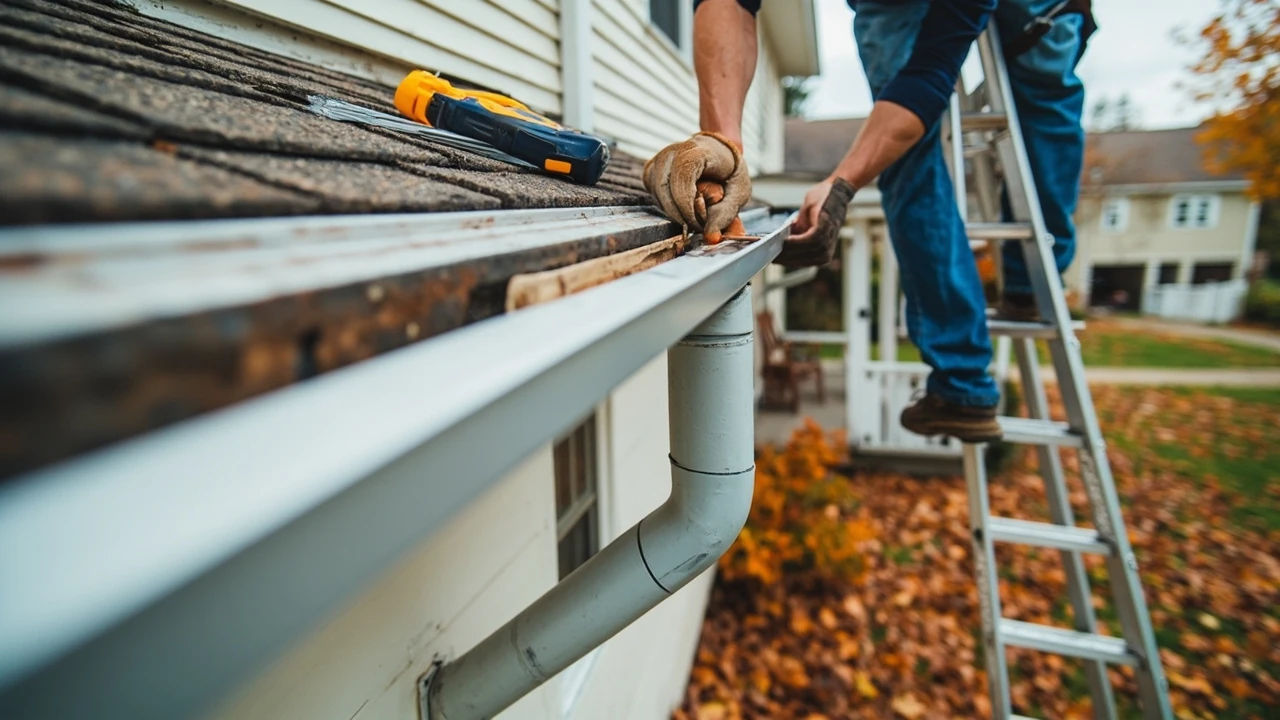
Gutter repair: what it really involves on a typical home
A homeowner in a tree-lined neighborhood watched a brown streak creep down the fascia board above the front porch. By the time the next storm hit, the streak had widened, paint was bubbling, and water was pooling against the foundation. The cause was not the roof or the shingles. It was a gutter section that had pulled away from the fascia by about half an inch, just enough to let a steady stream of water miss the channel entirely. That kind of slow, quiet failure is the most common reason people search for gutter repair in the first place.
Gutter repair covers the practical fixes that keep a working gutter system doing its job: re-securing loose sections, sealing leaks, replacing damaged lengths, unclogging downspouts, correcting pitch, and addressing the small water-management details that protect fascia, soffit, foundation, and landscaping. It is distinct from full gutter replacement, which means removing the existing system and installing new gutters and downspouts, and from routine cleaning, which is preventive maintenance rather than a fix for a known problem.
This article walks through the most common gutter problems worth fixing, the difference between a do-it-yourself fix and a professional repair, realistic cost ranges based on national data, and the practical questions to ask before hiring a contractor. It also covers the small details that separate a durable repair from one that fails again in the next heavy rain.
Most common gutter problems that need repair
Before deciding who fixes a gutter issue, it helps to identify the actual problem. The most common gutter repairs fall into a fairly small set of categories, and each one has a different cost, urgency, and skill level attached to it.
Leaks at seams and end caps
Sectional aluminum and vinyl gutters are joined together at seams every 10 or 20 feet. Over time, the sealant at these joints dries out, cracks, or pulls away, and water starts dripping behind the gutter instead of flowing through it. End caps and corner miters fail the same way. A seam leak is one of the most affordable gutter repairs and is often a good candidate for a careful homeowner fix.
Sagging or pulling-away sections
When a length of gutter sags in the middle or pulls away from the fascia, water stops flowing toward the downspout and begins to pool. Standing water adds weight, which makes the sag worse, and over time the section can separate entirely. The usual causes are loose or missing hangers, rotted fascia behind the gutter, or fasteners that have backed out of the wood.
Improper pitch
Gutters need a slight slope toward the downspout, typically about a quarter inch for every 10 feet of run. If a gutter was installed level, or has shifted over time, water sits in the channel instead of draining. Correcting pitch usually means loosening hangers, re-snapping a chalk line, and re-hanging the section.
Clogs in the channel or downspout
Clogs are technically a cleaning issue, but when a packed downspout has caused water to back up and overflow for long enough to rot the fascia or warp the gutter, the resulting damage is a repair problem. A serious clog can also freeze in cold climates, adding weight that bends the gutter out of shape.
Holes, cracks, and rust
Small holes in metal gutters can be patched with a sheet-metal repair patch and sealant. Rust is more common on older galvanized steel gutters and is often a sign that the system is nearing the end of its useful life. Vinyl gutters crack from UV exposure or impact, and a cracked section is usually replaced rather than patched.
Damaged downspouts
Downspouts get kicked, hit by lawn equipment, or simply pulled loose at the elbow where they meet the gutter. A dented or disconnected downspout is one of the simplest gutter repairs, but a missing downspout extension that lets water empty next to the foundation is a more serious problem because of the long-term damage it can cause.
Fascia and soffit damage behind the gutter
Sometimes the visible gutter is fine but the wood behind it has rotted. In that case, a true gutter repair has to include replacing the fascia board before the new section can be securely attached. Skipping this step leads to fasteners that pull loose again within a season or two.
How to tell whether you need a repair or a full replacement
One of the most common questions a homeowner asks is whether it makes sense to keep patching an old gutter system or invest in new gutters. The honest answer depends on three things: the extent of the damage, the age and material of the system, and how widespread the problems are.
| Situation | Likely answer | Why |
|---|---|---|
| One seam leak, otherwise sound system | Repair | Seam sealing is inexpensive and the rest of the system is functional |
| Two or three small holes, no rust, under 15 years old | Repair | Patch work is feasible and the metal still has life left |
| One sagging section, hangers loose, wood behind is solid | Repair | Re-hanging a single section is a normal gutter repair |
| Multiple sagging sections, widespread seam failure | Replace | When most sections are failing, new gutters are usually more cost-effective |
| Extensive rust across many sections | Replace | Rust spreads; patches are temporary on galvanized steel |
| Fascia rotted behind most of the system | Replace | You cannot attach new work to rotted wood; the substrate has to be rebuilt |
| Vinyl gutters with several cracks | Replace | Vinyl becomes brittle with age and tends to keep cracking |
As a rough rule of thumb, if more than a quarter to a third of the system is showing problems, or if the gutters are 20 or more years old, full replacement usually pencils out over another round of spot repairs.
What a professional gutter repair visit actually includes
A typical service call from a gutter repair contractor follows a predictable sequence. Understanding the steps helps a homeowner know what to expect and whether the work matches the price quoted.
- Inspection of the full system. A technician walks the perimeter, checks every run for pitch and secure hangers, looks at seams and end caps, and tests each downspout for flow.
- Diagnosis and written estimate. The contractor explains which sections need sealing, which need to be re-hung, which need to be replaced, and what the underlying cause is. The estimate should break out labor, materials, and any wood-replacement work.
- Preparation and safety setup. Ladders are positioned, stabilizers are used where possible, and the area below is cleared. Most pros work in two-person teams for safety and efficiency.
- The repair itself. Common tasks include cleaning the affected section, removing failed sealant, applying new high-grade gutter sealant, installing new hidden hangers or screws, re-pitching the run, replacing short sections, and reattaching downspouts.
- Water test. A good contractor runs a hose through the system before leaving to confirm that the repair actually drains and that no new leaks appear.
- Cleanup and a simple walkthrough. Debris is bagged, the area is rinsed down, and the technician shows the homeowner what was done and what to watch for over the next storm.
A For additional context, service visit like this is usually scheduled within a few days of the call, takes one to three hours for a straightforward repair, and does not require the homeowner to be home for the entire window.
DIY gutter repair versus hiring a pro
Some gutter problems are genuinely within reach of a careful homeowner with a sturdy extension ladder, basic tools, and a tolerance for working at height. Others are not, and the line between them is clearer than it looks.
| Task | DIY friendly? | What is involved | Typical risk |
|---|---|---|---|
| Sealing a small seam leak | Yes | Clean, dry, apply gutter sealant, let cure | Working wet or in cold weather ruins the seal |
| Reattaching a downspout or elbow | Yes | Sheet-metal screws, a drill, new straps | Wrong screws rust and stain the gutter |
| Replacing a short section on a single story | Possibly | Match material and color, cut, seal, rivet | Color mismatch and bad pitch are common |
| Re-pitching a long run | Mostly pro | Snap line, loosen hangers, rehang, test | Easy to overcorrect and create a new low spot |
| Replacing rotted fascia | Pro | Carpentry, often tied to roof edge | Hidden damage behind the gutter |
| Two-story or steep-pitch work | Pro | Specialized ladders and safety equipment | Real fall risk for a homeowner |
| Aluminum or copper soldering | Pro | Specialty tools and experience | Poor solder joints fail quickly |
The single biggest DIY risk is not skill; it is safety. Most gutter systems sit at the edge of a roof line, often above a deck or over uneven ground, and a fall from even a first-story gutter can cause serious injury. Any repair that requires leaning out, walking the roof, or working above a second-story drop is one to leave to a crew that does it every day.
How much gutter repair costs in 2026
National cost data for 2026 puts most small gutter repairs in the same general range, with the actual price driven by the type of repair, the height of the gutter, the material, and the local labor market.
| Repair type | Typical 2026 cost range | What affects the price |
|---|---|---|
| Seam or end-cap sealing | $75 to $200 | Number of joints, accessibility, material |
| Re-hanging a loose section | $150 to $400 | Number of new hangers, fascia condition |
| Re-pitching a gutter run | $200 to $500 | Length of run, number of brackets |
| Replacing a short section (under 10 ft) | $250 to $600 | Material, color match, height |
| Downspout replacement | $100 to $300 per downspout | Height, material, number of elbows |
| Fascia board replacement behind gutter | $300 to $800 | Linear feet, wood type, paint match |
| Two-story or steep-roof surcharge | $75 to $250 | Setup time, additional safety equipment |
For comparison, a full gutter replacement on a typical single-story home runs roughly $1,500 to $3,500 for aluminum and can climb to $4,000 to $8,000 or more for copper, depending on home size and the number of downspouts. That spread is the main reason targeted gutter repair is often the better value when the rest of the system is still sound.
Choosing a reliable gutter repair contractor
Gutter repair is not a regulated trade in most states, which means the quality of contractors varies widely. A short checklist helps sort the steady operators from the ones worth avoiding.
- Licensed, bonded, and insured. Ask for the license number and a current certificate of insurance. Coverage should include general liability and workers’ comp so a ladder accident is not the homeowner’s problem.
- Local address and a real track record. A Bay Area homeowner who hires a family-run crew with a verifiable local license and 15 years of experience is taking on a different level of risk than someone who hires an out-of-area truck that arrived after a storm. Local crews also know the regional weather patterns that drive the most common repairs.
- A written, itemized estimate. The estimate should list what is being repaired, what materials are being used, and the labor cost. Vague one-line quotes are a red flag.
- Warranty on the work. A one- to two-year workmanship warranty is common. The manufacturer may separately warranty the materials.
- References or recent reviews. A reputable contractor can point to recent jobs in the same area or has a steady stream of reviews on a verifiable third-party site.
- Clear payment terms. Avoid anyone asking for full payment up front. A small deposit or payment on completion is standard.
It is also worth asking whether the contractor does the work in-house or subcontracts it. Subcontracting is not automatically a problem, but the person quoting the job should be able to describe the crew that will actually show up.
How long a gutter repair should last
A well-executed seam seal, properly prepared and cured, should last 5 to 10 years before needing attention again. A re-hung section with new hangers and screws should last the remaining life of the gutter, which is another 10 to 20 years for aluminum and longer for copper. A short section replacement should be invisible from the ground and should perform like the rest of the system.
Repairs fail early for a predictable set of reasons:
- Sealant applied to a wet or dirty surface
- Wrong sealant for the gutter material
- Pitch not corrected, so water keeps pooling at the repair
- Hangers spaced too far apart for the local snow or leaf load
- Fascia not replaced, so screws back out within months
- Two dissimilar metals in contact, causing galvanic corrosion
Each of these is something a homeowner can ask about before the work starts. A good contractor will be able to name the specific sealant, hanger spacing, and material they plan to use.
Preventing the next gutter repair
Most gutter repairs are avoidable with a small amount of seasonal attention. None of the steps below are complicated, and together they extend the life of even an older system by several years.
- Clean gutters at least once a year. In a tree-heavy neighborhood, twice a year is better. The goal is to keep water flowing, not to keep the channels empty of every leaf.
- Check the downspouts. A clogged downspout is the single most common cause of an overflowing gutter. Water should run freely from the bottom during a test.
- Walk the perimeter after big storms. A five-minute look from the ground catches a pulled-away hanger or a new sag before it turns into a rotted fascia.
- Trim back overhanging branches. Fewer leaves in the gutter means less weight and fewer clogs.
- Consider gutter guards carefully. Quality guards reduce maintenance but do not eliminate it. Low-quality guards can create new problems by trapping debris at the edge.
- Redirect downspouts away from the foundation. Extensions or splash blocks should carry water at least four to six feet from the house.
These habits also make any future gutter repair cheaper, because the technician is fixing a real problem rather than working around years of accumulated neglect.
Seasonal timing for gutter repair
Most homeowners book gutter repair after they notice a problem, which usually means after the first big storm of the season. That timing is reactive, and it is also when contractors are busiest and prices are at their highest.
Late summer and early fall are often the best windows for a planned repair visit. The weather is dry, the schedule is more open, and any issues found can be fixed before the winter rain or snow arrives. In the Bay Area and similar climates, late summer through early fall is also the peak time for full-system replacements, so booking ahead matters.
Emergency repair, the kind that follows a storm that has torn a section off a house, is a different category. In that case, a temporary patch or tarp from any available contractor is reasonable, with a permanent repair scheduled as soon as the weather allows.
Frequently asked questions
What is the average cost of gutter repair for a typical home?
For a typical single-story home, a single small repair such as a seam seal or a re-hung section usually falls between $150 and $400 in 2026. Multiple repairs bundled into one visit typically total $400 to $900, and a more involved job that includes replacing short sections of gutter runs $600 to $1,500. Two-story homes, copper systems, and fascia replacement push the price higher.
Can you repair a gutter without replacing the whole system?
Yes, in most cases. As long as the underlying structure is sound and the damage is limited to specific sections, seams, or downspouts, targeted gutter repair is the more common and more cost-effective choice. Full replacement makes sense when the damage is widespread, the system is past its service life, or the fascia behind the gutter has rotted across most of the run.
How long does a typical gutter repair take?
A single, well-defined repair such as a seam seal, a re-hang, or a short section replacement usually takes 30 minutes to two hours. A larger visit that includes several repairs, a re-pitch, and a downspout replacement often takes two to four hours. Most professional crews can complete a standard repair in one visit without a follow-up.
Is it worth repairing old gutters, or should I just replace them?
It depends on the age of the system, the material, and the extent of the damage. If the gutters are aluminum or copper and the problems are limited to a few sections, repair is usually the better value. If the gutters are 20 or more years old, made of galvanized steel with widespread rust, or showing problems across most of the system, replacement generally makes more sense.
What are the signs that a gutter needs repair rather than just cleaning?
Visible leaks at seams, water marks on the fascia or soffit, sections pulling away from the house, standing water in the channel, mildew near the foundation, and water in the basement after a storm are all signs that the gutter system itself needs work, not just a cleaning. Cleaning addresses clogs; repair addresses the structure of the system.
Can a homeowner do gutter repair themselves?
Some repairs are realistic for a careful homeowner with a sturdy ladder and basic tools, including sealing a small seam, reattaching a downspout, or replacing a short, easily accessible section on a single-story home. Repairs that involve re-pitching a long run, replacing rotted fascia, or working above a single-story drop are usually better left to a professional crew.
How often should gutters be inspected to avoid major repairs?
A quick visual inspection from the ground once a season, combined with a closer look during a routine cleaning once or twice a year, catches most problems before they grow. A more formal inspection every two to three years, especially after a major storm or as the system approaches 15 to 20 years of age, is a good way to plan ahead.
Do gutter guards eliminate the need for gutter repair?
No. Quality guards reduce the amount of debris that enters the system and can lower the frequency of cleaning, but they do not stop all debris, and they do not address the underlying issues that cause most repairs: failing seams, loose hangers, and pitch problems. A common mistake is to assume that installing guards means the system can be ignored.
What is the difference between gutter repair and gutter replacement?
Gutter repair fixes specific problems in the existing system, such as leaks, loose sections, or damaged downspouts, while leaving the rest of the gutter in place. Gutter replacement removes the entire system and installs new gutters and downspouts. The choice between the two depends on the extent of the damage and the age of the system.
How do I find a trustworthy gutter repair contractor near me?
Look for a licensed and insured local company with a verifiable address, a written itemized estimate, a workmanship warranty, and recent reviews from customers in your area. Avoid door-to-door offers after storms, large upfront deposits, and contractors who cannot show proof of insurance. A short list of two or three quotes is usually enough to compare price and approach.
Quick reference: matching repair to problem
The table below condenses the decision points here into a single comparison a homeowner can use during a phone call with a contractor.
| Symptom | Likely cause | Likely fix | Pro or DIY |
|---|---|---|---|
| Drip behind a single joint | Failed seam sealant | Clean and reseal | DIY or pro |
| Section pulling away from fascia | Loose hangers or rotted wood | New hangers, possibly new fascia | Pro |
| Standing water in the channel | Wrong pitch | Re-pitch the run | Pro |
| Water beside the foundation | Missing or short downspout extension | Add or extend downspout | DIY or pro |
| Overflow during rain, no visible damage | Clogged downspout | Clear downspout, test flow | DIY or pro |
| Brown streak on fascia | Slow leak behind gutter | Seal joint, check for hidden rot | Pro |
| Pinhole leaks in metal | Surface corrosion | Patch and seal, monitor for more | Pro |
For a homeowner staring at a stained fascia or a section that has started to sag, the right next step is to identify the specific problem from the list above, decide whether it is a safe and realistic DIY task, and call a licensed local contractor for anything that involves the structure, the pitch, or any work above a single story. A reliable gutter repair visit, scheduled before the next big storm, is almost always cheaper and faster than waiting for the failure to spread into the fascia, the soffit, or the foundation.
Leave a Reply