
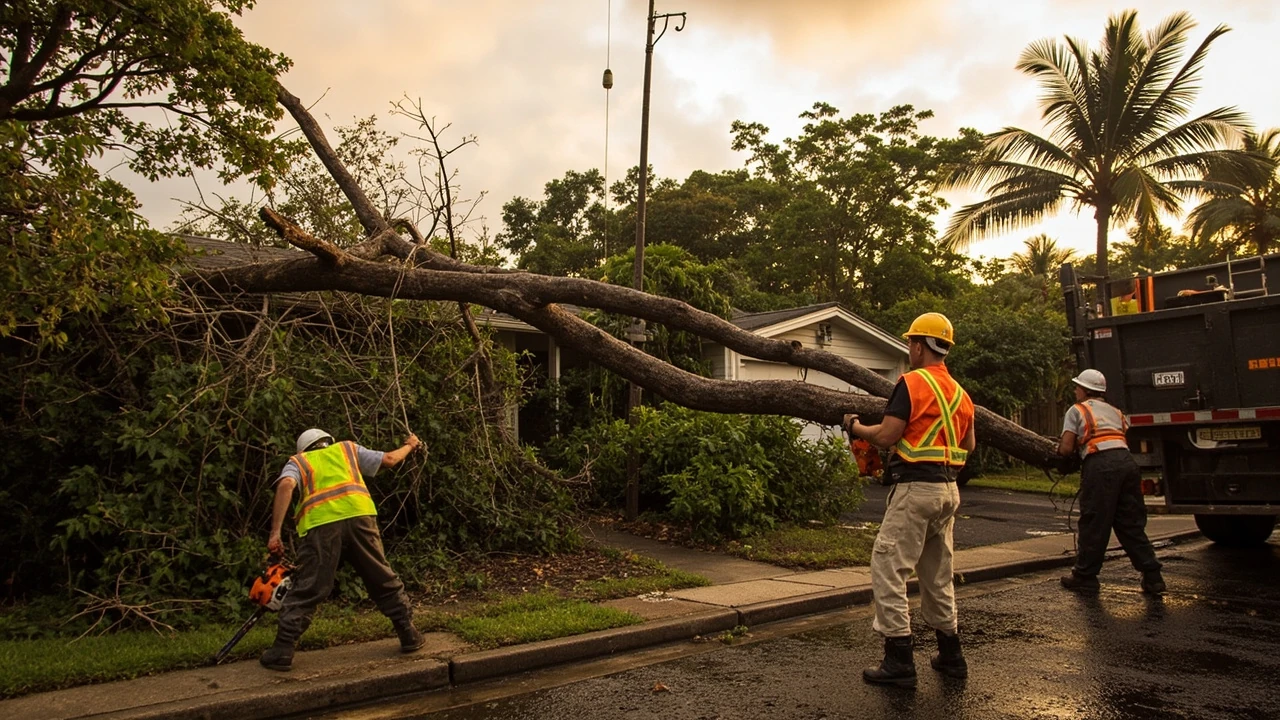
Downed tree removal in Honolulu: what to do first and who to call
A loud crack in the night, a sudden scrape against the roof, and then silence. That is how most Honolulu homeowners first experience downed tree removal, and the hours immediately after the fall are when the wrong decision costs the most. Stay clear of the tree, photograph what you can from a safe distance, and decide whether the situation is a 911 emergency or a job for a professional tree crew. Those three steps, in that order, protect both safety and any future insurance claim.
Honolulu’s climate makes these events more common than many residents expect. Trade wind squalls, Kona storms rolling in from the south, and the outer bands of Pacific hurricanes regularly push large trees onto houses, cars, driveways, and roads. Mature monkeypod, banyan, and Norfolk Island pine trees common across Oahu can be especially heavy when they fail. The rest of this guide walks through how to respond, who to call, what the work usually costs, and how to prevent the next failure.
First safety steps after a tree falls on your property
The first ten minutes after a tree comes down shape the rest of the incident. Move people, pets, and vehicles away from the trunk, the canopy, and any wires that sag into the tree. Do not try to cut a hanging limb, do not climb on the trunk, and do not pull a tarp over a roof penetration until the tree is stabilized. The instinct to “do something” is what sends people to the emergency room with chainsaw lacerations and crush injuries every year.
Once the area is clear, photograph the scene from a safe distance. Capture the full tree, the contact points with the house or car, any visible structural damage, and the trunk base if you can see it. These photos are the foundation of your insurance claim, and they are easier to take before crews begin cutting. After you have the photos, you can move on to the two phone calls that matter most.
Call 911 first if any of these are true
- A person is injured, even if the injury seems minor.
- Power lines are down, sagging, or touching the tree.
- There is active fire, smoke, or the smell of burning electrical insulation.
- Structural collapse is underway or the roof is visibly sagging.
- The tree is blocking a road and emergency vehicles cannot pass.
If none of those apply, skip 911 and call a tree removal crew directly. Honolulu crews that handle downed tree emergencies typically run 24/7 lines and can confirm an arrival window over the phone in a few minutes, which shortens the time your home is exposed to weather and pests.
When downed tree removal in Honolulu is actually an emergency
Not every fallen tree is a crisis, and treating every one as an emergency burns time and money. A limb on a lawn with no contact to anything can wait 24 to 72 hours in most cases. A tree leaning against a roof, blocking a driveway, or sitting on a power line cannot. The line between urgent and routine usually comes down to four checks.
Four-field check before you decide
| Check | Urgent | Can wait |
|---|---|---|
| Roof or structure contact | Tree resting on or pressing into a building, car, or fence post | Tree on open ground, no contact with structures |
| Utility lines | Any wire touching, draped over, or near the trunk or limbs | No wires within the tree’s reach |
| Access | Blocking a driveway, road, or the only exit from the property | Yard-only fall with full access around it |
| Hanging limbs | Large broken limbs still attached above a walkway, roof, or play area | Everything is on the ground and stable |
If two or more columns lean toward “urgent,” treat it as a same-day job. If everything is “can wait,” you have more flexibility on scheduling and can compare crews, get written quotes, and avoid the after-hours rate that emergency calls often trigger.
Who to call for downed tree removal in Honolulu
Three different groups of people can be the right call depending on what the tree is touching. Mixing them up is one of the most common mistakes homeowners make, and it either delays the response or creates a billing dispute.
- 911 and HFD: For injuries, fire, structural collapse, and any downed power line. Do not call a tree company first if a line is down.
- Hawaiian Electric: If a tree is on or near a power line but there is no fire or injury, the utility often dispatches a line crew to clear or de-energize the line before any tree work begins.
- Tree removal contractor: For the actual cutting, rigging, and hauling. A crew that handles downed tree removal in Honolulu will have aerial lifts, rigging rope, chainsaws, and a chipper, and will coordinate with the utility when lines are involved.
General landscapers are not the right call for a tree on a structure. Cutting a leaning trunk without proper rigging can drop additional weight onto the roof and turn a repairable hole into a collapsed section. Crews that handle emergency tree work in Honolulu specifically train for that risk.
What a professional downed tree removal actually involves
A crew that arrives for a downed tree in Honolulu follows a fairly predictable sequence, and understanding it helps you evaluate whether a quote and a plan make sense. The work is not just “cut it up and haul it away” when the tree is on a structure, and the planning stage is where most of the safety is built.
- Site assessment. The lead walks the property and checks roof contact, wall contact, soil stability, and the angle of lean. They look for tension in the trunk that could spring back when cut.
- Utility check. If any line is within reach of the tree or the planned cuts, the utility is called before cutting begins. No one cuts near a live line, even if the line looks undamaged.
- Rigging plan. For trees on structures, ropes and a lift are set so that each section is lowered rather than dropped. This protects the roof, the surrounding yard, and the crew.
- Sectional removal from the top down. Limbs come off first, then the upper trunk, then sections of the main trunk, working from the outside in. Each cut is controlled.
- Debris handling. Wood is cut into manageable sections, chipped on site where possible, and hauled away. Some crews leave logs for the homeowner on request.
- Final walkthrough. The lead walks the property with you, shows what was done, and points out anything that needs a roofer, a structural engineer, or follow-up stump grinding.
Typical cost ranges for downed tree removal in Honolulu
Costs vary widely with size, location, and risk, and any specific number should be confirmed in writing before work starts. The ranges below reflect what homeowners across Oahu typically see for common scenarios and are meant to help you sanity-check a quote, not to set a price.
| Scenario | Typical Honolulu price range | What drives the cost |
|---|---|---|
| Single large limb on lawn, no structure | $250 to $700 | Height, rigging needs, haul-away volume |
| Whole tree on open ground, under 30 feet | $500 to $1,500 | Trunk diameter, access for chip truck, species |
| Tree on a roof, single-story home | $1,500 to $4,000 | Rigging, lift rental, damage to roofing, permit |
| Tree on a roof, two-story or steep pitch | $3,000 to $8,000+ | Crane or larger lift, sectional removal time, utility coordination |
| Tree with power line involvement | Add $500 to $2,000+ | Utility coordination, slower pace, specialized crew |
| Stump grinding after removal | $150 to $600 | Stump diameter, root spread, accessibility |
After-hours and storm-event calls often carry a premium because crews are working overtime and demand spikes. If the fall is not an emergency, scheduling for the next business day usually saves 20 to 40 percent. A written quote should itemize the crew, the equipment, the debris haul, and any subcontracted utility work so you can compare one bid to another.
How Honolulu’s climate drives downed tree incidents
Honolulu’s weather is mild most of the year, which is exactly why big tree failures catch people off guard. Two storm patterns do most of the damage, and they stress trees in different ways.
- Trade wind squalls: Frequent, often intense, and short. They snap limbs and push shallow-rooted trees over without much warning.
- Kona storms: Less common but longer-lasting. They arrive from the south and southwest, which is the opposite of the prevailing trade winds. Trees that have grown to resist easterly wind can fail when the load comes from the other direction.
- Hurricane outer bands: Even without a direct hit, gusts above 50 mph can topple large trees, especially in exposed areas like Nuuanu and around Diamond Head.
None of this is unique to Honolulu, but the combination of mature tropical canopies, shallow volcanic soils, and sudden directional wind shifts makes the island a place where a healthy-looking tree can come down with very little warning.
Insurance, documentation, and what adjusters want to see
Homeowners insurance in Hawaii generally covers tree removal when the tree damages a “covered structure,” such as a home, garage, or fence. The coverage usually has limits, and the rules around debris cleanup are not always obvious. A few habits make the claim process much smoother.
- Photograph the tree, the structure, and the surrounding yard from multiple angles before any work begins.
- Save a sample of the broken limb or trunk section if the cause of failure is disputed.
- Keep all written quotes, contracts, and invoices from the tree crew.
- Log the timeline: when the tree fell, when you called the utility, when the crew arrived, and when the roof was tarped or repaired.
- Do not sign a full-release form with the tree company until the insurance adjuster has seen the site, unless you are prepared to absorb any disputed costs.
Documentation is the difference between a claim that closes in two weeks and one that drags on for months. The same habits that help with a downed tree also help with the related but separate problem of selling a home that has had storm damage; a clean repair file is reassuring to buyers and their lenders.
Preventing the next downed tree
Most downed tree removal jobs in Honolulu are avoidable. A short, regular maintenance routine catches the issues that lead to failure, and it costs a fraction of emergency work.
- Annual inspection of large trees. A certified arborist looks for cavities, fungal growth, dead limbs, and root plate issues. The best window is just before hurricane season, roughly May through June.
- Crown thinning and reduction. Removing selectively chosen branches reduces wind load without changing the tree’s shape. It is most useful for mature monkeypod and banyan trees with broad canopies.
- Dead wood removal. Dead limbs are the most common cause of partial falls, especially after Kona storms. Removing them in calm weather is a small job compared to removing them after they land on a roof.
- Root zone care. Avoid trenching, paving, or grade changes within the drip line. Roots recover slowly, and a damaged root plate is a common cause of whole-tree failures.
- Pre-storm preparation. Before a forecast storm, park vehicles away from large trees, secure patio furniture, and clear gutters so a downed limb does not also dump a roof-full of water into the house.
None of these steps guarantee a tree will stay upright in a major storm, but they reduce the odds that a healthy tree fails in a routine squall, which is the most common scenario for downed tree removal in Honolulu.
Choosing a downed tree removal crew in Honolulu
Not every tree company is set up for emergency work on Oahu. A few questions separate a good fit from a risky one, and they are worth asking before signing anything.
| Question to ask | What a good answer looks like |
|---|---|
| Are you licensed and insured in Hawaii? | Yes, with a current contractor’s license and liability and workers’ comp coverage. They should provide proof on request. |
| Do you handle trees on structures? | Yes, with rigging and aerial lift equipment, and a portfolio of similar jobs. |
| Do you coordinate with Hawaiian Electric when lines are involved? | Yes, and they will wait for the utility to clear or de-energize the line before cutting. |
| Is the quote written and itemized? | Yes, with crew, equipment, debris haul, and any subcontracted utility work broken out. |
| What is the response time for an emergency? | Specific, in hours, not “as soon as we can.” Confirm it in writing when you book. |
A crew that can answer these clearly is far less likely to leave you with a hidden bill, a damaged roof, or a missed utility step. The same contractor-evaluation habits apply to any specialized home service, including the more familiar work of getting a house ready to sell, where multiple trades need to coordinate around a tight schedule.
Common mistakes to avoid after a tree falls
Most of the expensive lessons from downed tree removal in Honolulu come from a short list of repeated mistakes. They are easy to avoid once you have seen them written down.
- Touching a downed line. Assume every wire is live, including cable and phone lines, until the utility confirms otherwise.
- Cutting the trunk yourself. A tension-loaded trunk can spring back violently. This is the most common cause of serious chainsaw injuries.
- Letting the first crew start without a written quote. Verbal quotes are hard to enforce, and storm pricing changes fast.
- Skipping the photo step. Once cutting starts, the original scene is gone, and the insurance claim becomes harder to prove.
- Ignoring the roof. A small hole today becomes a mold problem in two months. Tarp the roof as soon as the crew says it is safe to do so.
How downed tree removal fits into broader home maintenance
Tree work is one of several outside-the-house risks that Honolulu homeowners manage over the life of a property. Roofs, fencing, water heaters, and pest control all sit in the same maintenance bucket, and a serious storm tends to expose more than one weakness at a time. A homeowner who has already mapped out which contractors to call for which emergency recovers faster and spends less than one who is searching the phone after a tree hits the house. The same logic shows up in the planning guides for other large household projects, from a [getting house ready to sell checklist](https://betterbuildcontractors.com/getting-house-ready-to-sell-checklist/) to a [fence installation](https://betterbuildcontractors.com/fence-installation/) project that has to be scheduled around utility easements and tree root zones.
Frequently asked questions
How fast can a crew get to my home for downed tree removal in Honolulu?
For active emergencies inside Honolulu town, most established crews arrive within one to three hours, assuming they are not already on another job. After a major storm, response times stretch because the same crew is working a long triage list, and the highest-risk properties (trees on structures, trees on lines, blocked emergency access) are handled first.
Who pays for the tree removal, me or my insurance?
If the tree damages a covered structure such as your home, garage, or fence, most Hawaii homeowners policies cover the removal up to a stated limit, often a percentage of the dwelling coverage. If the tree is on open ground and did not damage anything, the cost is usually out of pocket. The exact answer depends on your policy, so call your carrier before scheduling non-emergency work.
What if the tree is on a power line?
Stay at least 30 feet away and call 911 if there is fire, injury, or visible damage to the line. Otherwise, call Hawaiian Electric and a tree removal crew that coordinates with the utility. No one should cut a tree that is in contact with a line until the utility confirms it is de-energized.
Can I leave the stump and clean it up later?
Yes. Most crews will cut the trunk close to the ground or just above grade, and you can schedule stump grinding separately. The exception is when the stump is on a slope or has roots lifting a walkway or driveway, in which case addressing it sooner avoids a trip hazard.
Do I need a permit to remove a downed tree in Honolulu?
For an emergency removal after a storm, the city generally allows work to proceed without a pre-issued permit, and crews document the situation for the after-the-fact paperwork. For non-urgent removals, especially of large trees, a permit is often required. Your contractor should be familiar with the current Honolulu process.
Will my homeowners insurance go up after a claim?
It can, depending on the carrier, the cause of the loss, and your claims history. A single weather-related claim is treated differently from a pattern of preventable claims, which is another reason to keep up with regular tree inspections and to document the storm that caused the failure.
What kinds of trees fail most often in Honolulu?
Mature monkeypod, banyan, and Norfolk Island pine trees are the most common in serious failures, partly because they are large and partly because their canopies catch wind from any direction. Dead or declining trees of any species also fail disproportionately, especially in Honolulu’s warm, humid climate where internal wood can soften quickly.
Should I be home when the crew arrives?
Yes, or have a trusted adult there. The lead will want to walk the site with you, confirm the plan, and get sign-off before cutting begins. Being there also helps you ask the follow-up questions that come up once the tree is off the roof and the real damage underneath is visible.
Is dead tree removal covered the same way as storm damage?
Not usually. If a dead tree falls in calm weather and damages a structure, some policies treat it as a maintenance issue rather than a covered loss. That is one reason annual inspections and proactive removal of visibly declining trees are worth the cost, even when the tree “still looks fine.”
How do I tell if a tree on my property is at risk of falling?
Look for large dead limbs, fungal growth at the base, bark peeling away without green wood underneath, visible cavities in the trunk, and a root plate that is lifting or heaving. A certified arborist can give a much more reliable answer in a one-hour inspection than any visual check from the ground, and the fee is small compared to a downed tree removal job.
Leave a Reply