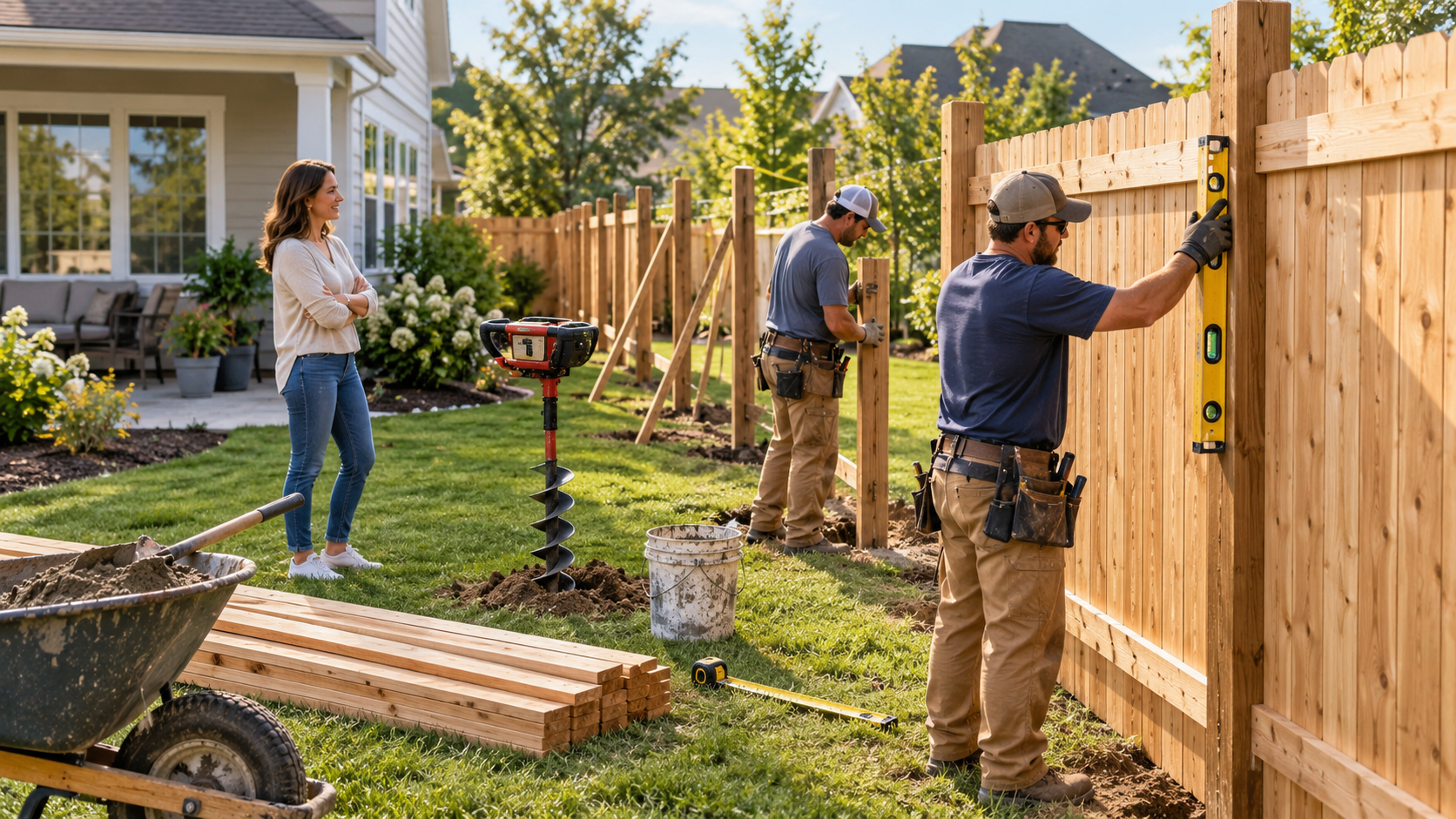
A new fence looks simple when you see the finished product. Straight posts. Clean lines. A gate that swings exactly where it should.
Getting there is another story.
Fence installation involves more than buying panels and digging a few holes. You have property lines to confirm, underground utilities to locate, materials to compare, local rules to check, and a surprisingly large number of decisions about height, gates, posts, finishes, and maintenance.
Then there is the big question: how much will the whole thing cost?
In 2026, homeowners in the United States are commonly spending a few thousand dollars on residential fence projects, but the range is wide. A short basic chain-link fence may stay relatively inexpensive. A tall privacy fence with premium materials, multiple gates, difficult terrain, and old-fence removal can climb well into five figures.
Recent U.S. project data puts an average fence installation around $3,277, with many projects falling between roughly $1,860 and $4,844. Another way to look at the market is by length: a 200-linear-foot wood or vinyl project can commonly cost around $4,000 to $12,000 installed.
That is quite a spread.
And honestly, that spread is useful. It tells you one thing right away: there is no meaningful “standard fence price” until you know what you are actually building.
How Much Does Fence Installation Cost?
Residential fencing is normally priced by the linear foot. That means contractors measure the total length of fence you need rather than simply looking at the square footage of your yard.
Across common residential materials, installed costs can range from under $10 per linear foot for very basic fencing to $60, $80, or even $90 per linear foot for premium materials and designs.
For a fairly typical project, around $20 to $60 per linear foot is a useful planning range for many wood and vinyl installations.
So a 100-foot fence could cost around $2,000 to $6,000. A 200-foot project might run $4,000 to $12,000.
But there is a catch. Cost per foot does not tell the whole story.
A small fence can sometimes cost more per foot because the contractor still has setup time, equipment, transportation, gate work, and other fixed costs. Meanwhile, a long, straight fence on flat ground may be faster to build per foot.
2026 Fence Cost by Material
The material is usually one of the biggest cost drivers.
| Fence Material | Typical Installed Cost per Linear Foot | Best Known For |
|---|---|---|
| Chain-link | $8-$40 | Low cost, durability, pets and boundaries |
| Wood | $10-$50 | Classic look, privacy, easy customization |
| Vinyl | $15-$60 | Low maintenance and clean appearance |
| Composite | $11-$85 | Low maintenance and wood-like appearance |
| Aluminum | $17-$90 | Decorative fencing and low maintenance |
| Steel | $17-$90 | Strength and security |
| Wrought iron | $25-$85 | Premium appearance and durability |
| Privacy fence | $10-$60 | Backyard screening and privacy |
These are broad national ranges. Your local quote can land outside them, especially in a high-cost metro area or when the job includes major site preparation.
For example, a simple four-foot chain-link fence on level ground is a very different project from an eight-foot horizontal cedar privacy fence built into a slope.
Both are technically fences. Their budgets have almost nothing else in common.
Wood Fence Installation: Still a Favorite
Wood remains one of the most popular residential fence materials in the U.S. It feels natural, works with many home styles, and can be built in almost any design you can imagine.
A professionally installed wood fence often costs roughly $10 to $50 per linear foot depending on the source, wood species, height, design, and local labor market. Recent 2026 project data puts many complete wood fence projects around $1,900 to $4,950.
Pine and pressure-treated lumber usually sit toward the more affordable end. Cedar often costs more but is popular because of its appearance and natural resistance to decay.
And then there are the designs.
A basic picket fence needs less lumber than a six-foot board-on-board privacy fence. Horizontal boards may require additional framing. Decorative tops, lattice, post caps, and custom gates all add time and material.
Wood also comes with maintenance.
Depending on the wood and climate, you may need staining, sealing, painting, board replacement, or occasional post repair over the years.
That does not make wood a bad deal. It just means the cheapest installation price is not the only number worth thinking about.
Vinyl Fence Installation: Pay More, Maintain Less
Vinyl fencing has become common in American suburbs for a simple reason: homeowners like fences that do not ask for much attention.
There is no staining every few years. No peeling paint. No splinters.
For standard four- or six-foot vinyl fencing, 2026 installed prices often fall around $15 to $40 per linear foot, although broader market ranges can reach approximately $60 per foot depending on design and location.
Vinyl usually costs more upfront than basic wood, but maintenance tends to be simpler. Washing dirt or algae from the surface is often the main routine job.
The downside?
Vinyl does not offer the same easy repair flexibility as wood. If a specific panel gets damaged, you usually replace the matching component rather than grabbing a board from the hardware store and cutting it to size.
Quality also matters. Thin bargain panels and sturdy premium vinyl products are not the same thing, especially in areas with strong wind or extreme temperatures.
Chain-Link: Still the Budget Workhorse
Chain-link will probably never win a backyard beauty contest, but it has survived for decades because it solves a practical problem very well.
It creates a durable boundary without blocking the entire view.
Installed chain-link pricing commonly runs about $8 to $40 per linear foot in 2026. Four-foot galvanized fencing tends to sit near the lower end, while taller fences, heavier materials, coatings, and more complicated installations raise the price.
Black vinyl-coated chain-link has become popular for homeowners who want something less industrial-looking than bright galvanized steel.
For dogs, side yards, utility areas, and large properties, chain-link can make a lot of financial sense.
And if you need several hundred feet of fencing, saving $10 or $20 per foot adds up very fast.
Aluminum, Steel, and Wrought Iron
Metal fencing often moves the conversation from “basic yard boundary” to “part of the architecture.”
Aluminum is popular around front yards, landscaped properties, and pools because it gives you an open decorative look without the rust concerns associated with traditional iron.
Steel offers more strength.
Traditional wrought-iron-style fencing sits toward the premium end of the market and can reach $50 to $85 per linear foot or more in elaborate projects.
If you have a historic home, stone columns, a formal front yard, or a property where curb appeal matters as much as containment, the extra cost may be worth it.
If your main goal is simply stopping your Labrador from visiting the neighbors, probably not.
What Actually Changes Your Fence Installation Price?
Material gets most of the attention, but it is only one part of the quote.
Several other details can push the total up fast:
- Fence length and height
- Material and design
- Number and size of gates
- Sloped, rocky, or uneven terrain
- Tree roots and landscaping
- Old fence demolition and disposal
- Permit requirements
- Property surveys
- Working around underground utilities
- Concrete and post depth
- Decorative caps, trim, lattice, or custom hardware
- Painting or staining after installation
You may look at your yard and think, “It is just a straight line.” The installer may see twelve buried roots, a slope, irrigation lines, two gates, and fifty post holes.
That is why an in-person quote is usually more useful than an online calculator.
Fence Height Makes a Bigger Difference Than You Think
A four-foot picket fence and an eight-foot privacy fence are not simply the same fence with taller boards.
A taller fence catches more wind. It weighs more. It needs more material. Posts may need to be larger or set deeper, and local regulations may treat taller fences differently.
For privacy fencing, six feet is common in residential backyards. Eight-foot fences can be considerably more expensive and may face stricter local rules.
Recent national cost data puts many six-foot wood or vinyl privacy fences around $25 to $60 per linear foot, while eight-foot versions can climb toward $50 to $85 per foot.
So if you mainly want to stop a dog from leaving the yard, think carefully before automatically going to eight feet.
You may be buying a lot of fence you do not need.
Gates: The Little Part That Can Cost a Lot
People often measure the fence and forget about the gates until the estimate arrives.
A basic walk-through gate may add a few hundred dollars. Large double gates, driveway gates, custom metal gates, and automatic systems can cost far more.
Current national pricing puts many gate additions somewhere around $150 to $2,000, depending on design and size.
Placement matters too.
If you regularly move a riding mower, trailer, wheelbarrow, trash bins, or landscaping equipment through the yard, a narrow gate can become annoying very quickly.
Think about how you actually use the property before deciding where the gate goes.
This is one of those small decisions that either feels completely obvious five years later or makes you wonder why nobody thought about it.
Removing an Old Fence
If an old fence is already standing where the new one needs to go, demolition needs to be part of the budget.
Professional removal commonly adds around $3 to $5 per linear foot, though difficult posts, concrete footings, access problems, and disposal fees can push the number higher.
The old posts are usually the annoying part.
A board can be removed in seconds. A four-by-four surrounded by a large chunk of concrete is another story.
Some contractors include removal in the total estimate. Others list it as a separate line item.
Do not assume.
What If Your Yard Is Sloped?
A gentle slope is usually manageable. A steep or uneven yard changes the project.
A contractor may rack the fence so the panels follow the grade, or step individual sections down the slope.
Those methods look different, and not every fence style handles slopes equally well.
Vinyl panels can sometimes be less flexible on dramatic grade changes. Wood is easier to modify on-site. Metal fencing may be manufactured or installed specifically for the slope.
Major leveling can also become its own landscaping project. National cost estimates for land leveling can run into the $1,000 to $3,200 range, depending on the amount of work required.
If your backyard resembles a ski hill, send photos when requesting quotes. Better yet, have the contractor walk the property.
Before Anyone Digs: Call 811
Fence posts go into the ground. Underground utility lines do too.
That combination deserves respect.
In the United States, homeowners and contractors should contact 811 before digging so participating utilities can mark buried lines in the work area. The required advance notice varies by state, so do not assume you can call Friday morning and start drilling post holes Friday afternoon.
Natural gas, electric, telecommunications, water, and other lines may be located underground.
And yes, the route can be surprising.
You may have lived in the house for 15 years and still have no reliable idea where every buried line runs.
One more wrinkle: private lines may not always be marked through the standard utility-locate process. That can include certain irrigation systems, private electrical lines, or lines installed beyond utility ownership points. When in doubt, ask what is and is not covered in your area.
Do You Need a Permit for a Fence?
Maybe.
There is no single national residential fence rule for the entire United States. Cities, counties, homeowners associations, and local zoning rules can all affect what you are allowed to build.
A basic permit may be inexpensive; recent national cost data puts many fence permits around $20 to $60. But local rules vary, and some places may charge more or require additional documents.
Height can matter. Front-yard fences may face different restrictions from backyard fences. Corner lots can have visibility requirements. Pool fences usually have their own safety rules. Historic districts and homeowners associations may add another layer.
Check before buying materials.
Discovering that your HOA allows only four-foot black aluminum after a truck delivers 180 feet of six-foot white vinyl would be a rough afternoon.
Where Exactly Is Your Property Line?
This sounds obvious until two neighbors have slightly different ideas about where the boundary actually sits.
Old fences are not automatically proof of the legal property line.
Neither is a row of trees.
Neither is the place where the previous owner always mowed.
If the boundary is unclear, review your property records and consider a professional land survey before installation.
Building six inches onto a neighbor’s property can turn a nice backyard upgrade into a legal headache and potentially require moving the fence.
Talking to the neighbor is a good idea too. You may not always be legally required to announce the project, but a quick conversation can prevent a lot of awkwardness.
What Happens During Professional Fence Installation?
The exact process changes by material, but most projects follow roughly the same sequence.
| Stage | What Happens | Why It Matters |
|---|---|---|
| Planning | Fence line, height, gates, material, and layout are confirmed | Prevents expensive changes later |
| Utility marking | Underground utilities are identified before digging | Helps prevent dangerous utility damage |
| Site preparation | Old fencing, vegetation, or obstacles may be removed | Creates a workable fence line |
| Post layout | Post locations are measured and marked | Keeps panels straight and evenly spaced |
| Post installation | Holes are dug and posts are set | Posts form the structural backbone of the fence |
| Panels or rails | Fence sections are attached after posts are ready | Creates the finished barrier |
| Gates and hardware | Hinges, latches, gates, and accessories are installed | Provides practical access |
| Final check | Alignment, gate movement, hardware, and cleanup are reviewed | Catches problems before the crew leaves |
Many straightforward professional projects can be physically installed within a few days. Planning, material ordering, permits, utility marking, weather, and concrete curing can stretch the calendar much longer.
In other words, “two-day installation” does not necessarily mean you call on Monday and have a finished fence Wednesday.
Should You Install a Fence Yourself?
Fence installation looks like an ideal DIY project on YouTube.
Dig hole. Set post. Attach panel. Repeat.
Then hole number four hits a giant root, post number seven is two inches out of line, and the gate somehow refuses to close.
A handy homeowner absolutely can build a fence, particularly a short, simple project on level ground.
DIY may save a meaningful chunk of labor cost. Recent national estimates suggest homeowners can save around $1,700 in labor on an average project.
But remember that you will still need materials, concrete, fasteners, tools, disposal, possibly equipment rental, permits, and a utility locate.
And digging dozens of deep post holes is real physical work.
DIY makes the most sense when:
- The fence is relatively short
- The property is flat and accessible
- The design is simple
- You already own many of the necessary tools
- You know where the legal boundary is
- You are comfortable laying out posts accurately
- You have enough time to finish the project without rushing
If the yard is steep, the soil is rocky, you need a large driveway gate, or the fence is several hundred feet long, professional installation starts looking a lot more attractive.
Why Good Post Installation Matters So Much
You can buy beautiful cedar boards and expensive hardware, but if the posts are bad, the fence is bad.
Posts keep everything upright.
They have to handle wind, gate weight, wet soil, freeze-thaw cycles in colder climates, and constant movement over the years.
Depth depends on fence height, local soil conditions, frost depth, engineering needs, and local practice. This is another reason generic online advice such as “dig every hole exactly two feet deep” is not great guidance for the entire country.
A contractor working in Florida deals with different ground and weather conditions from one building fences in Minnesota.
The pretty boards are what you see.
The post holes are what make the pretty boards stay there.
Which Fence Is Best for Privacy?
For backyard privacy, homeowners usually look at six-foot wood, vinyl, or composite fencing.
Wood gives you the most design flexibility. Vinyl reduces routine maintenance. Composite can offer a premium wood-like look with less upkeep but often comes at a higher initial price.
Board-on-board wood designs reduce gaps between boards. Shadowbox fencing offers partial airflow and a finished appearance from both sides. Solid vinyl panels provide strong visual privacy.
Think about wind before creating a completely solid wall around an exposed yard.
A fence that blocks sight also blocks airflow, which increases the wind load on posts.
Best Fence for Dogs
The right dog fence depends more on the dog than the Pinterest board.
A calm little dog and a young athletic German Shepherd do not present the same containment problem.
Think about jumping, digging, visibility, and gate latches.
Some dogs become more reactive when they can see pedestrians or neighboring animals through chain-link. A solid privacy fence can help in those cases. Other dogs simply need a clear physical boundary and do perfectly well with chain-link or picket fencing.
Also inspect the bottom edge. A beautiful six-foot fence does not do much if your dog can squeeze through a six-inch gap underneath it.
What About Pool Fences?
Pool fencing is a safety feature first and a landscape feature second.
Rules vary by state and local jurisdiction, and requirements can cover fence height, openings, gate direction, self-closing hardware, self-latching gates, and placement.
Do not copy a neighbor’s pool fence and assume it meets the current requirements for your property.
Check locally before construction.
Aluminum fencing is common around pools because it provides a barrier without completely blocking the view. Vinyl, mesh systems, and other approved designs are also seen depending on local rules and the type of pool.
How to Compare Fence Installation Quotes
Three quotes can show three different totals even when every contractor is technically pricing the same yard.
Look beyond the final number.
Before signing anything, compare:
- Exact fence material and product specifications
- Fence height and total linear footage
- Post size, material, spacing, and installation method
- Number and width of gates
- Gate hardware
- Old fence removal
- Concrete and other installation materials
- Permit responsibility
- Cleanup and debris hauling
- Labor and material warranty
- Expected start and completion schedule
- What happens if hidden site problems are found
A $4,500 estimate and a $5,100 estimate may not actually differ by $600 if the second includes demolition, hauling, two gates, and permit handling.
Itemized quotes make that much easier to see.
Cheap Fence Installation Can Get Expensive Later
The cheapest quote is tempting. Sometimes it is genuinely the best deal.
Sometimes the price is low because something is missing.
Thin posts, poor hardware, shallow holes, low-grade panels, no cleanup, or vague warranty terms can turn a bargain into repairs a few seasons later.
Look closely at the contractor too.
Ask about insurance, warranty, recent local work, and who will actually perform the installation. Make sure the written proposal matches what was discussed.
A fence is exposed to sun, rain, wind, snow, lawn equipment, pets, kids, and moving soil every day of its life.
It needs more than good looks on installation day.
When Is the Best Time to Install a Fence?
There is no single perfect season across the U.S.
Spring and summer are popular because homeowners are outdoors and the ground is generally workable. The downside is demand. Fence companies can get busy.
Fall can be excellent in many regions because temperatures are cooler and landscaping work may be slowing down.
Winter installation is possible in some climates, but frozen ground and severe weather can complicate digging in northern areas.
If your schedule is flexible, ask local installers when their slower season falls. You may have more scheduling options outside peak spring demand.
Can a New Fence Increase Home Value?
A good fence can make a home more appealing, but it is better to think in terms of usefulness and marketability than guaranteed dollar-for-dollar return.
Buyers with dogs or young children may see a fenced backyard as a major benefit. Privacy can be valuable in dense neighborhoods. A damaged, leaning fence can have the opposite effect.
Material and style matter too.
An elegant fence that fits the house and neighborhood may improve curb appeal. A huge privacy wall across an otherwise open front yard may not.
If resale is part of your thinking, keep the design reasonably consistent with nearby properties.
How to Keep Fence Installation Costs Under Control
The easiest savings usually happen during planning, not after construction starts.
Measure the area before collecting quotes. Decide where privacy is actually necessary. Maybe you need solid fencing only across the back and inexpensive open fencing along the sides.
Keep the layout as simple as practical. Every corner and gate adds work.
Do not automatically buy the tallest fence available.
And compare materials based on total ownership, not only the first invoice. Wood can cost less upfront but needs maintenance. Vinyl costs more initially but asks for less work later.
There is no universal winner.
Common Fence Installation Mistakes
One of the biggest mistakes is starting with the fence style instead of the purpose.
A homeowner sees a gorgeous horizontal cedar fence online and decides that is the answer. But maybe the real goal is keeping a small dog contained on a large lot. Suddenly a much less expensive design might do the job just as well.
Another mistake is ignoring drainage and grade.
Then there is the classic property-line problem.
And, of course, forgetting the gate.
Think about what needs to pass through that gate before its width becomes permanent.
Good planning is not glamorous, but neither is rebuilding a gate because your lawn tractor is three inches too wide.
FAQ
How much does fence installation cost in 2026?
Recent U.S. data puts the average project near $3,277, with many homeowners paying roughly $1,860 to $4,844. Larger projects can cost much more. A 200-linear-foot wood or vinyl fence commonly falls around $4,000 to $12,000.
How much does fence installation cost per linear foot?
Pricing varies widely by material. Basic fencing may start below $10 per linear foot, while premium metal fencing can approach $90 per foot. Many common wood and vinyl residential projects fall around $20 to $60 per linear foot installed.
What is the cheapest fence to install?
Basic wire and chain-link fencing are usually among the least expensive options. Chain-link commonly costs around $8 to $40 per linear foot installed, with simple four-foot galvanized fencing toward the lower end.
Do I need a permit to install a fence?
It depends on your city, county, fence height, property location, and sometimes your homeowners association. Some jurisdictions require permits while others do not. Check local requirements before buying materials or starting excavation.
Should I get a land survey before installing a fence?
If there is any doubt about the legal property boundary, a survey is a smart move. An existing fence, hedge, or mowing line does not necessarily show the actual legal boundary.
Can I install a fence myself?
Yes. A small fence on level ground can be a reasonable DIY project for an experienced homeowner. Long fences, steep yards, rocky soil, complex gates, and premium materials generally make professional installation more attractive.
How long does fence installation take?
A straightforward professional residential fence can often be physically installed within a few days. The full project timeline may be longer because of permits, utility marking, material delivery, weather, demolition, grading, and concrete curing.
Conclusion
Fence installation is one of those home projects that looks wonderfully simple once it is finished.
The real work happens before the first panel goes up.
You need to know where the property line sits, what local rules allow, where utilities are buried, what material fits your budget, how much privacy you actually need, and whether the yard itself is going to cooperate.
For many U.S. homeowners in 2026, a complete fence project will cost a few thousand dollars. Smaller chain-link or picket projects may come in below that. Long privacy fences, premium metal, composite, major grading, and custom gates can quickly push the total far higher.
So do not start with the question, “What is the cheapest fence?”
Start with a better one.
What does this fence need to do?
Maybe you need privacy from the house behind you. Maybe the goal is keeping a dog safe. Maybe you want a clean front-yard boundary that adds curb appeal. Or maybe you simply want to stop chasing a soccer ball into the neighbor’s flower bed every weekend.
Once the purpose is clear, the material decision becomes much easier.
Then measure the fence line, check the boundary, contact 811 before digging, confirm local requirements, and collect detailed quotes. Compare what is included rather than staring only at the final price.
A well-built fence can last for years and quietly become part of how your home works every day.
And that is really the goal.
Not just a row of panels around the yard, but a fence that looks right, opens where you need it to, survives the weather, and does its job without making you think about it every weekend.
Leave a Reply