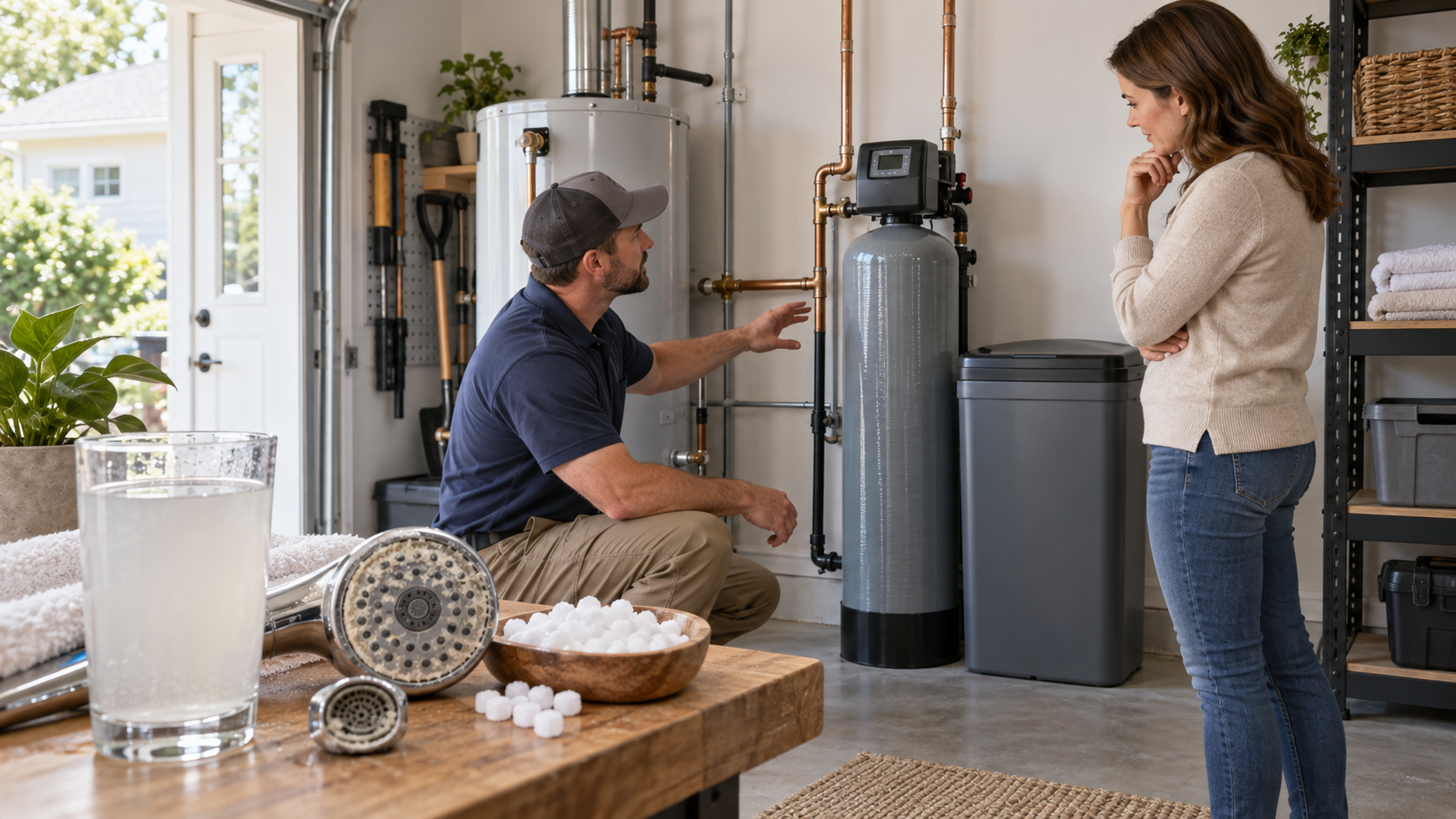
If you’re tired of cloudy glasses, crusty faucets, stiff towels, or that white film around the showerhead, a water softener probably sounds pretty appealing. Then comes the obvious question: how much is this actually going to cost?
For most U.S. homeowners, the total water softener cost lands somewhere around $1,200 to $3,800 for a professionally installed whole-house system. A fairly ordinary installation often comes in near $1,500 to $2,500. But there is a huge spread. A basic unit in a home that is already plumbed for a softener may cost well under $1,000, while a large dual-tank or whole-house treatment setup can climb to $5,000, $8,000, or more.
So yes, asking “How much does a water softener cost?” is a little like asking what a refrigerator costs. You can buy something basic that does the job, or you can keep adding capacity, controls, filtration, premium valves, and installation work until the invoice looks very different.
The trick is knowing what your home actually needs. Paying more does not automatically mean better water.
Water Softener Cost at a Glance
Here’s a practical starting point for a homeowner planning a project in 2026.
| Expense | Typical Cost |
|---|---|
| Basic water softener unit | $300-$1,000 |
| Standard whole-house ion exchange system | $500-$1,700 |
| Typical system with professional installation | $1,200-$3,800 |
| Dual-tank system | $1,000-$5,000+ |
| Salt-free conditioning system | $800-$4,000 |
| Professional installation labor | About $150-$1,000 for many standard jobs |
| Water softener salt | About $5-$10 per 40-lb. bag |
| Professional maintenance | Often $100-$300+ per year |
| Typical repair | About $150-$900 |
Those numbers are useful, but don’t treat them like a store price tag. Plumbing conditions, regional labor rates, water hardness, household size, system capacity, and extra filtration can move the final number quite a bit.
Why Does the Price Range Get So Wide?
Imagine two houses.
House A has two people, moderately hard municipal water, an existing softener loop, a floor drain nearby, and plenty of space beside the water heater. The installer basically swaps in a standard unit, programs it, checks the connections, and goes home.
House B has five people, very hard well water, iron staining, no existing plumbing loop, limited garage space, and a main water line that needs to be rerouted.
Those are not the same job. Not even close.
The biggest price factors usually include:
- Water hardness and water chemistry
- Household size and daily water use
- System capacity
- Single-tank versus dual-tank design
- Existing plumbing and drain access
- Local plumber or installer rates
- Electrical work, permits, or pipe changes
- Extra filtration for iron, sediment, chlorine, or other water issues
This is why a $700 softener on a hardware-store shelf can turn into a $1,500 or $2,000 project once everything is installed correctly.
How Water Hardness Changes the Cost
Before buying anything, test the water. Seriously. This is the part people tend to skip, and it is the part that tells you what system you actually need.
Hard water contains dissolved minerals, mainly calcium and magnesium. In the United States, hardness is usually reported as milligrams per liter of calcium carbonate or as grains per gallon, often shortened to GPG.
The U.S. Geological Survey generally classifies water this way:
| Hardness | mg/L as CaCO3 | Approximate GPG |
|---|---|---|
| Soft | 0-60 mg/L | 0-3.5 GPG |
| Moderately hard | 61-120 mg/L | About 3.6-7 GPG |
| Hard | 121-180 mg/L | About 7.1-10.5 GPG |
| Very hard | More than 180 mg/L | More than about 10.5 GPG |
If your water is only mildly hard, you may not need a huge system. If it is 15, 20, or even 30 GPG, the softener has a much heavier workload.
And that matters because harder water generally means you need more grain capacity, more frequent regeneration, or both. That can raise the purchase price and your ongoing salt and water costs.
What Does “Grain Capacity” Actually Mean?
You’ll see water softeners labeled 24,000 grain, 32,000 grain, 48,000 grain, 64,000 grain, and so on. At first glance, it looks like a bigger number must be better.
Not necessarily.
Capacity tells you how much hardness the resin can handle between regeneration cycles. Your household size, water use, and hardness all affect how much capacity you need.
A 32,000-grain unit might cost roughly $400 to $1,000 for the equipment alone. A 48,000-grain model may run around $600 to $1,200. Larger 64,000-grain systems often move into the $800 to $1,500 range, while very high-capacity residential models can go well beyond that.
Buying a unit that is too small can mean constant regeneration and higher salt use. Buying a monster system for a small two-person home is just spending money on capacity you may never need.
Correct sizing is the sweet spot.
Salt-Based Water Softener Cost
Traditional salt-based ion exchange systems remain the common choice for homeowners who want actual hardness minerals removed from the water.
A basic single-tank system typically costs around $500 to $1,700 before unusual installation work. Once professional labor, fittings, a bypass valve, drain connections, and possible plumbing modifications are added, many finished installations land somewhere between $1,200 and $3,800.
Ion exchange systems work by passing hard water through resin beads. Calcium and magnesium are captured and exchanged for sodium or potassium ions. Eventually the resin needs to be regenerated with brine.
That’s the reason you see a big plastic brine tank next to many softeners.
For actual hardness reduction, this remains one of the most straightforward residential solutions.
How Much Does a Dual-Tank Softener Cost?
A dual-tank softener normally costs more – often around $1,000 to $5,000, depending on capacity and equipment quality.
Why would anyone pay for two tanks?
Because while one resin tank is regenerating, the other can continue supplying softened water. That can be useful in larger households, properties with unusually high water demand, or homes where soft water needs to remain available around the clock.
For an average family that mainly showers, cooks, runs laundry, and uses a dishwasher on a normal schedule, a properly sized single-tank system may be perfectly adequate.
Dual tanks are useful. They’re just not automatically necessary.
What About Salt-Free Water Softeners?
Here’s where terminology gets a little messy.
Many products sold as “salt-free water softeners” are technically water conditioners. They do not remove calcium and magnesium in the same way an ion exchange softener does. Instead, many are designed to change how those minerals behave, with the goal of reducing scale formation.
Salt-free systems commonly cost about $800 to $4,000, depending on capacity, brand, media, and installation.
The appeal is obvious: no bags of salt, no brine tank, and usually less routine maintenance.
But if your main goal is truly soft water and your home has very hard water, make sure you understand what the system does before paying a premium for the words “salt-free.”
A conditioner and a traditional softener are not necessarily doing the same job.
Does Reverse Osmosis Replace a Water Softener?
Not really. They solve different problems.
A water softener is normally installed at the point where water enters the house and focuses on hardness minerals. Reverse osmosis is a filtration process that can remove a broad range of dissolved substances from drinking water.
A small under-sink RO system may make sense for drinking and cooking water. A whole-home reverse osmosis setup is another category entirely and can cost several thousand dollars – roughly $4,000 to $11,000 in some installations.
That does not mean everyone with hard water needs both.
In many homes, the setup is much simpler: a whole-house softener for hardness and, if desired, a small RO system at the kitchen sink for drinking water.
How Much Does Professional Installation Cost?
For a fairly straightforward water softener installation, labor may run around $150 to $1,000. The lower end usually means the plumbing is already prepared. The upper end often means the installer has more work to do.
You may pay extra if the job requires:
- Cutting and rerouting the main water line
- Adding a dedicated softener loop
- Installing a drain connection
- Moving pipes around a crowded mechanical room
- Adding an electrical outlet
- Installing a sediment or carbon prefilter
- Correcting old valves or leaking plumbing
- Obtaining permits where local rules require them
Location matters too. Plumbing labor in a high-cost metro area can be very different from labor in a smaller Midwestern town.
This is one reason online prices can be misleading. A unit may be advertised for $699, but that is not the same thing as a $699 finished project.
Can You Install a Water Softener Yourself?
If your house already has a softener loop and you are comfortable with plumbing, yes, some systems are realistic DIY projects.
You will need to shut off the water, connect the softener correctly, set up the drain line, check for leaks, program the control valve, and test the finished water.
That sounds manageable if you’ve done plumbing work before.
If the words “cut the main supply line” make you nervous, this may not be the project to learn on.
A bad connection can leak. An incorrectly sized drain line can cause problems. Poor programming can waste salt and water. Some manufacturers may also place conditions on warranty coverage when installation is not done according to their requirements.
DIY can save hundreds of dollars, but only when the plumbing itself is simple.
What Does a Water Softener Cost Per Year?
The purchase price gets most of the attention, yet the ongoing cost is what you’ll keep paying long after the installer leaves.
A conventional salt-based system needs salt, water during regeneration, a small amount of electricity for electronic controls, and occasional maintenance.
Salt often works out to roughly $50 to $150 per year for many households, although actual use depends heavily on water hardness, household consumption, and softener efficiency.
A 40-pound bag of standard water softener salt commonly costs around $5 to $10. Potassium chloride is far more expensive and can cost several times that amount.
Professional maintenance may add another $100 to $300 or more in a year when service is needed.
That does not mean you’ll write a $300 maintenance check every January. Some owners handle basic upkeep themselves and call a technician only when something seems wrong.
Salt Use: The Expense People Forget
It’s easy to focus on the tank and forget what goes into it.
How much salt a system consumes depends on how often it regenerates and how much salt is used per regeneration cycle. A modern demand-initiated softener can regenerate based on actual water use rather than blindly running every few days on a timer.
That matters.
A system that regenerates more often than necessary wastes salt and water. The EPA recommends demand-initiated regeneration for better efficiency and suggests looking for systems capable of removing at least 3,500 grains of hardness per pound of salt.
If two softeners cost about the same upfront, the more efficient model may be cheaper to own over the next decade.
Does a Water Softener Raise Your Water Bill?
A salt-based softener uses water during regeneration, so technically, yes.
How noticeable the increase is depends on the system and how often it regenerates. An efficient, properly sized unit should not regenerate every night for an average household.
If it does, something deserves a closer look. The settings may be wrong, the unit may be undersized, or household water use may be unusually high.
The EPA encourages homeowners to choose efficient demand-initiated systems and, when shopping for a replacement, look for models that use about four gallons of water or less per 1,000 grains of hardness removed.
That is the kind of spec worth comparing. It is not as exciting as a touchscreen control panel, but it may matter more on your utility bill.
What Does Water Softener Maintenance Cost?
Basic homeowner maintenance is not terribly complicated.
You need to check the salt level, watch for salt bridges, keep the brine tank in decent shape, and make sure the softener is regenerating normally. The EPA recommends annual servicing and cleaning the brine tank about once a year.
A technician may inspect the control valve, injector, resin condition, brine system, settings, and seals.
Professional annual service can commonly land around $100 to $300 or more, depending on the company and what is included.
If your softener is working normally and the manufacturer allows homeowner maintenance, your yearly cash cost may be mostly salt.
How Much Do Water Softener Repairs Cost?
Repairs often fall somewhere around $150 to $900. Major problems can cost more, especially if the resin, valve head, control system, or tank needs substantial work.
At some point, repair math stops making sense.
If you have a much older unit and receive a $700 repair quote, compare that with the price of a newer, more efficient softener. Spending a little more on replacement could get you new resin, a new control valve, a warranty, and lower salt use.
On the other hand, replacing a $25 seal does not justify throwing away an otherwise healthy system.
Get the diagnosis first.
How Long Does a Water Softener Last?
A conventional residential water softener can often serve a home for around 10 to 15 years, sometimes longer with good water conditions and proper maintenance.
That lifespan is not guaranteed. Chlorine exposure, iron, sediment, extremely hard water, poor maintenance, and very high water use can wear components faster.
Still, the upfront cost makes more sense when viewed over a decade rather than one afternoon.
A $2,000 installed system lasting 12 years works out to about $167 per year before salt, service, and utility costs.
That does not automatically make it a bargain. But it puts the purchase in perspective.
Do You Even Need a Water Softener?
Not every American home needs one.
If your water tests at 3 GPG and you have no scale problems, buying a large whole-house softener because a salesperson says everyone needs one would be hard to justify.
On the other hand, if your shower glass turns cloudy two days after cleaning, your faucet aerators crust over, and your water measures 18 GPG, the case becomes much stronger.
Common reasons homeowners consider a softener include:
- White scale on faucets and showerheads
- Mineral deposits inside kettles and coffee makers
- Soap that does not lather well
- Spots or haze on glassware
- Scale around water-using appliances
- Very hard water confirmed by a test
- Frequent cleaning caused by mineral residue
Hardness itself is generally more of a household nuisance than a drinking-water safety problem. The reason people soften water is usually comfort, cleaning, plumbing, scale control, and appliance protection.
Municipal Water vs. Well Water
If you have city water, start by checking your utility’s water-quality information. You may already have a hardness number available.
Well owners have a little more homework.
A private well may contain hardness minerals plus iron, manganese, sediment, sulfur-related odors, or other substances. A softener may handle some issues, but it is not a universal water-treatment machine.
If the water is orange, smells unusual, or leaves dark staining, test it before buying equipment.
Otherwise, you can end up with an expensive softener trying to fix a problem it was never meant to solve.
How Much Should a Family of Four Budget?
For a typical family of four with hard municipal water, budgeting around $1,500 to $3,000 for a good whole-house softener and professional installation is a reasonable starting point.
You could spend less if the plumbing is ready and your capacity needs are modest.
You could easily spend more if the water is extremely hard, the home needs plumbing modifications, or you add carbon filtration, iron treatment, reverse osmosis, or a dual-tank setup.
This is why getting a water test before quotes is so useful. It keeps the conversation grounded in numbers rather than sales talk.
Why One Quote Is $1,200 and Another Is $4,500
Do not compare quotes based only on the final number.
Look at what is actually included.
One quote might cover a basic 32,000-grain unit and installation. Another might include a larger high-efficiency valve, premium resin, a whole-house carbon filter, new plumbing, a bypass assembly, warranty service, and a more involved installation.
Ask each installer for the model number and capacity. Ask whether the equipment is certified to a recognized standard such as NSF/ANSI 44 where applicable. Ask about salt efficiency, regeneration type, warranty, labor, and maintenance.
You want apples compared with apples. Otherwise, the cheapest quote may simply contain less equipment.
Is Renting a Water Softener Cheaper?
Rental plans can run around $25 to $50 per month, sometimes more depending on the equipment and service package.
Renting lowers the upfront hit and may include repairs or maintenance. That can be attractive for renters, homeowners who expect to move, or people who simply do not want to deal with equipment service.
But do the long-term math.
At $40 per month, you pay $480 per year. Over five years, that is $2,400. Over 10 years, it is $4,800.
Buying often wins financially if you stay in the home for a long time and the system lasts. Renting buys convenience and shifts some repair risk to the provider.
How to Spend Less Without Buying Junk
The easiest way to overspend is buying the wrong system.
Test first. Size the unit correctly. Then compare at least a few written quotes.
A meter-controlled or demand-initiated system is usually more attractive than an old-style timer unit because it regenerates according to actual need. You also want easy access to replacement parts. A mysterious bargain brand is less exciting five years later if nobody can find a valve seal for it.
And be careful with packages that combine six forms of water treatment before anyone has tested your water.
You may need those extras. You may not.
Is a Water Softener Worth the Cost?
If your water is genuinely hard, it can be.
The most obvious benefit is less scale. Faucets, shower doors, fixtures, and water-heating equipment have less mineral buildup to deal with. Soap tends to work better in softened water, and many homeowners simply prefer the feel of it.
The financial return is harder to pin down because every household uses water differently. Do not expect a softener to magically pay for itself in six months.
Think of it as household infrastructure.
If hard water is constantly creating cleanup, scale, appliance problems, and frustration, then spending $1,500 or $2,500 on a system you use every day may feel completely reasonable.
If your water is only mildly hard and you barely notice it, the same purchase may not make sense.
FAQ
What is the average water softener cost in 2026?
A typical professionally installed residential system often costs around $1,200 to $3,800, while roughly $1,500 to $2,500 is common for many standard whole-house projects. Simple setups can cost less, while premium or complex systems can cost several thousand dollars more.
How much does a water softener cost for a family of four?
A family of four might reasonably budget about $1,500 to $3,000 for a standard installed system, but water hardness matters as much as household size. Very hard water may require a larger-capacity unit.
How much does water softener salt cost per year?
Many households spend roughly $50 to $150 per year on standard softener salt. Actual cost depends on hardness, water use, regeneration settings, system efficiency, and local salt prices.
Is a $5,000 water softener too expensive?
For a basic single-tank residential softener, $5,000 would be on the expensive side. But that price can be reasonable for a premium dual-tank setup, extensive plumbing work, very high capacity, or a package that includes additional filtration. Ask for an itemized quote.
Can I install a water softener myself?
Yes, particularly if your home already has a softener loop and you have solid plumbing experience. If the installation requires cutting or rerouting the main water line, adding drains, or changing electrical service, professional installation is usually the safer bet.
Are salt-free systems cheaper to own?
They can have lower routine maintenance because there is no brine tank to keep filled with salt. But many salt-free systems condition hardness minerals instead of removing them, so compare treatment performance as well as operating cost.
How do I know what size water softener I need?
Start with your water hardness and household water use. The harder the water and the more gallons your household uses, the more capacity you need between regeneration cycles. A water test and properly calculated capacity are much better guides than simply buying the biggest unit available.
Conclusion
The real water softener cost is not one number on a shelf tag.
For most homeowners in the United States, a professionally installed whole-house system will commonly fall somewhere around $1,200 to $3,800. A basic job can be cheaper. A large or complicated setup can push past $5,000 without much trouble.
Then there are ongoing costs: salt, a little extra water during regeneration, occasional service, and repairs over the life of the system.
But the biggest money-saving move happens before you buy anything.
Test your water.
If the water is only mildly hard, you may need less equipment than you thought. If it is very hard, spending more on the correct capacity can prevent years of inefficient regeneration and frustration.
After that, compare real specifications rather than sales pitches. Look at capacity, salt efficiency, regeneration controls, certification, warranty coverage, installation requirements, and the cost of future parts.
A water softener is one of those home purchases nobody really dreams about. It is not a new kitchen or a fancy patio. You install it in a garage, basement, utility room, or closet and mostly forget it exists.
And, oddly enough, that is the goal.
Once the white crust stops appearing on the faucet and the shower glass stays cleaner, you probably will not spend much time thinking about the softener at all. You’ll just notice the water.
Leave a Reply